tv review
Reviewing insightful and thought provoking science fiction TV and technology.
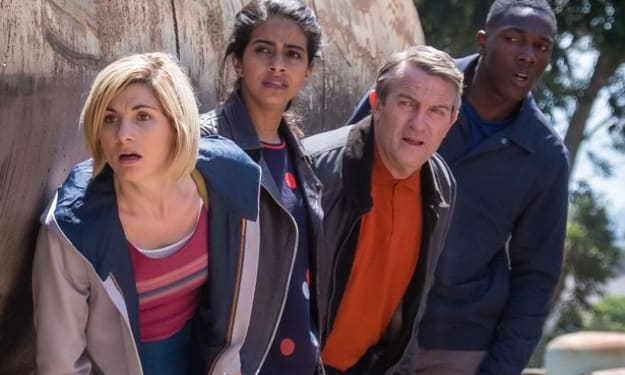
Review: 'Doctor Who' (11:7) "Kerblam!"
Funny, one this. On the one hand, it's a solid, highly enjoyable episode with a style and premise that would have slotted in quite happily at any point in the series in the last few years—in fact, as a few have pointed out, it's possible to imagine it as a Seventh Doctor story with minimal tweaking. On the other, it's as brazenly political as the year has been so far, but with a muddled message that eventually comes down on very much the wrong side of the debate.
By Daniel Tessier7 years ago in Futurism
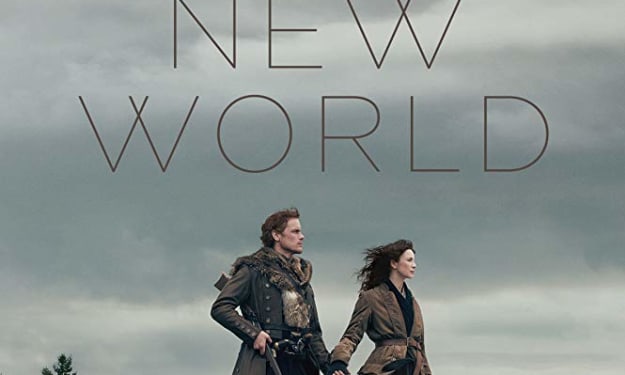
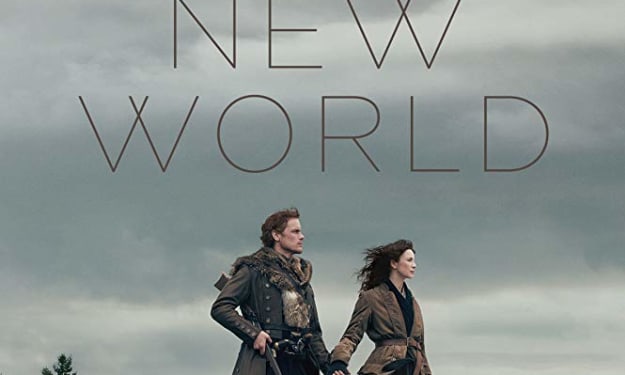
Review of 'Outlander' 4.2
Outlander 4.2 last night, another strong episode, continued the blending of opposites that is the essence of the series. This time it was Jamie's aunt's plantation in South Carolina. It's a beautiful, bucolic paradise on first glance. But on closer inspection, it thrives on the backs of hundreds of slaves. Jamie's aunt is kind -- meaning, she treats her slaves well. Claire with her future sensibilities is horrified. Jamie's not to happy either. And before the hour is over, we're treated to an in-depth, sensitive tour of the law and practice of slavery in pre-Revolutionary War America.
By Paul Levinson7 years ago in Futurism
Is the New 'Doctor Who' Political Correctness Gone Mad?
Some fans of the long-running British show thought that a female Doctor was more than they could handle (ignoring that the Doctor is an alien with two hearts who frequently regenerates). But showrunners Matt Strevens and Chris Chibnall may have taken it even further than that for the new season of Doctor Who.
By Megan Paul7 years ago in Futurism
Biology Behind 'Zoo'
In the CBS show Zoo, the animals have evolved and mutated, they now recognize the way we as humans have treated our planet and them and are fighting back against us with their newly mutated ‘superpowers.’ The CBS show revolves around the fact that the animals are now more adept to the way humans have ruled the food chain and currently have the want to group together and fight back. Bats have begun to swarm together and are now taking planes down during the day. Rats are now slaughtering cabin crew members that they once peacefully shared a boat with. While everyday house animals like cats and dogs are just grouping together and making use of what they have to fight back. There are a select few animals that seem to have these ‘superpower” like gifts. Sloths now have the ability to cause earthquakes, there are ants that can create an electric current large enough to blow up buildings, and five other creatures that have mutated into a super beasts that can cause large scale destruction. As evolution itself as one of the facts in today's world concepts in the show, there are a few false to today's world technologies that the show revolves around as well. Such as the mother cell which is what is causing the animals to behave so differently so suddenly, the triple helix which is the three strand DNA which is why there are super mutated animals, and ghost gene which causes the “superpower powers” in these super animals.
By Megan Granter7 years ago in Futurism
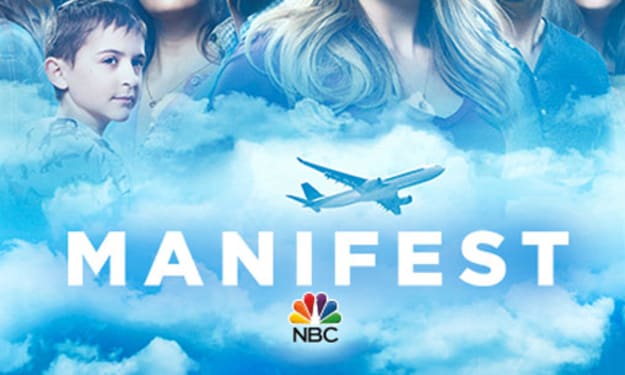
Review of 'Manifest' 1.5
Finally, a glimmer of progress in understanding what is going on in Manifest, in Monday's episode 1.5, just a glimmer. It comes from Cal, who becomes the first of the passengers on the flight that skipped ahead in time to not hear an instructive voice, but be the speaker of that voice. His father Ben is the one who hears it.
By Paul Levinson7 years ago in Futurism
Review of 'Manifest' 1.3
A fairly interesting Manifest 1.3 last night, centering around the murder of a passenger on the flight that skipped forward in time, Kelly. It turns out that her death was apparently just a run-of-the-mill murder—by a significant other who didn't like how Kelly was treating her after the return—but the end of the episode provided a more important payoff for the overall narrative. Or, rather, a question: why did the Feds take her body?
By Paul Levinson7 years ago in Futurism
Review of 'The Man in the High Castle' 3.7-10
The Man in the High Castle saved its crucial metaphysical reveal until nearly the last scene of the last episode, where Abendsen (the actual man in the high castle) explains to Smith that you can travel to an alternate reality only if you're no longer alive in that alternate world. This means Smith can bring back his son Thomas to his/our world (in which the Nazis and Japanese won the Second World War), Juliana can escape our reality to the one in which she saw herself killed (which she presumably does, also near the end), Tagomi wasn't alive in our off-screen reality which he visited in which we won the war (but great seeing him beat that Hitler youth, and fine performance throughout by Cary-Hiroyuki Tagawa), Joe can come back to our world (in which Juliana killed him)—though I hardly missed him in these last four episodes—and all kinds of similar possibilities.
By Paul Levinson7 years ago in Futurism
We Don't Get Aliens in Sheffield
Jodie Whittaker impressed everyone on Saturday Night. When it was first announced that Dr. Who would be getting a female doctor for the first time, people were split which is understandable. People don't like change very much and find it hard to adapt to, especially a big one such as gender. I think the BBC did incredibly well with the transition of Capaldi to Whittaker. I think many viewers have had their doubts put to rest.
By Chloe Gilholy7 years ago in Futurism
Review of 'The Man in the High Castle' 3.4-6
The Man in the High Castle episodes 3.4-6 contain the biggest stunner of the series. It's so unexpected, and handled so well, that I won't say what it is, on the slim chance that you're reading this and haven't yet seen these three episodes.
By Paul Levinson7 years ago in Futurism