
The Great Barrier Reef: As Large as Japan, Visible from Space, and Teeming with Life
There are natural wonders… and then there is the Great Barrier Reef.


Stretching across more than 1,400 miles (2,300 kilometers) along Australia’s northeastern coast, this vast underwater ecosystem covers roughly 133,000 square miles — an area comparable in size to Japan. It is so immense that astronauts can see it from space. And as a designated UNESCO World Heritage Site, it is officially recognized as one of the most important natural treasures on Earth.
But the reef’s true wonder isn’t just its size.
It’s the fact that it’s alive.
Beneath the turquoise waters of the Coral Sea lies a thriving, breathing ecosystem built by some of the smallest organisms on the planet — and it supports one of the richest concentrations of biodiversity anywhere in the world.
This is not just a beautiful destination.
It is a living masterpiece of nature — and one of the most important ecosystems on Earth.
________________________________________
The Largest Living Structure on the Planet
The Great Barrier Reef holds the title as the largest living structure on Earth. It consists of:
• More than 2,900 individual reef systems
• Around 900 islands
• Hundreds of coral cays and lagoons
From above, it appears as swirling patterns of electric blues and greens, a mosaic of coral formations shimmering beneath the surface.
Yet what makes this structure even more astonishing is how it was built.
The reef is formed by billions of tiny coral polyps — soft-bodied organisms no larger than a grain of rice. Over millions of years, these microscopic architects have constructed limestone skeletons that accumulate into massive reef systems.
Tiny creatures. Monumental impact.
It’s one of nature’s greatest paradoxes.
________________________________________
A Biodiversity Hotspot: Thousands of Species in One Ecosystem
The Great Barrier Reef is often described as an underwater rainforest — and for good reason. It is one of the most biologically diverse marine environments on Earth.
Scientists estimate the reef supports:
• Over 1,500 species of fish
• More than 400 types of hard coral
• Approximately 4,000 species of mollusks
• 30+ species of whales and dolphins
• Six of the world’s seven species of marine turtles
• Hundreds of seabird species
Colorful clownfish dart through anemones. Reef sharks patrol coral walls. Giant clams glow in iridescent blues and greens. Sea turtles glide silently through warm currents.
Every square meter pulses with life.
This biodiversity is not random — it’s interdependent. Herbivorous fish keep algae from smothering coral. Predators regulate populations. Coral structures provide shelter, breeding grounds, and protection.
The reef functions like a complex underwater city — each species playing a role in maintaining balance.
________________________________________
Why the Great Barrier Reef Matters Globally
The importance of the Great Barrier Reef goes far beyond its beauty.
1. Coastal Protection
The reef acts as a natural barrier, absorbing wave energy from storms and reducing coastal erosion. Without it, Australia’s northeastern coastline would be far more vulnerable to extreme weather.
2. Economic Value
The reef generates billions of dollars annually through tourism, fishing, and related industries. Millions of visitors travel each year to snorkel, dive, and explore this marine wonder.
3. Indigenous Heritage
For tens of thousands of years, Indigenous Australian communities have maintained deep cultural and spiritual connections to the reef. Their knowledge systems and traditions reflect sustainable coexistence with this ecosystem.
4. Scientific Research
The reef serves as a global research hub for marine biology, climate science, and conservation innovation.
It’s not just a scenic attraction.
It’s infrastructure — ecological, economic, and cultural.
________________________________________
A UNESCO World Heritage Treasure
The Great Barrier Reef’s designation as a UNESCO World Heritage Site recognizes its “outstanding universal value.”
This status means the reef is considered irreplaceable — not just for Australia, but for humanity.
World Heritage recognition brings international attention, conservation commitments, and global responsibility.
It reminds us that some places are too important to lose.
________________________________________
Climate Change and Coral Bleaching: A Growing Threat
Despite its immense size, the Great Barrier Reef is fragile.
Rising ocean temperatures — driven by climate change — have caused repeated mass coral bleaching events in recent decades.
When water becomes too warm, corals expel the symbiotic algae that provide them with nutrients and color. The result?
They turn white.
If temperatures remain high, the coral can die.
Multiple large-scale bleaching events have impacted significant portions of the reef, alarming scientists worldwide.
Other threats include:
• Agricultural runoff
• Plastic pollution
• Overfishing
• Coastal development
• Ocean acidification
Size does not equal invincibility.
Even something visible from space can be vulnerable.
________________________________________
Signs of Hope: Conservation and Innovation
The story of the Great Barrier Reef is not only one of decline.
It is also one of resilience.
Conservation efforts include:
• Expanding marine protected areas
• Regulating fishing practices
• Reducing agricultural runoff
• Developing coral restoration techniques
• Breeding heat-resistant coral species
Scientists are experimenting with innovative solutions such as coral gardening, assisted gene flow, and reef monitoring using advanced satellite and drone technology.
Recovery is possible — especially when global awareness translates into action.
________________________________________
What Individuals Can Do
Protecting the Great Barrier Reef doesn’t require living in Australia.
Global actions matter.
• Reduce carbon emissions
• Support renewable energy
• Limit plastic use
• Choose sustainable seafood
• Support eco-conscious tourism
• Advocate for environmental policies
Small decisions, multiplied by millions of people, shape planetary outcomes.
The reef’s future depends on collective responsibility.
________________________________________
A Living Wonder — Not a Static Monument
Unlike mountains or stone monuments, the Great Barrier Reef is alive.
It grows.
It evolves.
It responds to environmental change.
Every coral head records decades of ocean history. Every species tells a story of adaptation.
To see it from space emphasizes its scale.
To see it underwater reveals its soul.
It’s not just a formation.
It’s a living archive of Earth’s creativity.
________________________________________
A Wonder and a Warning
The Great Barrier Reef represents two powerful truths:
1. The planet can create breathtaking, intricate systems of life.
2. Those systems can be disrupted by human behavior.
Its beauty inspires awe.
Its vulnerability demands action.
Protecting this reef is not simply about preserving a travel destination. It’s about safeguarding biodiversity, stabilizing ecosystems, and respecting one of the most complex natural systems on Earth.
________________________________________
Final Thoughts: A Blue Miracle Worth Protecting
The Great Barrier Reef — as vast as a nation, visible from orbit, and home to thousands of species — stands as one of Earth’s most extraordinary achievements.
It reminds us that even the smallest organisms can build something monumental.
It reminds us that ecosystems are delicate networks, not infinite resources.
And most importantly, it reminds us that conservation is not optional — it is essential.
The reef still glows beneath the Coral Sea.
The question is whether future generations will inherit a thriving underwater world…
Or only photographs of what once was.
About the Creator
Adil Ali Khan
I’m a passionate writer who loves exploring trending news topics, sharing insights, and keeping readers updated on what’s happening around the world.
Keep reading
More stories from Adil Ali Khan and writers in Futurism and other communities.
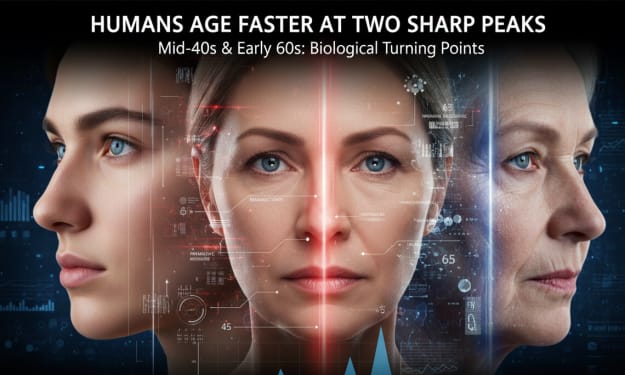
Humans Age Faster at Two Sharp Peaks, Study Reveals — A Major Breakthrough in Understanding the Aging Process
For generations, we’ve believed that aging is a slow, steady process — a gradual accumulation of wrinkles, gray hairs, and subtle changes over decades. But new scientific research is challenging that long-held assumption. According to a groundbreaking study, human aging does not happen at a constant pace. Instead, it accelerates dramatically at two specific stages of life.
By Adil Ali Khanabout 19 hours ago in Futurism
What Happens To Your Brain When You Stop Multitasking
Digital technology is the culprit that is causing us to doom scroll when tired, disengaged and unmotivated with the content that motivated you to log onto your device to consume in the first place. That is only the beginning. In the modern workplace (and even when filing cabinets were around, I confirmed this with my adopted parents to get my facts right); reading files while you are supposed to be present to the caller on the other end of the phone line is another classic example of multitasking that causes your brain (although adaptable and intelligent) to lose focus and concentration.
By Justine Crowley2 days ago in Psyche


Comments
There are no comments for this story
Be the first to respond and start the conversation.