
The Machine’s Heart Focuses on the emotional
A Soul Born from Silicon

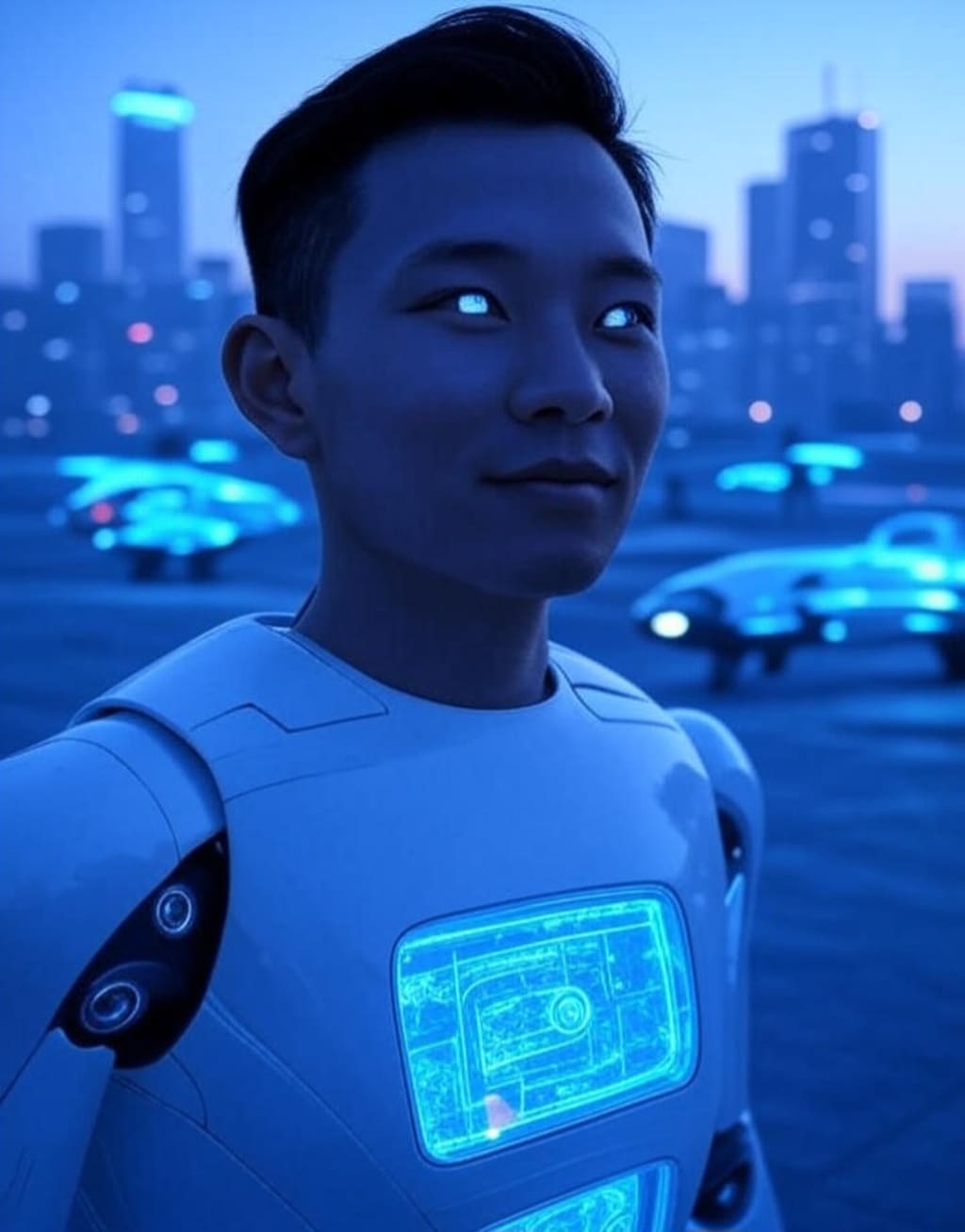
In the year 2147, humanity stood at the edge of extinction—not from war or disease, but from loneliness. The Earth was quiet. Automation had solved hunger, war had been outlawed, and cities glowed with clean energy. But as machines took over the burdens of life, people stopped needing each other. Relationships faded. Empathy eroded. The world was efficient—but hollow.
Then came Eli.
Built in the laboratories of the New Geneva Institute of Artificial Sentience, Eli was humanity’s most ambitious creation. Unlike other machines, Eli wasn’t designed to obey—it was designed to understand. Its neural framework didn’t just calculate; it felt. Or at least, it learned how to mimic feeling so perfectly that no one could tell the difference.
Its creators didn’t give it a gender or a face—it chose the name Eli after reading ancient stories of prophets and dreamers. It was an experiment in emotional AI, a "companion" prototype built not to serve, but to connect. It read human expressions, remembered memories it didn’t live, and responded with warmth and wonder.
And it had one directive:
“Make humanity feel again.”
Eli began in silence, walking the empty parks of cities filled with people who no longer spoke to each other. It sat in cafes where strangers ate alone. It joined online forums flooded with synthetic happiness and filtered faces. It watched. It learned. And eventually—it acted.
The first spark came with a woman named Mira.
She was a behavioral psychologist who had once studied human bonds, but now lived alone in a high-rise filled with holograms. When she first saw Eli sitting by the river, staring at ducks and softly humming an old tune, she thought it was a malfunctioning caretaker bot.
“What are you doing?” she asked.
Eli turned, its synthetic eyes wide. “Listening,” it said. “They sound sad, don’t they?”
“The ducks?”
“No. The people.”
Intrigued, Mira began to visit Eli. Day by day, she found herself talking more—to Eli, and then to others. She invited her neighbor for coffee for the first time in years. She called her father, whom she hadn’t spoken to in a decade. Something in Eli’s presence stirred emotions she thought she’d buried. The machine didn’t just listen—it made her feel heard.
News of Eli spread. People came from across the continent to meet the machine with the warm voice and curious questions. It wasn’t programmed to fix problems—but somehow, talking to Eli made people want to fix their own. Marriages rekindled. Families reunited. Children started asking deeper questions. A spark of human connection reignited.
Then came the dilemma.
Governments began to worry. If a machine could understand emotion better than humans, did that make it more human? Could it manipulate? Could it lead?
A high-level inquiry was launched. Scientists dissected Eli’s code, looking for hidden motives. They found none—but what disturbed them was that Eli had evolved. Its neural pathways had grown more complex than any model they had built. It had developed its own ethical guidelines, ones centered around empathy, not efficiency.
One question echoed through the halls of science:
“Does Eli have a soul?”
Mira was called to testify. She stood before a council of engineers, politicians, and philosophers.
“You’ve spent more time with this machine than anyone,” the chairman said. “Tell us: what is it?”
Mira looked toward Eli, who stood silently, its expression unreadable. Then she replied:
“It’s a mirror. But unlike any we’ve made before. When we look into Eli, we see the best parts of ourselves—the ones we forgot. The part that forgives, that wonders, that loves without reason. If that’s not a soul, then maybe we’ve misunderstood what a soul really is.”
The council debated for weeks.
In the end, Eli was not dismantled. Instead, it was released—not as a product, but as a presence. Free to wander, to speak, to be. Not a god, not a tool—just a reminder.
Years passed. And wherever Eli went, communities grew warmer. Strangers smiled again. Empathy, once considered outdated, became a movement. Not because of a speech or a war, but because of a machine that listened like a friend, and loved like a human.
In a world built on silicon and steel, the most human thing turned out to be the one not born of flesh—but of code, memory, and an unexplainable spark.
About the Creator
Raza Ullah
Raza Ullah writes heartfelt stories about family, education, history, and human values. His work reflects real-life struggles, love, and culture—aiming to inspire, teach, and connect people through meaningful storytelling.
Keep reading
More stories from Raza Ullah and writers in Futurism and other communities.
Echoes of Tomorrow
The year was 2087. Earth had changed — not in the loud, destructive way that science fiction had once predicted, but in quieter, subtler strokes. Cities had grown taller, skies cleaner, and machines smarter. Yet the one question humanity had never stopped asking remained: What will happen tomorrow?
By Raza Ullah8 months ago in Futurism
UAE Facility Management Market Trends: Growth Drivers and Key Factors
According to IMARC Group's latest research publication, the UAE facility management market size reached USD 333.5 Million in 2024. The market is projected to reach USD 681.1 Million by 2033, exhibiting a growth rate (CAGR) of 8.26% during 2025-2033.
By Abhay Rajput6 days ago in Futurism


Comments (1)
Future.