
Why Fake AI Videos of UK “Urban Decline” Are Flooding Social Media
Deepfakes Portraying Croydon as a Crime-Ridden Dystopia Are Racking Up Millions of Views


What Happened
A wave of AI-generated videos falsely portraying parts of the UK — especially Croydon in south London — as dystopian hubs of crime and social decay is spreading rapidly across TikTok, Instagram Reels and other platforms.
One viral clip shows a crowd of mostly Black young men wearing balaclavas sliding down a grimy water slide into litter-filled water. The caption claims the scene depicts a “taxpayer-funded water park in Croydon.”
The video is entirely AI-generated.
The creator, who goes by the online alias “RadialB,” told reporters he is in his 20s, from north-west England, and has never visited Croydon. He says the content is meant to be absurd and funny — but also believable enough to stop users from scrolling.
The videos are part of a growing trend sometimes described as “decline porn”: online content portraying Western cities such as London, Manchester, New York or San Francisco as collapsing under crime, immigration and disorder.
Copycat accounts have amplified the format, generating millions of views. Some videos include small labels identifying them as AI-generated, but many viewers appear to take them at face value.
What Is Analysis
1. The Mechanics of “Decline Porn”
The format is simple:
Hyperrealistic AI visuals
Familiar stereotypes (hoodies, balaclavas, tower blocks)
Claims of taxpayer waste or social breakdown
Minimal context
The creator admits the realism is deliberate: if viewers instantly know it is fake, engagement drops. Generative AI tools now make it easy to create convincing scenes with little effort.
The result is content that sits in an ambiguous space — partly satire, partly misinformation — optimized for algorithmic amplification.
2. Racial Archetypes and Digital Stereotyping
Many of the videos feature “roadmen” — a slang term associated with urban youth culture in the UK, often racialized and linked in public discourse to criminality.
Although the creator denies targeting a specific ethnicity, the visual cues — Black men in balaclavas, exaggerated depictions of grime and chaos — echo long-standing stereotypes.
Online critics from Croydon have accused the trend of portraying the area as a “ghetto” and reinforcing harmful narratives.
AI tools, trained on internet imagery and cultural tropes, can amplify these archetypes at scale, reproducing bias without overtly stating political intent.
3. Engagement Over Accuracy
The creator openly acknowledges that outrage fuels views. Older viewers often respond angrily in comment sections, sometimes interpreting the videos as genuine evidence of decline.
Several accounts outside the UK — including in Israel, Brazil and parts of the Middle East — have reshared the videos to boost engagement or monetize traffic.
This demonstrates how AI-generated local misinformation can rapidly globalize.
The economic incentive structure is clear:
Sensational content = higher engagement
Higher engagement = algorithmic promotion
Algorithmic promotion = monetization opportunities
Truth becomes secondary to virality.
4. From Satire to Political Narrative
Even if intended as absurdist humor, these videos feed into broader political narratives about immigration and national decline.
High-profile figures such as Elon Musk have publicly discussed themes of cultural erosion and migration-related instability in the UK.
While legitimate debates about crime and immigration exist, fabricated visuals distort perception by presenting invented scenes as evidence.
Research suggests perception gaps are widening. For example, polls show many Britons believe London is unsafe, while most London residents report feeling safe in their local areas.
AI-generated visuals can reinforce fears detached from empirical reality.
5. The New “Online Faker”
Unlike traditional misinformation campaigns tied to coordinated political groups, this case reflects a newer model:
Individual creators experimenting with AI
Prioritizing engagement over responsibility
Disavowing political motives
Benefiting from algorithmic amplification
The stigma around posting fabricated visuals appears to be weakening, especially when labeled loosely as “synthetic media.”
The barrier to entry is now extremely low. As the creator notes, advances in generative AI have made it easy for anyone to produce convincing fake scenes.
The Bigger Picture
This trend highlights three intersecting dynamics:
Technological acceleration – AI video tools now produce realistic urban scenes with minimal effort.
Algorithmic incentives – Platforms reward emotional, divisive content.
Narrative polarization – Existing anxieties about immigration and decline create fertile ground for fabricated imagery.
The danger is not merely that individuals are misled — but that repeated exposure to synthetic “evidence” shifts collective perception.
AI-generated decline porn blurs satire, propaganda and entertainment.
As generative video tools improve, distinguishing parody from manipulation will become harder. Platform labeling policies exist, but small disclosures may not counteract the persuasive power of visual realism.
The deeper issue is cultural: when attention becomes currency, distortion becomes strategy.
Whether this remains a fringe meme format or evolves into a more organized form of narrative manipulation may depend less on technology — and more on how platforms, regulators and audiences respond to it.
About the Creator
Keep reading
More stories from Behind the Tech and writers in Futurism and other communities.
Calcium Carbonate Market: High-Performance Fillers, Cost Efficiency & Industry Growth
According to IMARC Group's latest research publication, the global calcium carbonate market size reached 9.8 Million Tons in 2024. Looking forward, IMARC Group expects the market to reach 15.6 Million Tons by 2033, exhibiting a growth rate (CAGR) of 4.8% during 2025–2033.
By sujeet. imarcgroup5 days ago in Futurism
Kitchen Appliances Market Analysis: Consumer Convenience, Digital Retail & Industry Forecast to 2034
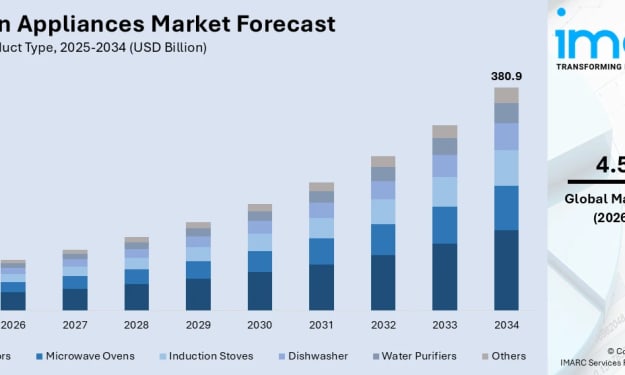
Rising urbanization, growing disposable incomes, and shifting consumer lifestyles are fueling strong demand for kitchen appliances worldwide, supported by rapid e-commerce expansion, smart home integration, and a steady cultural shift toward home cooking. According to IMARC Group's latest data, the global kitchen appliances market size was valued at USD 254.7 Billion. Looking forward, IMARC Group estimates the market to reach USD 380.9 Billion, exhibiting a CAGR of 4.58% during 2026-2034.
By Andrew Sullivan4 days ago in Futurism



Comments
There are no comments for this story
Be the first to respond and start the conversation.