
World Without Jobs
AI and its fast evolution

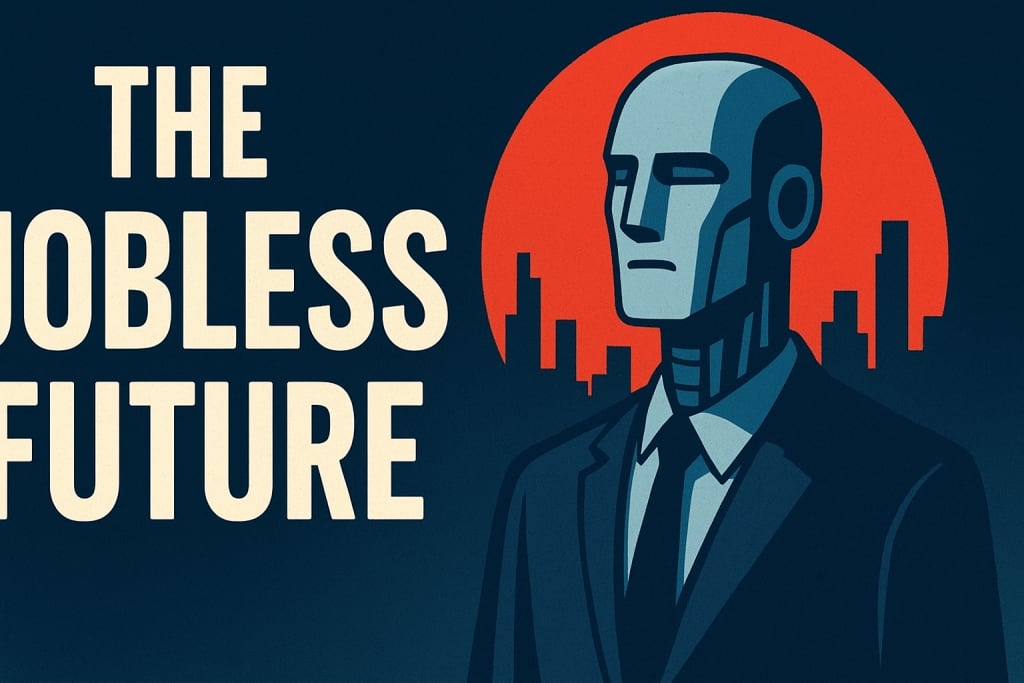
For decades we have imagined a future where technology makes life easier, people work less, and machines do the boring tasks for us. But what if the future takes a darker turn? What if the machines we built to help us end up replacing us completely? Artificial Intelligence is no longer a distant idea from sci-fi movies. It is here, rapidly evolving, and silently eating the global job market. The world stands at the edge of the most dramatic economic transformation ever seen: a future without jobs.
Artificial intelligence has already taken over small tasks—translation, customer support, driving assistance, accounting automation, and even legal research. But these changes are only the beginning. The real storm is coming within the next decade, when AI becomes capable of performing complex, creative, and high-skill tasks better, faster, and cheaper than humans. When that happens, unemployment will not be just an economic issue—it will become a global crisis that affects identity, purpose, and the structure of society itself.
To understand this future, we must first look at how quickly AI is accelerating. In 2020, AI could barely summarize text or recognize simple patterns. By 2025, AI models started writing books, generating code, diagnosing diseases, and even managing small businesses. The speed of this growth is exponential. Every new model learns from billions of data points, improving at a rate no human can compete with. For the first time in history, we are facing a type of intelligence that improves itself, learns from itself, and does not get tired, emotional, or distracted. Once companies see that AI can work 24 hours a day without salary, insurance, or vacation, the logic becomes simple: replace humans.
The first industries to fall will be predictable ones—manufacturing, transportation, customer service, and data entry. Self-driving trucks alone could eliminate millions of jobs across the U.S., Europe, and Asia. Fast-food automation is already replacing counter workers, cashiers, and even kitchen staff. One smart robot can do the work of five employees. And because robots do not need salaries, the profit motive pushes companies toward automation with no hesitation. This is not a theory; it is happening right now. Factories in China and Japan have already replaced entire human departments with AI-powered machines, increasing productivity and reducing labor costs by more than 40%.
But the dangerous part is that the second wave of AI replacement will hit skilled professions—lawyers, doctors, teachers, programmers, bankers, journalists, and even artists. AI tools can generate art in seconds, write better essays than students, and produce high-quality films or animations without a full production crew. Programmers, once considered irreplaceable, are already witnessing AI writing and debugging complex code faster than humans. When AI becomes the better worker in every field, humans will have very few roles left.
This creates a massive question: what happens to billions of unemployed people? The world economy is built on the assumption that people work, earn money, and spend money. Without jobs, demand collapses, businesses fail, and governments face extreme pressure. Unemployment is not just an economic problem—it becomes a social and political time bomb. Crime rates rise, mental-health issues increase, and political instability becomes unavoidable.
Some believe Universal Basic Income (UBI) will solve the issue. Governments would tax technology companies and pay citizens a basic amount of money each month so they can survive without working. It sounds hopeful, but it comes with philosophical and moral questions. What happens to human purpose when people have nothing to do? People often define themselves by their work. A world where billions are unemployed might create a crisis not only of economy, but also of identity. What does it mean to be human in a world where machines outperform us at everything?
Another perspective argues that AI will create new jobs just like past technological revolutions. When cars replaced horses, new industries emerged. When computers appeared, millions of new jobs were born. But AI is fundamentally different. Cars and computers still needed human involvement. AI does not. AI replaces the human decision-maker, thinker, and creator. It does not need supervision, and it improves without human input. This is why many economists call AI the “final economic revolution”—the one that removes human labor entirely.
There is also the geopolitical dimension. Countries that master AI will dominate the global economy, while countries that fail to adapt will fall behind. A world where a handful of nations control the world's automation systems could lead to extreme inequality between states. Wealth will concentrate in the hands of those who own the technology, while workers across the world lose bargaining power. This imbalance could reshape international relations in ways we cannot fully predict.
Despite the dangers, the future is not necessarily hopeless. AI can bring extraordinary benefits—curing diseases, reducing poverty, enhancing education, and extending human lifespan. But the transition must be managed carefully. Governments, companies, and societies must prepare for the jobless future now, not when it is too late. Education systems must shift from memorization to creativity, leadership, and human-to-human skills—the few elements AI cannot perfectly imitate yet. People must learn how to work with AI instead of competing against it.
But one truth is clear: the world is entering an age where the old rules no longer apply. The job market as we know it is dying. A world without jobs is not science fiction anymore. It is the next chapter of human civilization. Whether that chapter becomes a story of progress or a story of collapse depends entirely on the choices we make today.
About the Creator
Keramatullah Wardak
I write practical, science-backed content on health, productivity, and self-improvement. Passionate about helping you eat smarter, think clearer, and live better—one article at a time.
Keep reading
More stories from Keramatullah Wardak and writers in Futurism and other communities.
No Blindness Anymore; They Can See
Imagine a world where a person who has never seen light, shape, or color suddenly begins to perceive the world around them—not through their eyes, but directly through their brain. Thanks to Elon Musk’s Neuralink, that world is no longer just a dream. With a revolutionary technology called Blindsight, Neuralink promises to restore vision in individuals who are completely blind—even those born without functioning eyes or optic nerves. This is not science fiction anymore. This is happening now.
By Keramatullah Wardak6 months ago in Futurism
Automotive 48V System Market Outlook: Electrification Trends and Growth Opportunities
Rising focus on fuel efficiency, emission reduction, and vehicle electrification is driving growth in the automotive 48V system market. Automakers adopt 48V architectures to support mild hybrid functions, start-stop systems, and electric boosting at lower cost than full hybrids. According to IMARC Group's latest research publication, The global automotive 48V system market size reached USD 8.5 Billion in 2024. Looking forward, IMARC Group expects the market to reach USD 43.8 Billion by 2033, exhibiting a growth rate (CAGR) of 18.96% during 2025-2033.
By Michael Richardabout 16 hours ago in Futurism
Egypt Telecom Market Trends & Insights: Investment Opportunities & Forecast
According to IMARC Group's latest research publication, Egypt telecom market size reached USD 3.9 Billion in 2025. The market is projected to reach USD 5.5 Billion by 2034, exhibiting a growth rate (CAGR) of 3.85% during 2026-2034.
By Abhay Rajputa day ago in Futurism


Comments
There are no comments for this story
Be the first to respond and start the conversation.