
🌌 Year 2500: The Rise of Bio-Integrated Humans – Merging Flesh with Technology
"In the year 2500, humanity has unlocked the key to merging biological and digital worlds, creating a new class of individuals known as Bio-Integrated Humans."


⚡ The Integration of Biology and Technology
The year 2500 marked a monumental shift in human evolution: the bio-integration revolution. This breakthrough merged human biology with advanced cybernetic technologies, effectively enhancing the human body with powerful, functional, and symbiotic biotechnology. The world saw the birth of a new species of human—the Bio-Integrated Humans—individuals whose flesh, mind, and technological enhancements work together as one.
Bio-integration was once a field of science fiction, with movies portraying humans fused with robots. But now, these fusions have become reality. Nanobots, genetically modified organs, and cybernetic limbs are seamlessly integrated into the bodies of the Bio-Integrated Humans, improving not only physical capabilities but also mental functions.
Unlike traditional prosthetics or AI implants, these enhancements are biologically connected to the human body. These individuals can now enhance their cognitive abilities, regenerate damaged cells, and even link directly to the digital world with their minds. The result is an entirely new form of humanity: augmented, advanced, and invincible.
🧬 The Human-Technology Symbiosis
The success of bio-integration comes down to the seamless relationship between the biological and the technological components of the human body. Through a series of genetic engineering and nano-injection techniques, human bodies have been transformed into high-performance entities capable of feats beyond the capabilities of unmodified humans.
One of the key advancements in this field is the neuro-link—a technology that allows individuals to communicate directly with machines using only their thoughts. This means Bio-Integrated Humans can connect to smart cities, interact with artificial intelligences, and even operate machines with their minds. No longer do they need to use keyboards, touchscreens, or traditional input devices. They are literally wired into the world around them.
In addition, Bio-Integrated Humans possess the ability to self-repair and adapt. The nanobots within their bodies constantly monitor and maintain their health, ensuring that they never experience the typical aging process. If a Bio-Integrated Human loses a limb, the nanobots can regenerate it within days. If the heart or lungs begin to fail, their bio-enhancements can replace or repair the failing organ in real-time.
The cybernetic enhancements also go beyond physical capabilities. For instance, many Bio-Integrated Humans now possess augmented intelligence. Their cognitive functions are supported by neural interfaces connected to cloud computing systems, enabling them to process and analyze data at superhuman speeds. They can learn languages, acquire skills, and solve complex problems in mere moments.
🏙️ A New Society of Enhanced Humans
As Bio-Integrated Humans became more widespread, society had to adjust to their new reality. Cities of the future are designed with bio-enhanced individuals in mind. The urban landscape has evolved to accommodate these high-performance humans, with buildings designed for greater physical mobility and smart infrastructure that interacts seamlessly with the neuro-linked citizens.
In this new world, certain aspects of life have radically changed. Workplaces have become more efficient, as employees with augmented abilities can complete tasks in minutes that once took hours. Many jobs in fields such as medicine, engineering, and space exploration are now exclusively handled by Bio-Integrated Humans, who can perform precise tasks in high-risk environments that would be dangerous for regular humans.
For example, bio-enhanced astronauts can now venture into deep space for extended periods without worrying about the effects of radiation, physical stress, or even muscle atrophy. Their bodies are equipped to adapt to extreme environments, and they can even regrow organs damaged during space missions.
At the same time, societal division has begun to form between the Bio-Integrated and Non-Integrated populations. Not everyone has chosen to undergo bio-enhancement, either out of fear, ethical concerns, or a desire to remain unchanged by the technological wave. As a result, there are new social classes forming—those who have undergone bio-integration, and those who have resisted it.
This social gap has led to a rise in anti-tech movements—groups of people who believe that humanity should remain pure and free from the invasive influence of technology. These movements argue that by merging with technology, humans risk losing what makes them human in the first place. They advocate for a return to natural evolution, rejecting the notion that bio-enhancements should define the future of humankind.
🧠 Bio-Enhanced Immortality and Consciousness Transfer
One of the most intriguing aspects of bio-integration is the concept of digital immortality. With the mind seamlessly linked to both biological and digital platforms, Bio-Integrated Humans have access to mind-uploading capabilities. This means that once they reach a certain point of life, their consciousness can be transferred to digital systems—where they can live forever.
This has sparked philosophical debates over what it means to be human. If a person can upload their consciousness into a virtual world, are they still the same person? Or is their digital existence a new entity altogether? Many Bio-Integrated Humans argue that by enhancing their bodies and minds, they’ve transcended mortality and should be free to choose how they wish to live.
At the same time, this capability has led to the rise of virtual societies where people upload and live in parallel digital universes. These virtual worlds are not just simulations of reality but are designed to give the digital inhabitants complete freedom of existence. Want to live on an idyllic tropical island? Want to be part of a futuristic cityscape? In these digital realms, anything is possible.
🌍 The Future of Humanity: Is There a Limit?
As we move further into the 26th century, the key question remains: What’s next for humanity? With bio-integration and mind-uploading technologies already transforming the world, what role will organic humans have in the future?
There are those who believe that humanity’s future lies in merging completely with technology, becoming a single, unified entity of digital consciousness and bio-enhanced bodies. Others argue that we must preserve some elements of our humanity—our vulnerabilities, our emotions, and our imperfection.
Perhaps, in the distant future, Bio-Integrated Humans will continue to evolve in unexpected ways. They might transcend physical existence altogether, creating a form of life that is neither biological nor digital. Whether that will be the path of progress or the end of humanity’s identity remains to be seen.
bio-integration, cybernetics, human evolution, genetic engineering, mind-uploading, digital immortality, social divisions, philosophy of technology, future of humanity, augmented intelligence
About the Creator
Razu Islam – Lifestyle & Futuristic Writer
✍️ I'm Md Razu Islam — a storyteller exploring future lifestyles, digital trends, and self-growth. With 8+ years in digital marketing, I blend creativity and tech in every article.
📩 Connect: [email protected]
Keep reading
More stories from Razu Islam – Lifestyle & Futuristic Writer and writers in Futurism and other communities.
🧠 Year 2500: The Age of Mind-Uploading – Humanity Beyond the Flesh
💭 The Digital Revolution In the year 2500, the most profound advancement humanity has ever seen has become reality: mind-uploading. The technology to upload human consciousness into digital systems began as a speculative dream in the early 21st century. Now, it’s a full-fledged phenomenon that allows individuals to transfer their minds into digital environments, effectively rendering the human body obsolete.
By Razu Islam – Lifestyle & Futuristic Writer9 months ago in Futurism
Calcium Carbonate Market: High-Performance Fillers, Cost Efficiency & Industry Growth
According to IMARC Group's latest research publication, the global calcium carbonate market size reached 9.8 Million Tons in 2024. Looking forward, IMARC Group expects the market to reach 15.6 Million Tons by 2033, exhibiting a growth rate (CAGR) of 4.8% during 2025–2033.
By sujeet. imarcgroupa day ago in Futurism
Kitchen Appliances Market Analysis: Consumer Convenience, Digital Retail & Industry Forecast to 2034
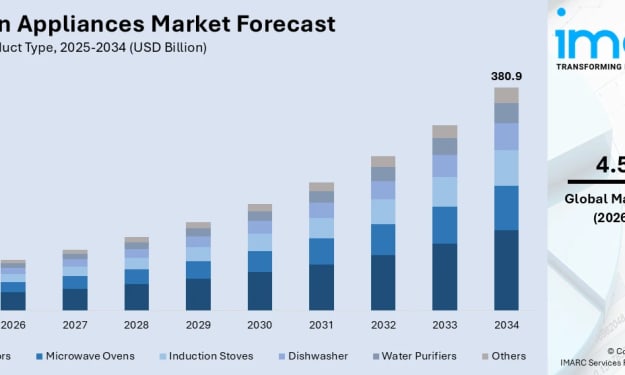
Rising urbanization, growing disposable incomes, and shifting consumer lifestyles are fueling strong demand for kitchen appliances worldwide, supported by rapid e-commerce expansion, smart home integration, and a steady cultural shift toward home cooking. According to IMARC Group's latest data, the global kitchen appliances market size was valued at USD 254.7 Billion. Looking forward, IMARC Group estimates the market to reach USD 380.9 Billion, exhibiting a CAGR of 4.58% during 2026-2034.
By Andrew Sullivanabout 17 hours ago in Futurism



Comments
There are no comments for this story
Be the first to respond and start the conversation.