
10 Largest Things in Nature That Will Make You Feel Incredibly Small
From colossal caves to the biggest living organism on Earth, here’s a humbling journey through nature’s true giants, and yes, I’m publishing this today because you need to see this now.

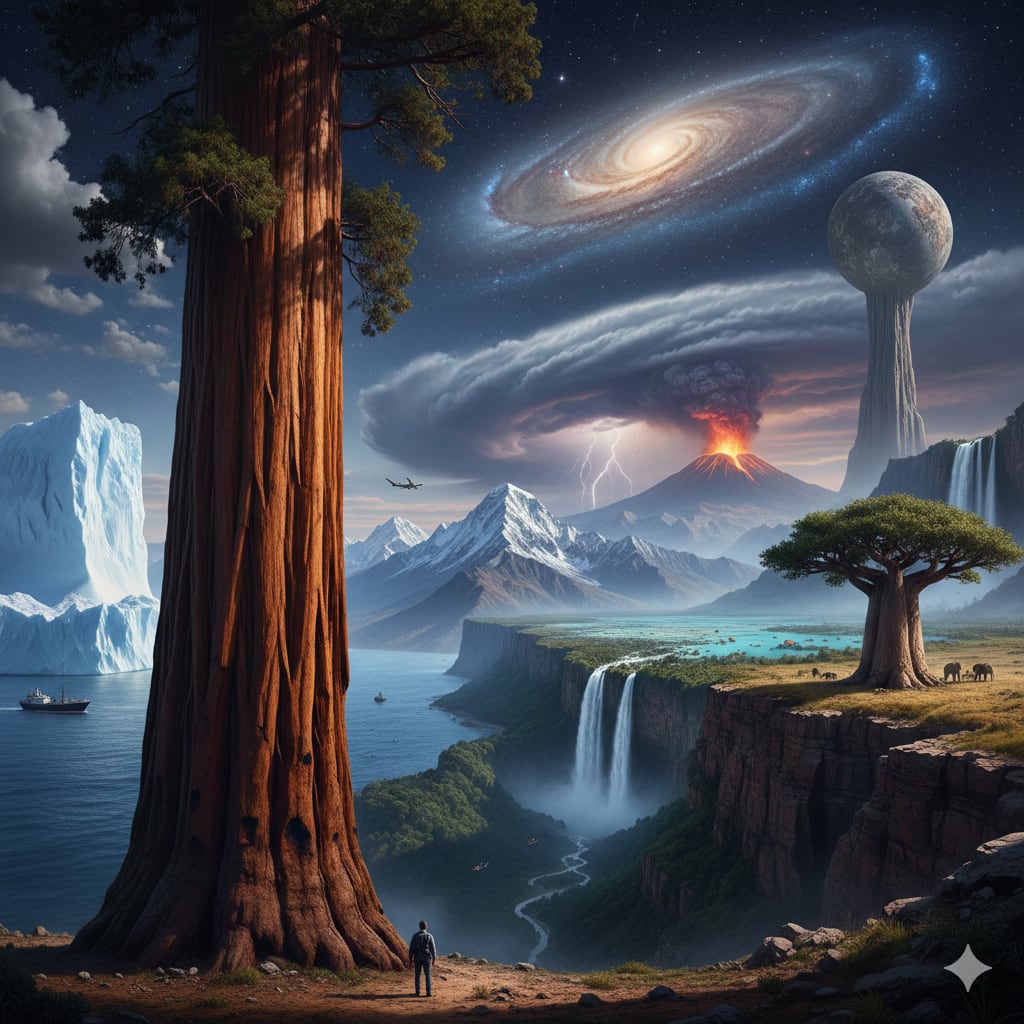
Astronauts who return from space often talk about the “overview effect,” that overwhelming realization that Earth, and all of us on it, are just microscopic specks in the vast universe. But here’s the thing: we don’t even have to leave our planet to feel that humbling perspective.
Stand at the edge of the Grand Canyon. Dive into the depths of the Great Barrier Reef. Look up at a towering elephant. Nature constantly reminds us that we are small, beautifully, wonderfully small.
Today, we’re counting down 10 of the largest things found in nature. Prepare to be amazed.
10. Inga Falls: The World’s Most Powerful Waterfall
When you think of massive waterfalls, you probably picture Niagara Falls or Victoria Falls.
But the real champion of volume is Inga Falls.
It doesn’t have the tallest drop (only about 21 meters), and it’s not the widest. But here’s the jaw-dropping part:
- Niagara moves roughly 85,000 cubic feet of water per second.
- Victoria moves about 38,000 cubic feet per second.
- Inga Falls? Over 900,000 cubic feet per second
That’s more than 10 times Niagara’s flow. Sometimes, size isn’t about height; it’s about sheer power.
9. Sequoia Trees: The Largest Trees by Volume
If you’ve ever stood next to a sequoia, you know the feeling: pure insignificance.
The giants of the Redwood National and State Parks can reach:
- 160-275 feet tall
- 20-26 feet in diameter
- Up to 3,500 years old
Sequoias aren’t just tall; they are the largest living things on Earth by volume. And here’s a fun fact: “Sequoia” contains all five vowels in order. Nature and linguistics win.
8. The Trembling Giant: The Heaviest Living Organism
Deep inside Fishlake National Forest lives something extraordinary.
Meet Pando, also known as the Trembling Giant, a single clonal colony of quaking aspen trees connected by one massive root system.
- Around 47,000 stems
- Weighs approximately 6,600 tons
- Estimated age: up to 80,000 years
That makes it both one of the heaviest and oldest living organisms on Earth. And it looks like… a normal forest.
7. Son Doong Cave: The Largest Cave Ever Discovered
Hidden in Vietnam lies the breathtaking Son Doong Cave.
Discovered in 1991, this cave stretches about 5 kilometers long, with ceilings soaring up to 300 meters high.
It contains:
- Natural skylights
- A subterranean river
- Entire jungle ecosystems inside
It’s so massive that a Boeing 747 could theoretically fit inside its main chamber. Let that sink in.
6. Salar de Uyuni: The World’s Largest Salt Flat
Located in Bolivia, Salar de Uyuni covers more than 10,000 square kilometers.
At 3,600 meters above sea level, this surreal landscape:
- Holds one of the largest lithium reserves in the world
- Hosts massive populations of pink flamingos
- Turns into the world’s largest natural mirror during the rainy season
It looks like another planet. But it’s Earth just showing off.
5. Saltwater Crocodile: The Largest Living Reptile
The Saltwater Crocodile is pure prehistoric energy.
- Can grow over 22 feet long
- Weigh up to 4,400 pounds.
- Known to overpower sharks
It’s the largest terrestrial and riparian predator alive today. And yes, they are extremely territorial. Admire from a distance.
4. African Bush Elephant: The Largest Land Animal
The African Bush Elephant is the undisputed heavyweight champion of land.
- Up to 13 feet tall
- Around 11 tons
- 22-month gestation (longest of any mammal)
These gentle giants consume about 350 pounds of vegetation daily. Sadly, they remain threatened due to poaching, a reminder that even the biggest creatures can be vulnerable.
3. Blue Whale: The Largest Animal Ever
Nothing, and I mean nothing, beats the Blue Whale.
- Up to 100 feet long
- Weighs around 200 tons
- Heart the size of a car
- Tongue as heavy as an elephant
Their calls can travel up to 1,000 miles underwater. Imagine hearing something that massive across an entire ocean.
They are living proof that Earth once and still does produce absolute giants.
2. Rafflesia: The Largest Flower on Earth
The infamous Rafflesia arnoldii, often called the Corpse Flower, produces the largest single bloom in the world.
- Up to 3 feet wide
- Weighs around 15 pounds
- Smells like rotting flesh
That horrifying smell? It attracts flies for pollination. Disgusting. Genius. Effective.
1. Honey Fungus: The Largest Organism on the Planet
And now for the true heavyweight champion.
In Malheur National Forest lives a single organism of Armillaria solidipes.
It spans about 3.7 square miles.
Let me repeat that: one organism.
Estimated to be between 2,400 and possibly 8,650 years old, this underground network of fungal threads silently spreads beneath the forest floor, killing trees and expanding its territory.
Above ground, you’ll only see clusters of harmless-looking honey-colored mushrooms.
Below ground? A biological empire.
Why We’re So Fascinated by Gigantic Natural Wonders
Size forces perspective.
Whether it’s the overwhelming power of Inga Falls, the silent dominance of a blue whale, or an 80,000-year-old forest pretending to be “just trees,” these natural giants remind us of something important:
We are small, but we are lucky to witness greatness.
And maybe that’s the real magic.
.
.
.
.
.
.
.
.
.
.
Largest things in nature, Biggest natural wonders in the world, Largest organism on Earth, World’s biggest cave, Largest animal ever, Giant natural phenomena
About the Creator
Areeba Umair
Writing stories that blend fiction and history, exploring the past with a touch of imagination.
Keep reading
More stories from Areeba Umair and writers in FYI and other communities.
Inside Pam Bondi’s Epstein Hearing: What Really Happened and Why It Matters
When a US attorney general calls a congresswoman a “washed-up loser” on live TV… you know it’s not going to be a chill hearing. Honestly, this whole thing felt less like government and more like a very tense family reunion where everyone finally reads the group chat receipts.
By Anie the Candid Mom Abroad5 days ago in FYI




Comments
There are no comments for this story
Be the first to respond and start the conversation.