Historical
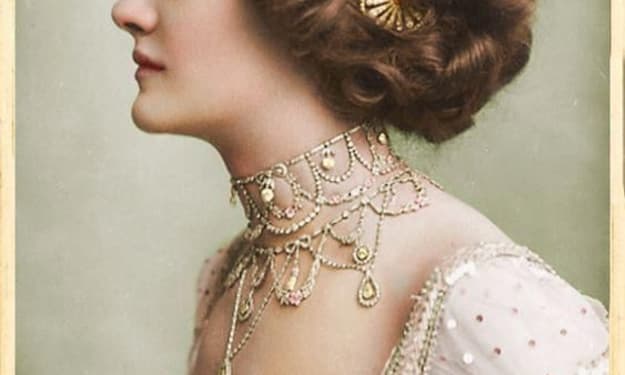
Tiny but Mighty: The Choker. Top Story - October 2021.
I grew up in the 90’s and early 2000’s. I scrunched my hair and straightened my bangs. I accessorized with bouncy butterfly clips, white eyeshadow, and flavored lip-gloss. I wore scrunchies on my wrist. I wrapped flannel shirts around my waist and danced in frayed wide leg jeans to Brittney. I begged my mom to let me bedazzle my bellybutton with stick-on rhinestones like Christina. (Looking back, thank God she said no.) It was grungy, it was tacky, and it was wonderful. As the fads of the 90’s and early 2000’s come trickling back into present day trends, the nostalgia washes over me and wraps me into the warm hug of childhood memories. As I happily embrace the comeback of bellbottoms and flannel, there has been one thing that just gets me giddy: the choker. Easily my favorite item from the time, wearing a choker always made me feel like the coolest kid in the room. They made me feel pretty, and there was something about them that felt so mature, like wearing one made me older and edgier than I was. As an adult, wearing a choker evokes the same kind of confidence; I feel sexy, spunky, and there’s something about them that now feels so sophisticated. It’s such a tiny accessory, and yet it stirs up so much emotion and so quickly bumps my self-esteem up a few notches. Looking back through the choker’s history, it turns out that I am not the only one that the piece has this type of effect on. It’s been a look for thousands of years and has held power in many ways over the centuries.
By Chelsea Adler4 years ago in FYI
The 4 Best Books About American History
"History is the biography of the present," wrote Alexis de Tocqueville. The History Of the United States Of America may be unwieldy in size; but then its enormousness is testimony to the plethora of incidents and characters that shaped the American story.
By Borba de Souza4 years ago in FYI
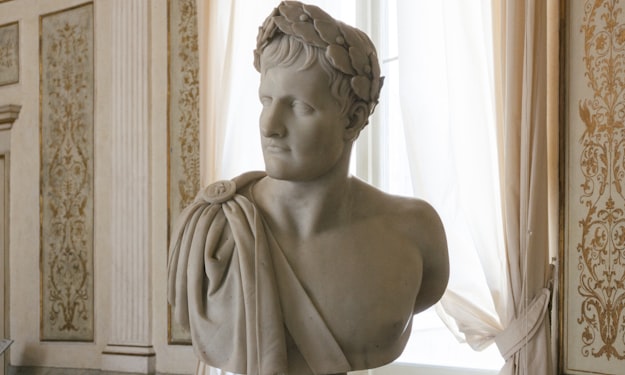
The 4 Best Books About Napoleon
Napoleon Bonaparte, one of the greatest military geniuses in history and a charismatic leader, rose from humble origins to become Emperor of France. He established the Napoleonic Code, which is still the basis of French law today. His campaigns reshaped Europe and sent shockwaves through the rest of the world. Even two centuries after his death, historians and biographers continue to publish books about Napoleon.
By Borba de Souza4 years ago in FYI
Agenda 21 - an overview
Agenda 21, the United Nations Sustainable Development Plan signed by the leaders of 178 countries in 196 countries in 1992, is not legally binding and has no authority to act. In the hands of a dedicated group of right-wing activists, however, it was portrayed as a key step in a secret plan to undermine property rights, redistribute wealth, and force the United States and other countries to become a one-world dictatorship.
By Shreya Poudel4 years ago in FYI
Deciphering a 250-Year-Old Mysterious Cipher
In the fall of 1998, Dr. Christiane Schaefer, professor at the department of linguistics and philology, was moving from Germany to Uppsala University. During her farewell, one of her colleagues gave her an old green-colored book as a parting gift.
By Kamna Kirti4 years ago in FYI
Do you even know why we celebrate Columbus Day?
The biggest mass lynching in U.S. history was committed against Italian immigrants in New Orleans in retaliation for the murder of an Irish police chief. That’s probably not what comes to mind when you think “lynching,” but it’s a fact. Although the vast majority of lynching victims in American history were black, a small but not-insignificant percentage were not. The glittering surface of America’s “Gilded Age” — roughly 1880 to 1910 — served as cover for the dark underbelly of the era: rising white nationalism, explosive growth of the Ku Klux Klan, racial pseudoscience (genteely described as “eugenics”), and mob terror — certainly against African-Americans, but also anyone deemed not quite white. It was also a time of extreme wealth inequality — the Tech Titans of the era were called “Robber Barons” for a reason. Industrial fat cats and their political allies knew that the best way to keep voters from noticing the real source of their problems was to find a scapegoat — preferably one with dark skin and a foreign language and religion. On the West Coast, Chinese immigrants would have to suffice. Everywhere else, bronze-skinned immigrants, mostly from Italy, made the perfect whipping boys.
By Ashley Herzog4 years ago in FYI
Out with the old and in with the new?
I woke up today from a text from my oldest stating: 'Happy Indigenous People's Day.' So I had to jump on google calendars and look to see what I had missed. Nope- the google calendar still states- Federal Holiday- Columbus Day. However, all the major museums, government buildings, and the Smithsonian are posting articles on Indigenous Peoples Day.
By Rose Loren Geer-Robbins4 years ago in FYI
First Olympiad in Greece
The curtain fell on April 3 at the Panathenaic Stadium in Athens' first Olympic Games, where the winners were awarded and presented with medals and diplomas by King George I at first Olympic Games in Athens. While the international media welcomed the revival of the Games, Greek newspapers commented on the ignorance of the organizers and their decision not to take the games to the stadium.
By Cs Sapkota4 years ago in FYI
Source Analysis
From its inception, Christendom’s relationship with Rome was at best ambivalent. Throughout the 1st century, Emperor Nero was viewed with distrust, with the Diocletianic Persecutions throughout the early 4th century substantiating such dubiety. Whilst Constantine’s issuance of the Edict of Milan (c.a. 313.A.D.) saw Christianity’s distrust of Rome recede, the relationship between Rome and Christian apocalypticism was inconsistent. Apart from the persistent anxiety that Nero would return as Antichrist, Roman emperor’s rarely featured in late antique eschatology. Negative discourse surrounding the Roman emperor abruptly changed in the late seventh century due to the work known as The Apocalypse of Pseudo-Methodius. Whilst certain mainstream aspects of Christian apocalyptic tradition are coherent throughout Pseudo-Methodius, such as the Son of Perdition and the Enclosed Nations narrative, the fascinating Last Roman Emperor is of particular significance to eschatological scholars. Pseudo-Methodius’s’ Last Roman Emperor promoted the quintessential Christian monarch, elevating kingship to a godly position intrinsically tethered to Christ’s second coming. Whilst the significance of the Last Roman Emperor cannot be disputed, Witakowski’s view that Pseudo-Methodius’s invented such a concept is fallacious. In the upcoming paper, I am going to argue that Pseudo-Methodius’s’ Last World Emperor was not a unique concept, rather an amalgamation of Jewish Messianism, Biblical scripture and Syriac literature. I will explain how the author used Jewish Messianism for the basic structure of his Last World Emperor, substantiating the concept through allegorically interpreting biblical scripture and localising it within the Syriac socio-political environment.
By T.P Schofield4 years ago in FYI