Historical
Philip the Arab: Emperor of Rome
Philip the Arab is so named because his family came from Syria. However, this background does not appear to have affected his behavior in office to any extent – there was nothing noticeably “un-Roman” in how he treated the role of Emperor.
By John Welford5 years ago in FYI
History and Memory
Individual and collective memories of historic events are unreliable. Because memories are influenced by internal and external forces, the recollection of events can be rendered incomplete or incorrect by factors such as time, sentiment, circumstance, and even basic human ego.
By Mack Devlin5 years ago in FYI
The World That Came After
Wars are transformative events, but because of the nature of warfare prior to the twentieth century, their consequences were generally localized. The thirty-two years war, for instance, involved many combatants, but Eastern and Central Europe experienced the bulk of the consequences. World War II, on the other hand, was a massive global conflict, a war of such magnitude that the consequences carried worldwide significance and would vastly alter the course of human history.
By Mack Devlin5 years ago in FYI
From the Cave to the Page
Language has been a major part of our social evolution, completely altering the course of human life. We have evolved from a series of grunts and gesticulations to a deeply articulated language. What is even more impressive is that we have taken our myriad vocalizations and learned to transfer them to the page. Writing has come a long way, from the cave wall to the Facebook wall. The evolution of writing is a complex narrative of slow progression: from rudimentary figures drawn on stone with blood and chalk, to lines etched in clay, to complex pictographs carved into temple walls, to fully formed words and sentences being combined into volumes of text, to the complex world-building of binary code.
By Mack Devlin5 years ago in FYI
Old School
Decades ago I came across In The Morning Of My Life, an account of the life, times etcetera of the recently deceased singer entertainer Tom Netherton. What brought this to mind was the part of this fairly thin celebrity autobiography that dealt with Mr. Netherton's time spent in the armed forces before making a career for himself as an entertainer. His description of what it was like to rise to the level of Drill Instructor interested me. Mostly what seemed to ring true was that at the end of the day as a DI he would collapse in exhaustion from expending so much energy outdoing his pupils in every way all day long. Somehow I find this relatable. Of course there was nothing that I recall about Mr. Lou Gossett's Officer And A Gentleman DI struggling in this way.
By P. B. Friedman5 years ago in FYI
What the Black Plague Can Teach Us About the Current Pandemic
In the later Middle Ages, the Black Plague swept across Europe, decimating approximately one-third of its population, although that figure is contested. The mysterious illness was spread by the usual vermin, rats and fleas, and moved amongst the human continent with no regard for rank, or wealth. Death it seemed, was the great equalizer, and morbidity abounded.
By Katie Alafdal5 years ago in FYI
The sinking of the Lusitania, 1915
The sinking of RMS Lusitania on 7th May 1915 – the victim of a torpedo fired from a German U-boat - has long been regarded as a major war crime and a prime cause of the United States entering World War I. However, there are questions that are still unanswered.
By John Welford5 years ago in FYI
The Starry Painting by Vincent Van Gogh
Today Vincent van Gogh is regarded as one of the most famous 19th-century artists, and his 1889 Starry Night painting is not only one of his most famous works, but also one of the world's most famous paintings. This oil painting by Dutch artist Vincent Van Gogh, painted in June 1889, depicts the view of the sun from the east window of his asylum in Saint-Remy-de-Provence with the addition of an unimaginable city. Starry Night is an unseen world painting from 1889 with a clear night sky and a small mountain town and is one of the most famous works by Dutch artist Vincent Van Gogh.
By Tsunami Karki5 years ago in FYI
Julius Caesar Life biography
Caesar was conceived Gaius Julius in 100 BC and was chosen diplomat for Rome in 59 BC after shaping a casual union with two of Pompey's adversaries: Marcus Licinius Crassus. As a component of the development, Caesar rose to conspicuousness by joining the positions of the well-off Crassuss and the renowned General Pompey to be quick to vanquish power with Caesar as an envoy. From that point, Caesar set up a coalition with Gnaeus Pompey Magnus, another incredible military and political pioneer.
By Shreya Poudel5 years ago in FYI
Nicolaus Copernicus Life biography
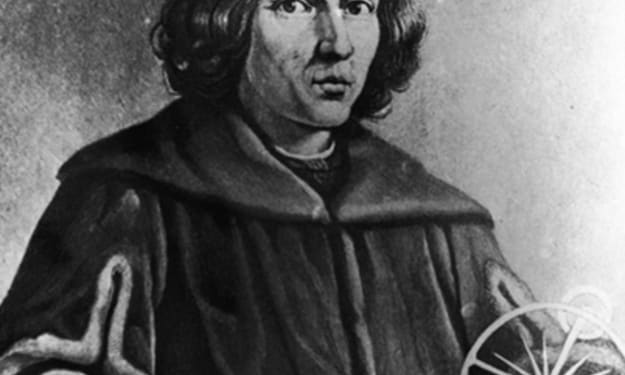
Copernicus examined human sciences while learning at the College of Krakow, including cosmology and stargazing, and was shipped off to Italy to contemplate medication and law with many Clean individuals of his social class. In 1491 he went to the Cracow Institute of Jagiellonian College and in 1496 got back to Italy to contemplate law.
By Diya Kumari5 years ago in FYI