
Unseen Symphony: Radio Waves and Cosmic Interference
Exploring the Intricacies of Signals, Spectrum, and Skies
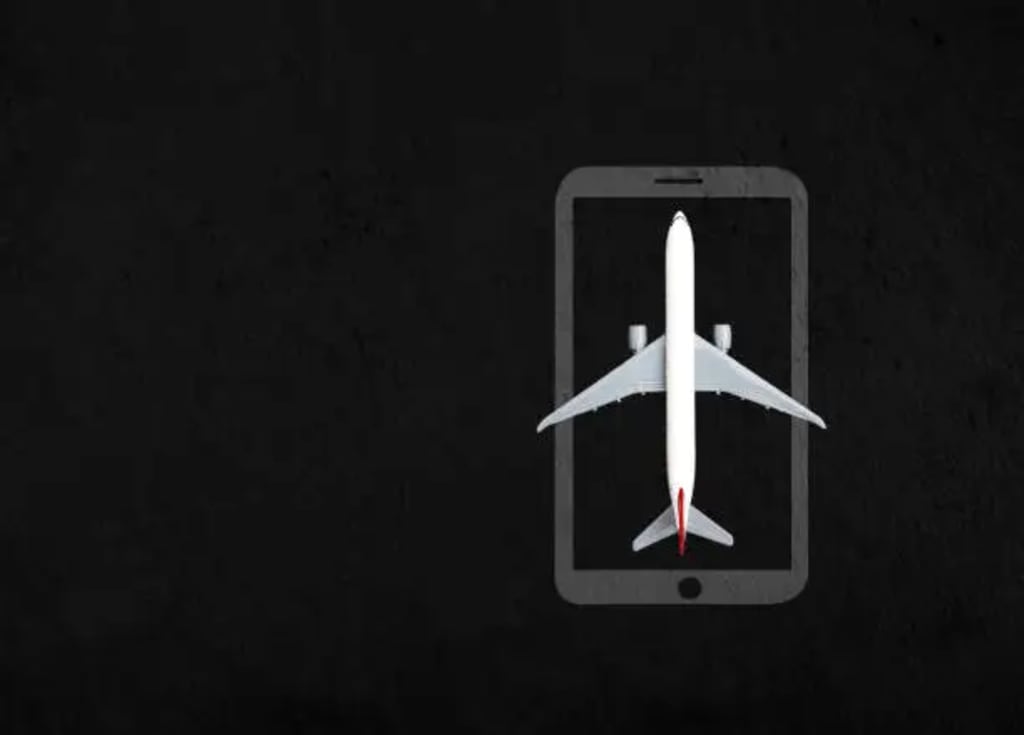
In the unseen expanse that surrounds us, a symphony of invisible signals permeates the air. Beyond the grasp of our eyes, these intangible currents of communication traverse the spectrum, with colossal radio waves serving as conduits between computers, GPS systems, and cell phones, among other devices. It's intriguing to consider that the strength of your phone's signal is so formidable that, if our eyes possessed the ability to perceive radio waves, its presence could be detected from the distant realm of Jupiter. Regrettably, the atmosphere is now awash with the cacophony of interference emanating from routers, satellites, and inconsiderate airborne travelers who neglect to activate airplane mode.
Contrary to a common misconception, the airplane mode isn't solely safeguarding the voyage itself; it's primarily a measure to shield the communications environment of fellow passengers. Phones establish connections by emitting electromagnetic waves, specifically radio waves, situated within a certain segment of the electromagnetic spectrum. Envision a scenario where your eyes can discern various wavelengths as distinct hues. When initiating a call, your phone generates a radio wave that is dispatched to the closest cell tower. In situations of limited connectivity, your phone expends greater battery power to project a stronger signal, a higher amplitude, in its endeavor to establish contact. This signal then journeys from cell tower to cell tower, ultimately reaching your intended recipient.
Considering the surfeit of simultaneous signals, cell towers assign unique wavelengths to each participating phone. This distinct "color" ensures that you don't inadvertently intercept others' conversations. Importantly, this wavelength diverges slightly from the one used to receive incoming information, thereby averting interference. Yet, the palette of available "colors" is finite. The proliferation of Wi-Fi and escalating demand for these wavelengths have intensified the contest for their ownership. With the atmosphere saturated with signals and a limited spectrum to allocate, the challenge of evading interference has become increasingly complex. Particularly during regional crises, when call volumes surge, the confluence of signals taxes cell towers, making interference a more acute issue.
While some sources of interference may be beyond our control, others can be managed. Take the example of phones aboard airplanes. These devices, situated far from terrestrial cell towers, intensify their signaling efforts to establish connections. The paradox emerges when the rapid movement of the aircraft brings it into closer proximity with a cell tower than expected. Consequently, a powerful signal is unleashed, capable of overpowering nearby signals. Thus, flying without activating airplane mode inadvertently assumes the role of a radio jammer, emitting robust radio waves that disrupt neighboring signals.
The reverberations of interference aren't confined to the skies; they pervade our daily lives. Nearly all our electronic gadgets emit stray radio waves, introducing lags in internet speed and causing call disruptions. This, in turn, leads consumers to subscribe to wider bandwidths, prompting service providers to assert greater control over the radio spectrum and potentially launching more satellites into orbit. This ominous cycle could, over time, obscure the night sky and sever our connection with the stars. The issue even extends its reach into the realm of astronomy. Radio telescopes, which peer into the cosmos, rely on specific wavelength bands to delve into the depths of space.
However, the safeguarding of these bands remains porous, as seen in the example of the Very Large Array, which might encounter interference from 5G network traffic, hindering its efforts to explore signals below 5 GHz. Today, the entirety of Earth resonates with radio waves, propagated by satellites crisscrossing the globe. Yet, there exist a few pockets of comparative tranquility, where radio telescopes can gaze unobstructed into space. Within these realms, the enigma of the Milky Way's central black hole and the secrets of galaxies situated billions of light-years away can be unveiled—provided our quest isn't impaired by signals from airborne phones.
About the Creator
Keep reading
More stories from stephen kinyanjui and writers in FYI and other communities.
Chickens: A Journey from Reverence to Dinner Plates
The annals of Ancient Egyptian king Thutmose III described a marvelous foreign bird that “gives birth daily.” Zoroastrians viewed them as spirits whose cries told of the cosmic struggle between darkness and light. Romans brought them on their military campaigns to foretell the success of future battles. And today, this bird still occupies an important, though much less honorable position – on our dinner plates.
By stephen kinyanjui3 years ago in History
10 Dangerous Ways North Koreans Escape the World’s Most Secretive Nation
North Korea has long carried the reputation of being the world’s ultimate “hermit kingdom.” It’s a country sealed off by ideology, military force, and fear where borders are not just lines on a map, but life-or-death barriers.
By Areeba Umaira day ago in FYI




Comments
There are no comments for this story
Be the first to respond and start the conversation.