
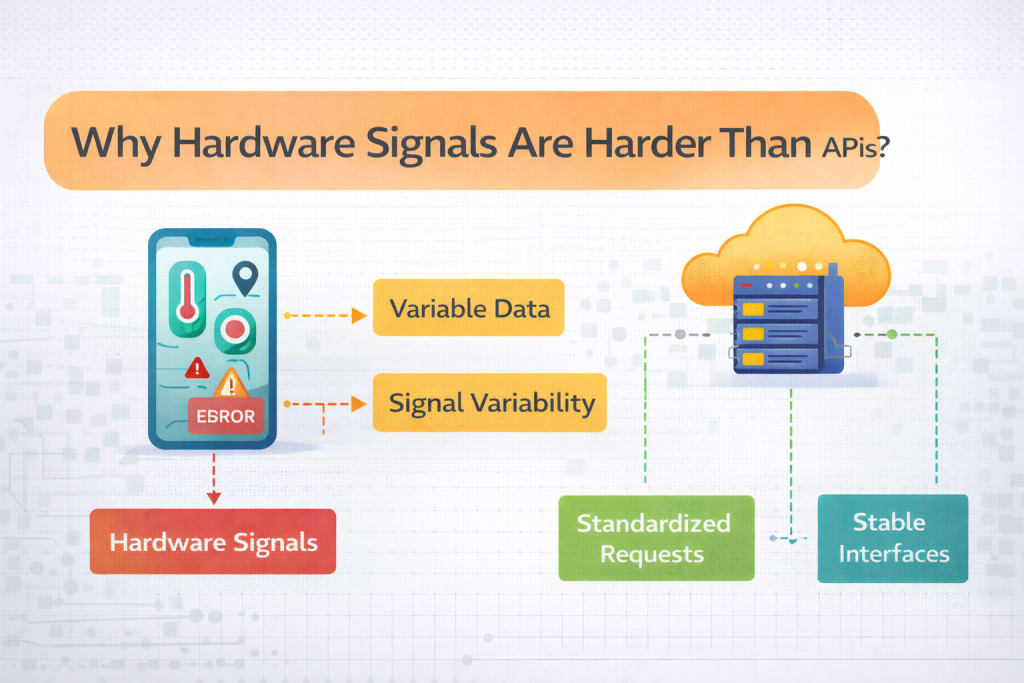
Why Hardware Signals Are Harder Than APIs?
A first-person look at why sensors, radios, and real-world signals introduce uncertainty that clean APIs never prepare you for.

I learned this lesson the slow way.
For years, most of the problems I dealt with in mobile apps came from APIs. Network failures. Timeouts. Bad payloads. Version mismatches. They were annoying, but they were understandable. APIs fail in predictable ways. They return errors. They retry. They log what happened.
Then hardware entered the picture in a serious way.
Suddenly, nothing behaved the way I expected anymore.
The app didn’t crash.
The API didn’t fail.
The code didn’t throw errors.
Yet the behavior was wrong.
That was when I understood something that still shapes how I design systems today. Hardware signals are fundamentally harder than APIs, not because they’re lower level, but because they live in the real world, not the software one.
Why APIs Feel Comforting by Comparison
APIs are contracts.
You send a request.
You receive a response.
If something goes wrong, the system usually tells you.
Even bad APIs are at least consistent. If they fail, they fail in the same way every time. That predictability is a gift.
As engineers, we build intuition around that. We learn how to retry. How to debounce. How to validate. How to log. Over time, failures stop being surprising.
Hardware signals don’t offer that courtesy.
What I Mean by “Hardware Signals”
When I talk about hardware signals, I’m not talking about drivers or firmware. I’m talking about the signals mobile apps consume every day.
- GPS location
- Accelerometer and gyroscope data
- Bluetooth and NFC
- Camera input
- Microphone input
- Battery and thermal signals
- Network radio state
- Sensor fusion results
These inputs don’t come from deterministic systems. They come from physical environments filled with noise, interference, motion, and human behavior.
And that changes everything.
The First Time Hardware Broke My Mental Model
The first bug that really taught me this involved location.
The API worked perfectly. The permission was granted. The callback fired. We received latitude and longitude.
But the user was indoors. Surrounded by concrete. Moving slowly. The GPS signal drifted.
Our app trusted the signal too much.
It showed the user as moving when they weren’t. It triggered logic that assumed intent. It logged actions that never actually happened.
From the system’s perspective, everything was correct.
From the user’s perspective, the app felt unreliable.
No error message could fix that.
APIs Fail Loudly, Hardware Fails Ambiguously
This is the core difference.
APIs fail loudly.
Hardware fails ambiguously.
An API timeout is obvious. A malformed response is obvious. A 500 error is obvious.
Hardware signals don’t “fail.” They degrade.
Location becomes less precise.
Audio input becomes noisy.
Motion sensors drift.
Bluetooth signals fluctuate.
There is no clear moment when you can say, “This is broken.”
You only know later, when the app behaves strangely.
The Scale of Hardware Dependence Is Growing Fast
This problem isn’t shrinking.
According to Pew Research Center, smartphones are carried almost constantly by a large portion of adults, meaning apps interact with users in motion, not at desks.
Statista reports that wearable device usage continues to grow globally, adding more sensor-driven input paths into mobile apps.
IDC estimates hundreds of millions of wearables shipped annually, each one producing continuous streams of hardware signals.
More hardware signals mean more uncertainty, not more control.
Why Timing Makes Hardware Harder Than Data
APIs are transactional.
Hardware is temporal.
A GPS reading is true for a moment, then slowly becomes false.
A motion signal is only meaningful in context.
A microphone signal depends on environment, distance, and timing.
If your architecture treats hardware signals like static data, you will build fragile logic.
I’ve seen teams store a single sensor value and base decisions on it long after it stopped being valid. The app didn’t crash. It just slowly drifted away from reality.
The Problem of False Confidence
One of the most dangerous things about hardware signals is that they look precise.
Coordinates have decimals.
Accelerometer values have units.
Signal strength has numbers.
That precision creates false confidence.
Engineers trust what looks exact. Users feel the consequences when it’s wrong.
This is why hardware-driven bugs feel uncanny. The app appears confident, but behaves incorrectly.
Expert Warnings That Only Make Sense After You Feel the Pain
Don Norman once wrote, “Technology should be designed to accommodate human behavior, not require humans to adapt to technology.” Hardware signals are deeply tied to human behavior and environment.
Martin Fowler has pointed out that systems interacting with the real world must expect uncertainty, not exceptions.
Jake Wharton has repeatedly reminded mobile developers that sensor data is best-effort, not truth.
These ideas sound abstract until hardware logic breaks trust.
Hardware Signals Multiply State and Edge Cases
An API call usually has three outcomes.
- Success
- Failure
- Timeout
Hardware signals create gradients.
- Strong signal
- Weak signal
- Fluctuating signal
- Delayed signal
- Conflicting signals
Each gradient introduces states your app must reason about.
When teams underestimate this, they end up with logic that works in the lab and fails in the field.
Why Testing Hardware Logic Is So Difficult
You can mock an API.
You can’t mock a crowded subway, a concrete building, or a rainy day.
Hardware behavior depends on environment, motion, and timing. Automated tests struggle here. Manual testing is inconsistent.
That’s why hardware-related bugs often survive release and show up only in real usage.
Teams working in mobile app development Indianapolis environments often discover that apps behave perfectly in office testing and strangely in warehouses, basements, or moving vehicles.
Hardware Signals Break Clean Architecture Boundaries
Another hard lesson was architectural.
APIs live cleanly behind interfaces.
Hardware signals leak everywhere.
Location affects UI, background services, analytics, and business logic. Motion affects power management, tracking, and state transitions.
Without careful design, hardware logic bleeds across layers.
Suddenly, UI code starts making sensor decisions. Services start depending on view state. Ownership becomes unclear.
That’s when systems become fragile.
Power and Battery Make Everything Worse
Hardware signals cost power.
Listening drains battery.
Sampling frequently heats devices.
Background processing wakes radios.
According to Statista, battery life remains one of the top user complaints in mobile apps.
If hardware logic isn’t throttled and contextual, users feel it physically. Warm phones. Faster drain. Shorter sessions.
No API failure creates that kind of visceral feedback.
The Psychological Impact on Users
Hardware-driven failures feel personal.
“If the app says I moved, did I do something wrong?”
“Why does it think I’m here?”
“Why did it react when I didn’t do anything?”
Users don’t blame hardware. They blame the app.
Trust erodes faster when behavior feels inexplicable.
What Finally Helped Me Design Better Hardware Logic
I stopped asking, “What does the signal say?”
I started asking, “How confident am I, and what happens if I’m wrong?”
That shift changed everything.
We introduced confidence thresholds.
We required corroboration from multiple signals.
We decayed old data aggressively.
We designed UI that communicated uncertainty instead of hiding it.
The app became calmer.
Not because signals improved.
Because expectations became honest.
Why This Gap Will Keep Growing
Mobile apps are becoming more sensor-driven, not less.
- Context awareness
- Health tracking
- Ambient computing
- AI-assisted interpretation
All of these depend on hardware signals.
APIs will remain important, but hardware will increasingly shape behavior.
Teams that treat hardware like APIs will keep getting burned.
The Lesson I Took Away
APIs live in controlled systems.
Hardware lives in reality.
Reality is noisy.
Reality is inconsistent.
Reality doesn’t retry politely.
Once I accepted that, I stopped trying to force certainty where none existed.
I designed for doubt instead.
And that made the app feel more trustworthy, even when signals weren’t perfect.
Because users don’t need certainty.
They need honesty.
Frequently Asked Questions
Why are hardware signals harder to work with than APIs?
Because hardware signals come from the physical world, not controlled software systems. APIs follow contracts and fail loudly, while hardware signals degrade quietly, fluctuate with environment, motion, interference, and timing, and rarely provide a clear “this is wrong” moment.
What makes hardware failures feel more confusing to users?
Hardware-driven issues don’t look like errors. The app still responds, but behavior feels off. Users see actions triggered unexpectedly, locations drift, or sensors misinterpret intent, which feels unpredictable rather than broken.
Can’t hardware signals just be validated like API responses?
Not reliably. APIs can be validated against schemas and status codes. Hardware signals require interpretation, confidence thresholds, and context. A GPS coordinate or motion value may be technically valid but practically wrong.
Why do hardware-related bugs escape testing so often?
Because hardware behavior depends on real-world conditions that are hard to simulate. Crowded buildings, moving vehicles, interference, temperature, and user motion can’t be fully recreated in test environments or emulators.
How do hardware signals increase architectural complexity?
They introduce continuous streams instead of discrete events, uncertainty instead of certainty, and overlapping states instead of clean transitions. This forces apps to manage timing, decay, confidence, and corroboration across multiple layers.
Why does trusting hardware signals too much cause problems?
Hardware data often looks precise, with numbers and decimals, which creates false confidence. When apps act on that data without questioning its reliability, they make decisions that don’t match reality.
How do hardware signals affect battery life and performance?
Listening to sensors, radios, and microphones consumes power. Without throttling and context-aware logic, apps drain battery, heat devices, and degrade performance, which users feel physically.
What’s the biggest mistake teams make with hardware-driven features?
Treating hardware signals like API responses. When teams assume signals are accurate, immediate, and reliable, they design logic that breaks under normal real-world conditions.
How should apps handle uncertainty in hardware signals?
By designing for doubt. This includes using confidence thresholds, combining multiple signals, expiring old data quickly, allowing correction and undo, and communicating uncertainty instead of hiding it.
Why will this problem keep getting harder over time?
Mobile apps are becoming more context-aware, sensor-driven, and ambient. As reliance on location, motion, health data, voice, and environment increases, the gap between clean software logic and messy physical reality widens.
What’s the most important mindset shift for developers?
Stop asking “Is this signal correct?” and start asking “How confident am I, and what happens if I’m wrong?” Designing for uncertainty builds trust even when signals are imperfect.
How do users ultimately judge hardware-driven behavior?
Not by accuracy alone, but by consistency and honesty. Users tolerate uncertainty when apps behave calmly and predictably, but they lose trust when confident-looking behavior is wrong.
About the Creator
Keep reading
More stories from Mary L. Rodriquez and writers in FYI and other communities.
A Failed Artist, A Disillusioned Poet, An Underpaid Game Show Host
I took my son and niece to Gori, a small town in Georgia where Joseph Stalin was born. They talked me into visiting the Stalin's Museum, the largest in the post-Soviet space. I had resisted going there because I just can't stand the monster and know enough about him, or so I thought.
By Lana V Lynx27 days ago in FYI
When Safety Comes First: Understanding the Ramipril Medication Recall
Ramipril is one of the most commonly prescribed medications for treating high blood pressure, heart failure, and kidney disease related to diabetes. For millions of patients worldwide, it plays a vital role in preventing strokes and heart attacks. However, recent medication recalls involving certain batches of Ramipril have raised concerns and questions among patients and healthcare providers alike. The incident highlights how closely monitored the pharmaceutical supply chain is and why patient safety remains the highest priority in modern medicine.
By Sajida Sikandara day ago in FYI
A Love Forboding
The chipped stone slope caused unbearable footing. I slid, skirting on my heels. I cast my shield, relinquishing my guard to stay upright. Left with my double-edge and a prayer to the maker, I skated toward my objective. The earthly stubble gave way to solid ground. I found myself restored, a trail of dust in my wake.
By James U. Rizzi3 days ago in Fiction


Comments
There are no comments for this story
Be the first to respond and start the conversation.