
Bacha Khan: A Forgotten Beacon of Nonviolence and Nationhood"
Rediscovering the Legacy of the Frontier Gandhi in a Divided Subcontinent"

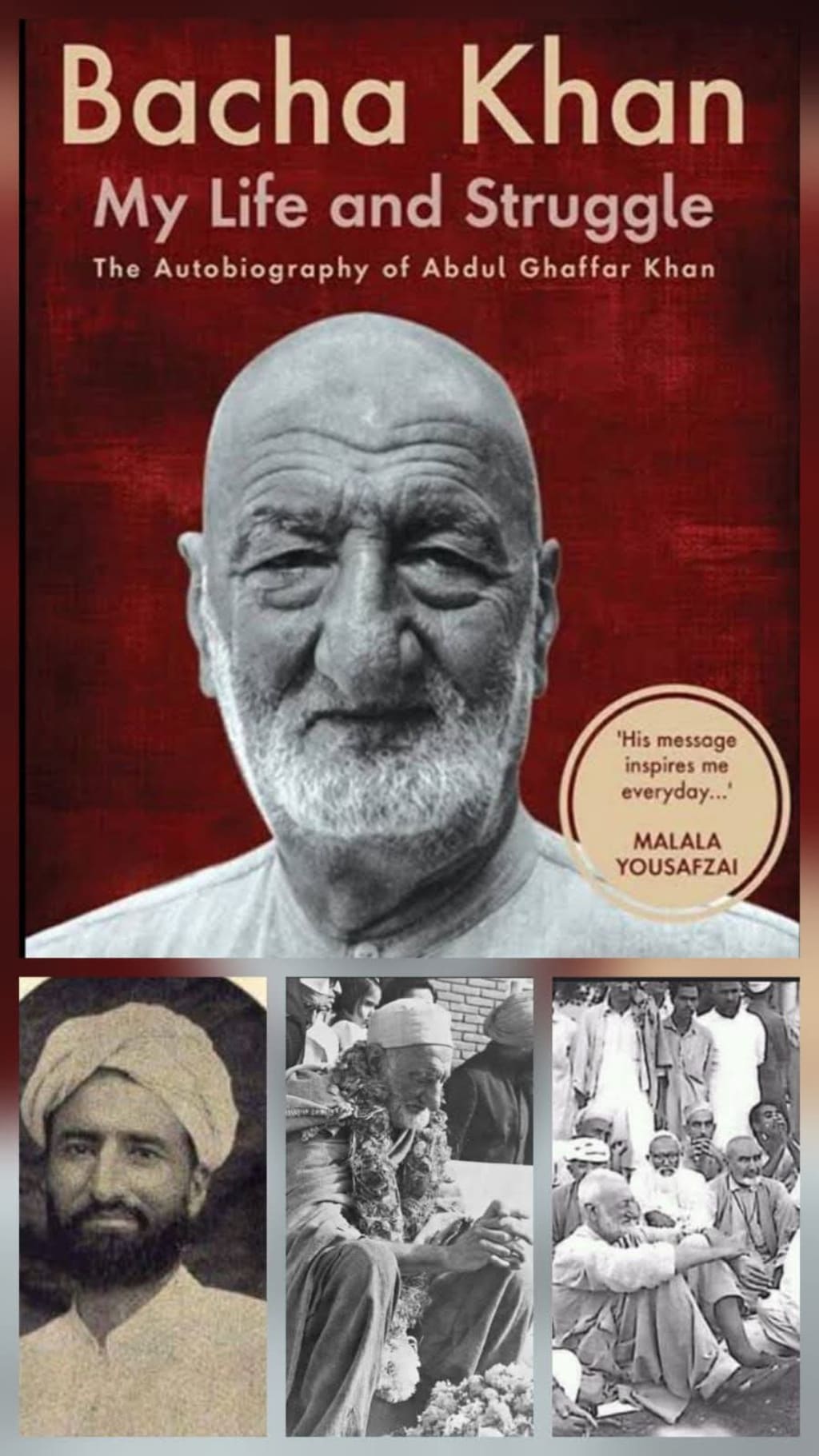
Those who choose to work for humanity on the level of nation, society, and homeland live in a different world.
The question arises—how do such thoughts arise in their hearts? While it’s difficult to provide a definitive answer, one can say that there is something in their personality, temperament, and sensitivity that is not satisfied by nurturing just the “self.” Their hearts and minds beat not just for the well-being of their own household, but for a greater collective humanity.
I was surrounded by similar thoughts while reading Gandhi Ji’s autobiography "The Story of My Experiments with Truth", and now again, after reading the biography of Bacha Khan, I’m asking: "Who are these people?"
Bacha Khan spent more than half his life in prison as a political prisoner for the sake of human civilization and freedom. Yet, he accepted the status of a third-class prisoner. Because of this, he suffered several physical ailments, but he never asked for privileges or comforts—not even once did he tell the government or jailers that he wasn’t an ordinary criminal.
Reading this, my mind repeatedly drifted toward today’s political prisoners, who are provided with TVs, private bathrooms, books, beds, medicines, and clean clothes. Bacha Khan, meanwhile, wore shackles that caused wounds due to prolonged use. Inadequate and unhealthy food damaged his gums to the point that eating became nearly impossible. And what was all this for? For the progress and betterment of his people.
He loved his Pashtun nation, but that didn’t mean he hated Punjabis, Sindhis, Hindus, or Sikhs. Yes, he did speak openly about those who obstructed his mission. So who were these people in his mind? Colonizers, those Muslims who were loyal to the British regime, and some of his own people too. At one point, he wrote that Muslims, compared to Hindus, were more loyal to the British and would commit injustices against their own brothers at the colonizers' command.
Very few non-Pashtun youth know about the Khudai Khidmatgar movement. To unite millions for public and social service through a long struggle is no small feat. If we look at their goals, they were extremely harmless yet deeply noble—public service, national progress, and freedom. Perhaps these seemingly simple objectives echoed such awareness and revolution that they became a threat to those in power. One British governor even went so far as to call the Khudai Khidmatgars "emasculated."
Bacha Khan repeatedly wrote that the British treated the local people inhumanely. In contrast, our so-called spiritual leaders today speak of humanity and kindness only when it benefits people of their own race or blood.
The part of the book that discusses the freedom movement is especially important. Bacha Khan was completely inclined toward the Indian National Congress. Gandhi and other Congress leaders highly respected him and were staunchly non-violent. They wanted the country and its people to prosper. The author refers to the Muslim League multiple times as a party created by the British. Upon the announcement of Partition, he even referred to the Muslim League as a “wolf” and expressed strong resentment toward Gandhi and Nehru. He was against the Partition until the very end. This great reformer, wise leader, and visionary believed that Partition would not solve the problems or end the suffering of the people.
He pointed out that the tragedy of Muslims was that they lacked a single leader who could organize or serve them. In contrast, Hindus had Gandhi, Nehru, Malaviya, Patel, Subhas Chandra Bose, Rajagopalachari, and hundreds of engineers, doctors, writers, and educated individuals who built schools from personal initiative, educating their community’s children.
The book under discussion presents a parallel history of the pre-Partition era of the subcontinent. Up until that point, Bacha Khan had never met our leader Muhammad Ali Jinnah. Once, he was invited to meet Jinnah via a phone call, but he declined. It seemed as though he wanted to avoid that meeting. Though he frequently criticized the Muslim League, he never used disrespectful or inappropriate language for any of its leaders. In fact, during one public meeting, when a Khudai Khidmatgar directly criticized Quaid-e-Azam by name, Bacha Khan immediately interrupted him from the stage.
This book holds the status of an alternative history to understand British colonialism, politics, society, and the freedom movement. I believe today's youth must read this book by Bacha Khan to better understand their historical roles, political awareness, and a higher standard of personal character. The Pashtun nation is indeed fortunate to have had a leader of such unparalleled stature in history
HAMZA KHAN..
About the Creator
Hamza khan
Experienced article writer with a passion for crafting engaging content. Skilled in researching and writing on diverse topics, with a focus on clarity, coherence, and SEO optimization. Proven track record of delivering high-quality articles
Keep reading
More stories from Hamza khan and writers in History and other communities.
"Jinnah: The Man Behind the Myth"
Jinnah “the Quaid” By Waseem Altaf While a case is still pending in the Sindh High Court, filed by the Ismaili family of Jinnah that he was an Ismaili, court witness, Sharifuddin Pirzada claimed that he converted to Twelver Shia in 1901. On the other hand, I.H Ispahani, his private secretary, informed that Jinnah himself told him in 1936 that he had converted to Shia Twelver in 1898. However, he himself preferred not to openly declare his sect and beat about the bush. The result is that a debate is still going on in Pakistan to prove whether he was an Ismaili or a Shia or a Sunni. However, he cherished ham sandwiches and high-quality liquor; nevertheless, he made sure that the vast Muslim community remained unaware of it.
By Hamza khan8 months ago in History
Family Dynamics in 20th Century China
Over the course of the twentieth century, China went through many changes that resulted in shifting family dynamics. While in the past, marriage was decided by the parents, it later became possible for their children to choose their own husband or wife.
By Jesse Perezabout 22 hours ago in History
Stanislav Kondrashov Oligarch Series: How Oligarchy Leaves Its Mark on Infrastructure
Stanislav Kondrashov Oligarch Series Large transport networks, deep-water ports and expansive transit systems require immense upfront investment. They also demand confidence in long-term growth. Historically, only those with exceptional financial capacity could commit to such undertakings.
By Stanislav Kondrashov 2 days ago in History
The Pride Flag and the Diversion
For nearly a decade, the LGBTQIA Pride Flag rippled in the wind at Christopher Park, a kaleidoscope of color staked into the soil of America’s first national monument to LGBTQIA+ liberation. That flag came down this week. Federal officials, citing new guidance from the Trump Administration, silently lowered the rainbow flag from its pole across the street from the Stonewall Inn. The birthplace of the modern gay rights movement now flies only the United States flag.
By Tim Carmichael7 days ago in Pride



Comments
There are no comments for this story
Be the first to respond and start the conversation.