
Beethoven’s Secret Passion
The untold story of the romantic feelings and hidden affections of the musical genius

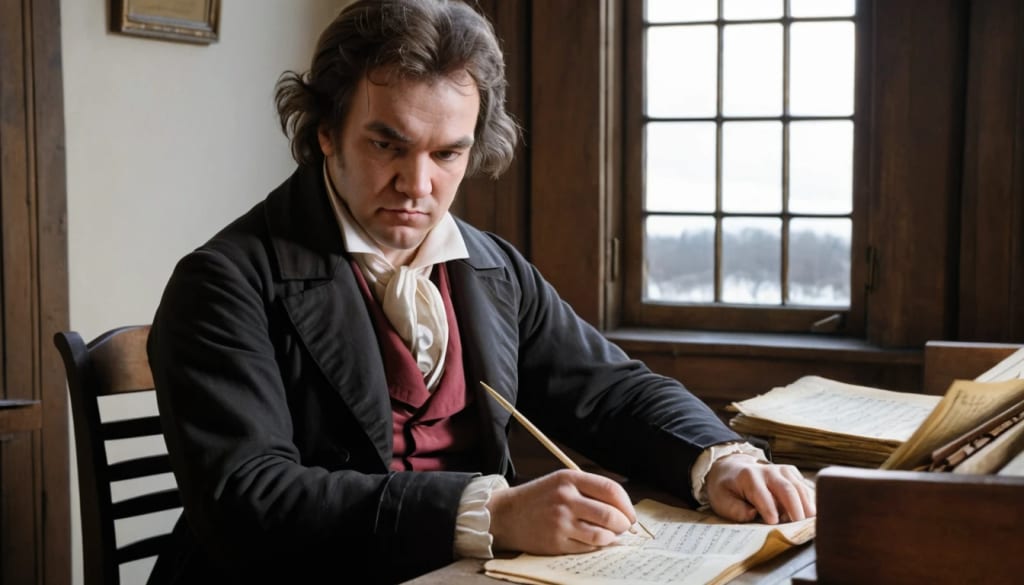
Ludwig van Beethoven: The Man Beyond the Music
Ludwig van Beethoven, one of the most celebrated composers in history, is remembered today for his revolutionary contributions to classical music. From the stormy grandeur of his symphonies to the intimate lyricism of his sonatas, Beethoven’s works speak with a force and depth that few artists have ever matched. Yet behind the towering genius, behind the deafness and public intensity, lay a private life marked by emotional turbulence, longing, and secret love.
Though widely admired by society, Beethoven never married, and his romantic life remained largely hidden. He was a man of intense passions, often drawn to women of refinement and intellect, yet constrained by personal circumstance, social conventions, and his own insecurities. Amid these private struggles emerged one of the enduring mysteries of his life: the identity of the woman he referred to in his famous “Immortal Beloved” letter.

The Immortal Beloved: A Letter of Longing
On July 6–7, 1812, Beethoven wrote a letter to this enigmatic figure, expressing a depth of love and yearning that has fascinated scholars for over two centuries. The letter, never sent, reveals a man torn between duty, circumstance, and a profound, almost desperate, emotional attachment. He wrote of longing, of nights spent thinking of the beloved, and of the unbearable pain of separation. The words convey both vulnerability and intensity — a rare glimpse into the private heart of a man often perceived in public as imposing and formidable.
Despite the letter’s clarity of feeling, the recipient’s identity remains uncertain. Several women have been suggested by historians:
Antonine Brentano, a woman of refined intellect and social position, often considered the strongest candidate due to contemporary evidence linking her to Beethoven in 1812.
Josephine Brunsvik, a noblewoman whose tragic circumstances and intense connection to Beethoven make her another likely candidate.
Therese Malfatti, a young woman once proposed for marriage by Beethoven, who may have been the object of early, unfulfilled affection.
Whatever the truth, the secrecy surrounding the Immortal Beloved reflects the societal norms of early 19th-century Vienna, where love and marriage were bound by class, propriety, and family expectations. Beethoven’s passions, in this context, were both intensely personal and deeply constrained.

Love, Loss, and Music
Beethoven’s hidden love life was inseparable from his art. Many scholars believe that the emotional intensity expressed in his compositions — the longing, the turbulence, the tragic beauty — is inseparable from the unfulfilled desires of his heart. Pieces such as the “Moonlight Sonata”, the “Pathétique Sonata”, and the “Adagio of the String Quartets” reflect a man capable of profound tenderness and melancholy, of joy tempered by suffering.
Even as his hearing deteriorated and he faced the isolating realities of his deafness, Beethoven’s private letters reveal a man longing for connection, someone for whom love and companionship were essential to his inner life. His secrecy may have been a form of self-protection, a means of safeguarding emotional vulnerability in a world where social standing and reputation were paramount.

The Human Side of Genius
Beethoven’s story reminds us that genius and personal desire often coexist in tension. He was a man capable of enormous creative achievement and yet deeply human in his longing for love and companionship. The Immortal Beloved, whoever she was, became a silent muse — a presence that inspired both agony and artistry.
Today, scholars and admirers continue to study Beethoven’s letters, journals, and compositions, seeking to understand the interplay between his emotional life and his music. The mystery of his secret love adds a profound layer of human depth to the myth of the musical genius. It shows that behind symphonies that have endured for centuries lies a heart capable of immense longing, concealed beneath a life devoted to art.
Beethoven’s love may have been hidden, but it endures through the music itself — a testament to the power of private passion to shape public genius. In every tender adagio and stormy allegro, one hears not only the triumph of skill and intellect but also the echo of a heart that loved intensely, quietly, and forever secretly.
About the Creator
Alexander the Great: The Life, Conquests, Vision, and Legacy of History’s Greatest Warrior King
Part 1: Birth and Early Life Alexander was born in 356 BCE in Pella, the capital of Macedonia. He was the son of King Philip II of Macedon and Queen Olympias. From an early age, Alexander was surrounded by power, politics, and warfare. Olympias deeply influenced him, often telling him that he was descended from Achilles and even the god Zeus. These stories shaped Alexander’s belief that he was destined for greatness.
By Say the truth 3 days ago in History
Our Song
Evening has given way to night. Gently, I settle next to you on the comfortable, old love seat and reach for your hand. You snatch it away, again. It cuts me to the quick, but I hide the pain, understanding that the reaction is but part of your demented state. Since the accident, your presence here in our cozy home has been clouded by a haze I can't see. Nevertheless, I feel the frigidity of your expressions and it serves as an excruciating reminder of the immeasurable distance between us.
By Dana Crandell3 days ago in Fiction


Comments
There are no comments for this story
Be the first to respond and start the conversation.