
Charles Bridge: Prague’s Timeless Stone Gateway
A medieval masterpiece connecting Prague’s history, culture, and legends.
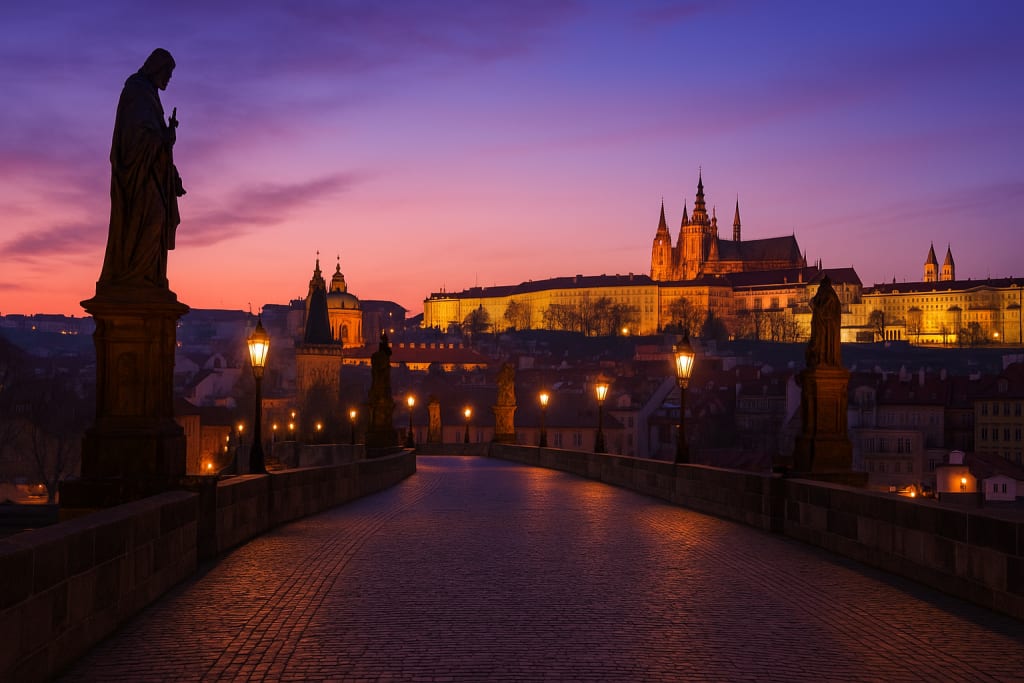
Charles Bridge: Prague’s Timeless Stone Gateway
The Charles Bridge, known in Czech as Karlův most, is one of Europe’s most iconic medieval monuments and one of the proud symbols of Prague. Stretching gracefully across the Vltava River, it links the Old Town with the Lesser Town and Prague Castle. More than just a bridge, it is a living museum of art, history, and legend. For over six centuries, it has withstood wars, floods, and political upheavals, continuing to inspire and fascinate millions of visitors each year.
Origins of a Medieval Masterpiece
The bridge was commissioned by King Charles IV in 1357, during Prague’s golden age. The city was fast becoming one of Europe’s most important political and cultural centers, and Charles wanted a structure that would reflect its growing prestige. The older Judith Bridge, built in the 12th century, had collapsed after a flood in 1342, leaving a crucial gap in the city’s infrastructure.
Construction began at a moment believed to carry mystical significance. On July 9, 1357, at exactly 5:31 AM, Charles IV laid the foundation stone. Astrologers advised him to choose this date and time because it formed a symmetrical sequence of numbers: 1357 9 7 5:31. This alignment was thought to ensure stability and longevity.
The bridge was designed by the German-Czech architect Peter Parler, already renowned for his work on St. Vitus Cathedral. Built of Bohemian sandstone, the structure measures over 516 meters in length and about 10 meters in width. Supported by sixteen arches and shielded by massive stone piers, the bridge was engineered to withstand the unpredictable floods of the Vltava River. For centuries, it served as Prague’s only crossing, making it vital for trade and communication
A Gallery of Statues
Walking across Charles Bridge feels like wandering through an open-air sculpture gallery. Between the late 17th and early 18th centuries, thirty Baroque statues and sculptural groups were installed along its balustrades. Each represents saints, martyrs, or biblical figures important to the Catholic faith.
The most famous of these is the statue of St. John of Nepomuk, a priest who became a martyr in 1393. According to legend, he was thrown into the Vltava at the orders of King Wenceslaus IV for refusing to reveal the secrets of the queen’s confession. His statue features a bronze plaque that visitors touch for good luck, and tradition holds that it ensures a return to Prague.
Other striking figures include St. Lutgard, depicted in a mystical vision of Christ on the cross, and St. Christopher carrying the infant Jesus. Though the originals have long been moved to museums for protection, the replicas continue to enchant travelers from all over the world.
Legends in the Stone
Charles Bridge is surrounded by folklore as rich as its architecture. One enduring tale claims that raw eggs were mixed into the mortar to make the structure stronger. Records show that eggs were indeed collected from villages across Bohemia for the construction, though it remains unclear whether they were used raw or boiled.
Another legend suggests the bridge is enchanted because of the exact numerological sequence chosen for its foundation. These stories, whether fact or myth, add to the bridge’s aura of mystery and charm.
Witness to History
Over the centuries, Charles Bridge has borne silent witness to many of Prague’s triumphs and tragedies. In medieval times, it hosted royal processions and trade caravans. During the 17th century, following the Battle of White Mountain, the severed heads of Czech noble leaders were displayed on its Old Town tower as a grim warning.
The bridge also endured devastating floods, with particularly severe damage occurring in 1890. Despite repairs and restorations, the structure has remained remarkably true to its original form, a testament to medieval engineering and determination.
A Living Landmark Today
Today, Charles Bridge is more than a monument—it is a vibrant part of Prague’s daily life. Street performers, painters, and musicians gather to share their talents with locals and tourists alike. The bridge offers breathtaking views of Prague Castle, the Old Town’s spires, and the flowing Vltava beneath.
The best times to visit are early in the morning, when mist hovers over the river and the cobblestones are nearly empty, or late in the evening, when the lanterns cast a golden glow and the city feels timeless.
Enduring Symbol of Prague
Charles Bridge endures not only because of its physical strength but also because of what it represents: the unity of Prague, the vision of Charles IV, and the resilience of a city that has faced countless challenges. To walk across it is to walk through history, art, and legend all at once.
For travelers, it is more than a crossing—it is an unforgettable journey through centuries. As one of Europe’s most cherished landmarks, Charles Bridge continues to serve as Prague’s timeless stone gateway, a link between the past and the present, between myth and reality.
About the Creator
Keep reading
More stories from Mukhtiar Ahmad and writers in History and other communities.
Prague Castle: A Millennium of Power
Prague Castle – The Heart of Czech History High on a hill overlooking the winding Vltava River, Prague Castle (Pražský hrad) dominates the skyline of the Czech capital. Its silhouette, with Gothic spires and sprawling courtyards, has been a symbol of Czech identity, resilience, and power for more than a millennium. More than just a fortress, it is an enduring witness to the changing tides of history — from medieval kings to modern presidents — and holds the Guinness World Record as the largest ancient castle in the world, covering nearly 70,000 square meters.
By Mukhtiar Ahmad5 months ago in History
Rising U.S.–Iran Tensions: Power, Warnings, and the Risk of a Wider Conflict
Rising U.S.–Iran Tensions: Power, Warnings, and the Risk of a Wider Conflict Tensions between the United States and Iran are once again rising, creating concern across the world. Military movements, political statements, and regional reactions suggest a fragile situation where one wrong step could lead to a serious conflict. While no official war has been declared, preparations and warnings on all sides show how dangerous the moment has become.
By Wings of Time 4 days ago in History
Elizabeth I of England: Strategic Ambiguity
Elizabeth I ruled in one of the most dangerous political environments in European history—and survived. Surrounded by religious conflict, foreign threats, and internal conspiracy, she governed not through brute force or rigid ideology, but through something far subtler: strategic ambiguity. Where others rushed toward certainty, Elizabeth mastered delay. Where others declared, she implied. Her power lay not in decisive answers, but in carefully preserved options.
By Fred Bradford2 days ago in History



Comments
There are no comments for this story
Be the first to respond and start the conversation.