
City changed forever by one bomb
"The Day the Sun Fell: A City, A Bomb, A New World"

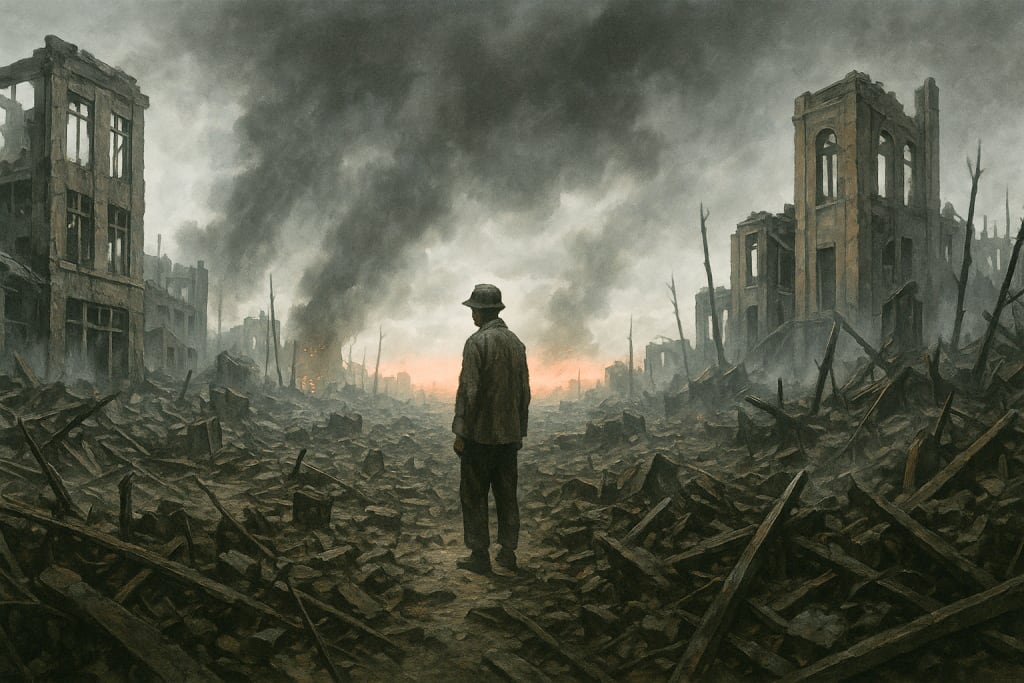
The morning of August 6, 1945, began like any other in the city of Hiroshima. Children raced down narrow streets, the elderly swept dust from their porches, and shopkeepers rolled up shutters with hopeful hearts. After years of war, the rhythm of life still pulsed, even amid rationing and whispers of American planes above.
But at exactly 8:15 a.m., the ordinary became unthinkable.
A sudden light — brighter than a thousand suns — flashed across the sky. It wasn’t followed by thunder, at least not immediately. There was only silence. Then, seconds later, came the roar — a sound so monstrous that it felt as though the heavens had split open. The air turned to fire. Windows shattered for miles. Walls crumbled like sand. Human beings simply vanished, their shadows burned into stone.
Yuki, a fourteen-year-old schoolgirl, had just stepped outside her classroom. She remembered only the light — blinding, white, consuming. When she opened her eyes again, the building was gone. Her teacher was gone. Her skin felt like it was peeling away. She didn’t scream. No one did. Not yet. The city was quiet in its ruin, stunned into silence.
As the hours passed, smoke began to rise in plumes from every corner of the city. Fires ignited wherever debris had fallen, and soon, Hiroshima became a furnace. People stumbled like ghosts through the streets, skin hanging from arms, eyes wide but empty. Some carried the remains of loved ones, some wandered calling names into the void.
At the edge of the river, bodies floated silently, having jumped into the water to escape the fire only to succumb to radiation or drowning. Children sat beside the dead, nudging them to wake. The air stank of burning flesh and something metallic and unnatural — the scent of something not of this world.
In a makeshift shelter on the outskirts of the city, Dr. Masaru tried to treat the survivors. He was a young man, barely thirty, trained in traditional medicine and field care. But nothing in his books had prepared him for this. Burns that peeled to the bone, strange bleeding from the mouth and ears, people dying not from wounds but from something inside their blood.
The days that followed blurred into one long nightmare. The skies darkened with black rain — oily, sticky, and toxic. Those who had survived the initial blast began to fall ill, vomiting, their hair falling out in clumps. They had no word for what was killing them, no explanation for the horror inside their bodies. It was not fire. It was not shrapnel. It was invisible. And it did not stop.
Yuki wandered for three days before she found her mother’s body near the riverbank. Her clothes were fused to her skin, and her hands still clutched a bundle of rice meant for lunch. Yuki didn’t cry. The tears had long since dried in the searing wind of the explosion.
News of what happened spread slowly. Japan’s leaders did not at first understand. America had dropped a new kind of bomb, something different from anything the world had known. It was called “atomic.” It split atoms to unleash power beyond comprehension. Hiroshima was not merely attacked — it had become a test site for the most devastating weapon ever created.
Three days later, Nagasaki would suffer the same fate.
By the time Japan surrendered, the cities were wastelands. Survivors — the hibakusha — were marked not just by scars but by silence. Many would never speak of what they had seen. Others would become witnesses to a new truth: that mankind had touched something forbidden, something godlike, and in doing so, had opened a door that could never be closed again.
Years passed. Hiroshima rebuilt. Cranes returned to the sky — not machines, but paper ones, folded by children like Sadako, who believed in a legend: fold a thousand paper cranes, and you shall be granted a wish. Sadako’s wish was simple — to live.
But she died, like many others, from the lingering effects of the radiation.
Today, a peace memorial stands at the epicenter of the blast. People from around the world come to leave flowers, fold cranes, and remember. Not just the dead, but the lesson. That in one blinding moment, a city vanished — and humanity crossed a line it can never uncross.
The world moved on. But Hiroshima does not forget.
About the Creator
TrueVocal
🗣️ TrueVocal
📝 Deep Thinker
📚 Truth Seeker
I have:
✨ A voice that echoes ideas
💭 Love for untold stories
📌 @TrueVocalOfficial
Locations:
🌍 Earth — Wherever the Truth Echoes
Diamonds Around the World: The Countries That Live and Breathe Baseball
There's something almost mystical about the crack of a bat connecting with a fastball. In certain corners of the globe, that sound carries the weight of history, identity, and dreams passed down through generations. While soccer may dominate the world's sporting consciousness, baseball has carved out its own sacred territories—places where the sport transcends mere entertainment and becomes woven into the very fabric of culture.
By Gianni Bertoni5 days ago in History
Rachel Reviews: Lunch Tales: Teagan by Lucille Guarino
Well, I did enjoy this! Sometimes, all you need is just great storytelling and this is what Lucille Guarino delivers here. There's no big message to this book; it's just about folks and families, living their lives and coping with everything that's being thrown at them and finding their way. But when it's done well, like it is here, then you have characters to whom you can relate, tension which leaves you rooting for a better outcome, attraction which has your heart racing and an urge, as a reader, to see the characters happy with the people with whom they belong.
By Rachel Deeming4 days ago in BookClub


Comments
There are no comments for this story
Be the first to respond and start the conversation.