
Evolution Of Human
Are monkeys are our nearest relatives.

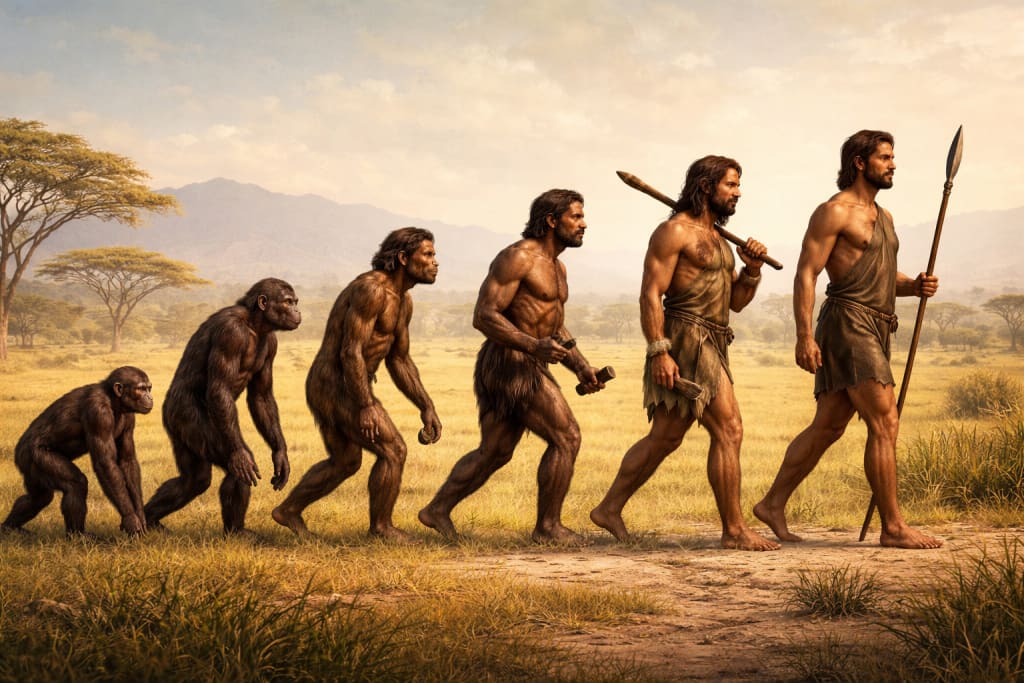
Human Evolution: The Long Journey from Primate Ancestors to Modern Humans
Human evolution is one of the most fascinating and complex stories in the history of life on Earth. It explains how modern humans, Homo sapiens, emerged through millions of years of biological, environmental, and cultural change. This journey is not a straight line of progress but a branching tree filled with experiments, adaptations, extinctions, and remarkable survival strategies. By studying fossils, genetics, archaeology, and comparative anatomy, scientists have pieced together a detailed narrative of how humans evolved physically, cognitively, and socially.
Understanding human evolution not only answers the question of where we came from but also helps us understand who we are today—our bodies, behaviors, intelligence, and capacity for culture.
The Foundations of Evolutionary Theory
The concept of evolution is rooted in Charles Darwin’s theory of natural selection, introduced in the 19th century. Darwin proposed that organisms evolve over time through variations that enhance survival and reproduction. Those individuals with advantageous traits are more likely to pass them on to the next generation.
Applied to humans, evolution suggests that we share a common ancestor with other primates, particularly chimpanzees and bonobos. Genetic evidence confirms this relationship: humans share approximately 98–99% of their DNA with chimpanzees. However, small genetic differences, accumulated over millions of years, led to profound differences in anatomy, cognition, and culture.
Human evolution is part of a broader process called hominin evolution, referring to the group that includes modern humans and their extinct relatives after the split from the common ancestor with chimpanzees.
Early Primate Origins
The story of human evolution begins around 60–70 million years ago with early primates. These small, tree-dwelling mammals evolved traits such as forward-facing eyes, grasping hands, and flexible shoulders—features that later proved crucial for human development.
Around 7–8 million years ago, environmental changes in Africa, including cooling climates and expanding grasslands, altered habitats dramatically. Forests shrank, and open savannas became more common. These changes placed selective pressure on primates, encouraging adaptations that favored survival in mixed environments.
It was during this period that the evolutionary line leading to humans diverged from that of chimpanzees.
The Emergence of Early Hominins
The earliest known hominins include species such as Sahelanthropus tchadensis and Orrorin tugenensis, dating back over 6 million years. Although fossil evidence is limited, these species show early signs of bipedalism—the ability to walk upright on two legs.
Bipedalism was one of the most important milestones in human evolution. Walking upright freed the hands for carrying objects, using tools, and eventually creating complex technologies. It also allowed hominins to see over tall grasses, travel long distances efficiently, and regulate body temperature more effectively.
Australopithecus: Walking Upright but Still Ape-Like
Between 4 and 2 million years ago, several species of the genus Australopithecus lived in Africa. One of the most famous fossils, “Lucy” (Australopithecus afarensis), provides clear evidence of habitual bipedalism.
Australopithecines had a mix of human-like and ape-like features:
Upright walking posture
Relatively small brains (about one-third the size of modern humans)
Long arms and curved fingers for climbing
Prominent jaws and large teeth
These early hominins likely lived in social groups and had a varied diet that included fruits, roots, seeds, and occasional meat. Although they probably used simple tools, there is limited evidence that they manufactured them.
The Genus Homo: A New Chapter
Around 2.5 million years ago, a significant evolutionary shift occurred with the emergence of the genus Homo. This transition marked increased brain size, more refined tool use, and greater adaptability.
Homo habilis: The Handy Human
Homo habilis is often considered the first true human species. Fossils show a larger brain than Australopithecus and association with the earliest known stone tools, known as Oldowan tools. These tools were simple but revolutionary, allowing early humans to cut meat, crack bones, and process plant material more efficiently.
Tool use significantly increased access to high-energy foods, particularly meat, which likely supported brain growth and cognitive development.
Homo erectus: The Great Migrator
One of the most successful and influential human ancestors was Homo erectus, which appeared around 1.9 million years ago. This species displayed several modern human characteristics:
Taller stature and longer legs
A more human-like body proportion
Significantly larger brain
Advanced stone tools (Acheulean hand axes)
Most importantly, Homo erectus was the first hominin to migrate out of Africa, spreading into Asia and Europe. This expansion demonstrated remarkable adaptability to different climates and environments.
Evidence suggests that Homo erectus controlled fire, which revolutionized human life. Fire provided warmth, protection, cooked food, and social gathering opportunities, further strengthening cooperation and communication.
Archaic Humans and Human Diversity
Following Homo erectus, several archaic human species emerged, including Homo heidelbergensis, Homo neanderthalensis (Neanderthals), and Denisovans.
Neanderthals
Neanderthals lived in Europe and western Asia until about 40,000 years ago. Once thought to be primitive, they are now known to have been intelligent, skilled hunters with complex social behaviors. They buried their dead, used sophisticated tools, and possibly engaged in symbolic activities.
Genetic studies reveal that modern humans outside Africa carry Neanderthal DNA, proving that interbreeding occurred between species.
Denisovans
Discovered through DNA analysis rather than complete fossils, Denisovans lived in Asia and contributed genetic material to modern populations, particularly in Melanesia and parts of Southeast Asia.
These interactions highlight that human evolution was not a simple replacement but a process of mixing and coexistence.
The Rise of Homo sapiens
Modern humans, Homo sapiens, evolved in Africa approximately 300,000 years ago. Early Homo sapiens showed anatomical features similar to modern humans, including:
A rounded skull
Smaller face and teeth
Highly developed brain
What truly set Homo sapiens apart, however, was not just anatomy but behavioral and cognitive sophistication.
Cognitive Revolution and Cultural Evolution
Around 70,000 years ago, humans experienced what some scientists call a “cognitive revolution.” This period saw rapid advancements in:
Language and symbolic communication
Art and personal ornamentation
Complex tools and technologies
Long-distance trade networks
Language allowed humans to share knowledge, plan collectively, transmit culture across generations, and build large, cooperative societies. Culture became a powerful evolutionary force, accelerating innovation far faster than biological evolution alone.
Migration and Global Expansion
Modern humans migrated out of Africa in multiple waves, eventually colonizing every continent except Antarctica. They adapted to deserts, rainforests, mountains, and icy tundras.
This global expansion led to physical variation among human populations, such as differences in skin color, body shape, and facial features. However, these differences are superficial adaptations to local environments. Genetically, all humans are remarkably similar, emphasizing the unity of our species.
The Role of Genetics in Understanding Evolution
Advances in genetics have revolutionized our understanding of human evolution. DNA analysis confirms fossil evidence, traces migration routes, and reveals interactions between different human species.
Genetics shows that evolution is ongoing. Traits such as lactose tolerance, disease resistance, and adaptation to high altitudes evolved relatively recently, demonstrating that humans continue to evolve in response to environmental and cultural pressures.
Human Evolution and Modern Challenges
Understanding human evolution also helps explain modern challenges. Our bodies evolved for active lifestyles and natural diets, yet modern environments often conflict with these adaptations, contributing to health issues like obesity and stress.
Social behaviors such as cooperation, competition, empathy, and aggression have deep evolutionary roots. Recognizing this can help us better manage conflict, promote cooperation, and design societies that align with human nature.
Conclusion
Human evolution is a story of resilience, adaptability, and creativity. From small tree-dwelling primates to technologically advanced global societies, humans have undergone profound transformations over millions of years. This journey was shaped by environmental changes, biological adaptations, cultural innovations, and social cooperation.
Far from being a finished process, human evolution continues today, influenced by genetics, culture, technology, and global interconnectedness. By understanding our evolutionary past, we gain insight into our present and guidance for our future.
The story of human evolution is ultimately the story of humanity itself—a testament to survival, intelligence, and the extraordinary capacity to change.
About the Creator
Ibrahim Shah
I am an Assistant Professor with a strong commitment to teaching,and academic service. My work focuses on fostering critical thinking, encouraging interdisciplinary learning, and supporting student development.
Keep reading
More stories from Ibrahim Shah and writers in History and other communities.
FUZZY BEAR
*Fuzzy Bear: A Hug You Can Trust* In a cozy little forest surrounded by tall trees, colorful flowers, and chirping birds, lived a teddy bear named *Fuzzy*. Fuzzy wasn’t like other bears—he wasn’t wild or loud. In fact, he wasn’t even real. He was a soft, stuffed bear with button eyes, stitched paws, and golden brown fur that was always warm, no matter how cold the night was.
By Ibrahim Shah about 8 hours ago in Art
Who is Bashir Zeb, the head of the banned organization BLA?
Before the attacks carried out on several cities including Quetta, the capital of Balochistan, the banned separatist organization Baloch Liberation Army (BLA) had released a video. In this picture , armed men can be seen riding three motorcycles at an unidentified deserted location. Only one of the six individuals’ face is visible. According to the banned organization, this person was the head of the BLA, Bashir Zeb, and it was also claimed that Bashir Zeb personally took part in these attacks. The BLA did not clarify where the video was recorded; however, Balochistan Chief Minister Mir Sarfraz Bugti claimed that the video was filmed in Afghanistan. It should be noted that last Saturday armed militants targeted various installations in Quetta, Mastung, Kalat, Nushki, Kharan, Dalbandin, Turbat, Tump, Gwadar, Pasni and several other areas. According to the provincial chief minister, a total of 31 civilians and 17 security personnel were killed in these attacks, while the government claimed that 145 militants were also killed. The banned BLA has been active in Balochistan for more than a decade, but in recent years the scope and intensity of attacks by the organization and its subsidiary group Majeed Brigade have increased. The BLA has been declared a banned organization by both Pakistan and the United States. It is worth recalling that since the attack on the Chinese Consulate in Karachi in November 2018, Bashir Zeb has been wanted by the Government of Pakistan in numerous cases involving attacks carried out by the BLA. These include the planning of the 2020 attack on the Karachi Stock Exchange, the planning of the female suicide bombing targeting Chinese teachers at Karachi University, and the attack on a convoy of Chinese engineers near Karachi Airport. In the airport attack case, a court has already declared him an absconder. However, there was a time when Bashir Zeb was active in student politics on the streets of Quetta. We spoke to journalists and former and current security officials, and also reviewed Bashir Zeb’s own writings and interviews given as chairman of BSO Azad, in order to understand who Bashir Zeb is and how he became part of this organization.
By Hashim Khan 2 days ago in History
Drones vs Aircraft Carriers
Drones vs Aircraft Carriers For decades, aircraft carriers have been the strongest symbol of military power. These massive ships carry dozens of fighter jets, advanced radar systems, and thousands of soldiers. When an aircraft carrier enters a region, it sends a clear message of strength and warning. But today, a new challenger is changing the rules of war: drones.
By Wings of Time 8 days ago in History




Comments
There are no comments for this story
Be the first to respond and start the conversation.