

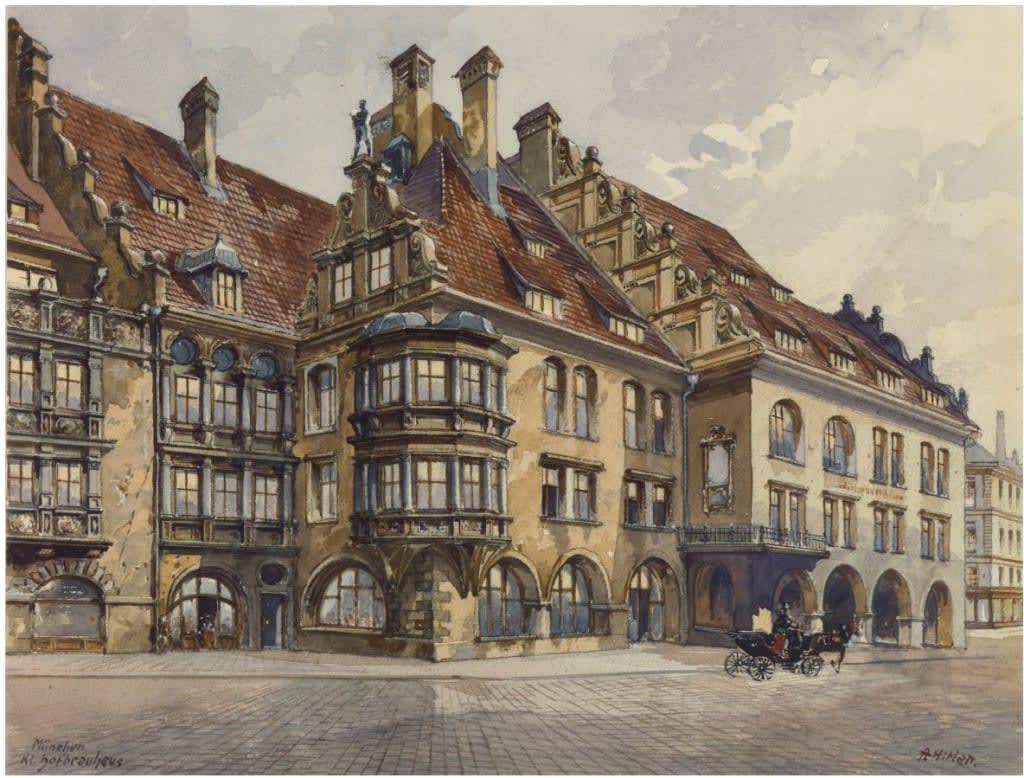
She sat alone, her chin nestled on steepled hands, staring at a wall full of posters that needed to come down with the end of the semester, awaiting the knock.
It was coming; he had never been late to class once, and he would not be tardy now. Still, she hoped that somehow this conversation could be delayed; put off until she found the words needed to soften the news.
He had worked harder than almost anyone in her class, driven by a thirst to prove himself, almost dangerously so. Short on natural talent, his brushstrokes were full of an immense focus, and each work consumed him as he painted. He ate up every piece of advice she gave, eyes and ears absorbing every move she made when demonstrating. While others joked around, he scribbled in notebooks, and while they strolled leisurely from one workstation to the next, he walked with force.
What she would give for a class full of students with his intensity.
And yet.
He refused to take feedback from anyone but her, and on more than one occasion had rebuked other students for daring to offer him advice. He forgot to eat or drink or take regular breaks, and he would not be budged from his chair once upon it. The templates she set seemed to constrain his thought, to stilt and stifle it where others found opportunity.
Now tired fingers ran through tired hair as she waited, hoping that he didn't come after all.
They only allowed a student to take the exam twice, and this had been his second attempt.
The door, for him, was closed.
A sharp rap of knuckles on wood brought her back to her desk, and she inhaled.
This was going to be unpleasant. Tears? Pleading? A tantrum? Surely not from him, yet there must be some reaction. No-one with that amount of dedication cou ld accept failure without a fight.
“Come in” she called, half-hoping her response died in the space between her mouth and the door.
No such luck. In he came, polished black shoes stepping smartly towards her, feet full of hope. He bowed slightly; always one to keep with the formalities.
“Ado, it's good to see you. Please close the door behind you."
When he had done so, and approached the desk, she gestured to the seat in front of him with a warm smile. Despite her news, it was good to see him again.
He politely declined, standing to attention beside the chair.
”If it is okay with you Frauen Meyer, I would rather stand. Vater says it reflects better on a man to stand in the presence of a lady.”
”I see. Ado, I...”
She paused, unsure how to deliver the news now that he was actually in front of her. Why must it fall on her to crush the dreams of her student?
She glanced at him quickly, a last look at a young man unaware that there was no good news for him here.
With an eye that had spent a career observing details, she took him in. Black hair hung close to his head, all strands following the same direction down. His clothes were pressed and tucked in, dull colours a reflection of uniform thought. A strong case for efficiency, it would seem. The faint traces of a moustache reminded her that he is not yet a man, though desperate to be seen as one. A jaw set in a line, betraying nothing.
His eyes glimmered, tracking her gaze as it fell to the papers between them, seeking a way to postpone the inevitable. Maybe he had already guessed at their content.
“This is the feedback the Academy gave.”
Inwardly she cursed, knowing that this was no way to break the news, but by then it was too late. His eager hands moved from behind him to his side, itching to reach out and read it, yet he waited for her signal, obedient even now to hierarchy.
She slid the crisp white paper across the space between them, and nodded just the once.
His careful hands grasped the sheets, scanning for meaning. The words fell like hammer blows, and his face twitched as if to shrug them off.
They wrote themselves across her mind as he ploughed on, and she tried to imagine what he was feeling even now.
"The artwork is cold, unfeeling, automatic, structured, and lacking freedom of expression, especially in people or trees.
“Too few heads in the people. Buildings are good."
”The pieces are prosaic, utterly devoid of rhythm, color, or spiritual imagination.”
Of course, it was not all bad, and there was much he did well. But she knew it would be of little consolation to him now.
For one dreadful moment, she felt his rage, his eyes burning holes in the paper he held, and she feared he would turn them on her. Finally, thankfully, he tore his gaze from the awful words.
He threw the papers back onto the table, staggering slightly as if struck, and slumped down into his seat, the cold steel doing nothing to soften the wound he now suffered. The certainty had seeped out of him, and she couldn't help but feel repulsed at how a handful of words could destroy a man's spirit so.
In his vulnerability, she sensed a small chance to reason with him, and leaned across the desk.
”Ado...I am truly sorry, but the Academy has made their decision. I disagree, but it is out of my hands. However, that doesn’t mean you should give up. There are other places that I believe would take you, and if you went…”
But he was already up, pacing back and forth, hands locked behind his back. His momentary lapse had lasted barely a minute, and all traces of disappointment and sadness had been masked. She knew, without him saying a word, that there would be no reasoning with him.
He stopped, straightened his back and nodded curtly, just once.
It was not her that made the call, after all. She believed in him, that he was sure of. He would prove the doubters wrong, and make his detractors look foolish.
“Frauen Meyer."
He looked directly at her, and she found nothing in his face to read.
"Thank you for the time you have put into teaching me. I know I have not always been the easiest student. You alone encouraged me, and I will not forget it.”
His tone was clipped, and though she knew he meant it, she was sure underneath simmered a bitter resentment, the shame burning at his insides.
Before she could reply, he was off, so quickly she was unable to act.
Turning sharply on his heel, his boots clicked down to the door, his hand deftly twisted it open, and the young man stepped out without a sound.
With his absence, the tension deflated, and she sighed heavily, compassion mingled with uncomfortable relief. True, he had not broken anything, or yelled, or begged. There had been no tears or excuses.
Then again, had she really expected that behaviour from him? Perhaps that might have reassured her in a strange way; that he was human, and that he would allow himself to feel. Instead, he had covered his distress in an instant, refusing to allow it to be seen or heard, like a shameful secret one hides from the world.
Now that their lessons were over, she wondered if she would ever see him again; this determined, serious young man who dreamed of painting for the great halls of Vienna.
Turning away from the rejection letter, its words staring at her in accusation, she glanced out the window, seeking solace in the late afternoon sun.
But clouds of grey had swallowed it whole, and she found no comfort there.
Had they made the right decision? Should she have fought harder on his behalf? Would his pride and ambition carry him through the disappointment?
He was stubborn, and she could not see him giving up that easily, but nor would he force open a closed door. Without being given the key, she suspected his pride would not allow him to pursue something that had been so firmly denied him.
Such a forceful will would find another way to assert his ideas, that she was sure of, and if not in painting, then where?
She forced herself to let it go. She had done all she could to help him, and he was no longer her student, nor her responsibility anymore. New students were enrolling in a week, and it was time to start afresh.
She breathed out, walked back over to the desk, collected the papers, and closed the folder of Adolf H.
Maybe it was for the best.
Author’s note:
This story is not meant to be read as excusing the crimes of Adolf Hitler, but rather to make us think “what-if?”
It came about as a sliding-doors idea, when I learned that he had been rejected twice by the Academy of Fine Arts Vienna as a young man, and pondered what might have happened if he and his paintings had been accepted. Would World War II and the Holocaust have happened?
This story is inspired by real events, but the idea of a conversation between a caring mentor and a young Hitler is completely fictional.
This story is not criticising the decision of the Academy, nor intended to make the reader feel sorry for Hitler. I believe it is possible to both condemn his actions as an adult, and also to wonder what direction his life would have taken had he been accepted.
The picture is a real painting of his, and the feedback is also real.
This is an updated version of my original piece, "Humanising Him", which can be found here- https://todaysurvey.today/fiction/humanising-him.
That particular Challenge was to write a scene that could realistically play out in a minute, so the whole thing was snappier, sharper, and set in present tense. Here, I wanted to let things be slower, more reflective, and switched to past tense.
About the Creator
Joe O’Connor
New Zealander
English teacher
Short stories and poems📚
Please be honest- I would love your constructive feedback, as it's the only way I'll get better. Would rather it was pointed out so I can improve!
Currently writing James The Wonderer
Keep reading
More stories from Joe O’Connor and writers in History and other communities.
Tensions, Transitions, and a Fragile Global Balance
Today’s World Affairs: Tensions, Change, and an Unstable Balance Today’s world affairs show a global system under great pressure. Many countries are facing political tension, economic uncertainty, and security challenges at the same time. The world is changing quickly, and no single event explains everything. Instead, a mix of conflicts, power struggles, and new technology is shaping how nations deal with each other.
By Wings of Time 7 days ago in History
The Demanding Factors That Created Alexander the Great’s Path to Victory
1. The Foundation Laid by Philip II of Macedon One of the most important factors behind Alexander’s victories was the groundwork laid by his father, King Philip II of Macedon. Philip transformed Macedonia from a weak kingdom into a dominant military power. He reorganized the army, introduced the Macedonian phalanx, and armed soldiers with the long sarissa spear, which gave them a decisive advantage over traditional Greek hoplites.
By Say the truth about 7 hours ago in History



Comments (5)
I wondered if it was him. I think you struck the nuance here beautifully.
I recognized this right away from the original publication! Fantastic entry for the new challenge! Good to say your name in my notifications!!
Narcissists cannot accept that they are not perfect. His art reflected his character...seems he could draw, but he was a dark personality...today it may have been accepted. What if...
Well done, Joe! I like the scenario you've imagined, and the mannerisms of "Ado" are well described. Great challenge entry!
Very thought provoking, and a challenging idea. I think the “would I have killed hitler to save his victims” question has popped up a million times in my own head— we even talked about it in philosophy courses back in college. But in that class, nobody thought to ask “would you have changed his path peacefully?” I think for myself, and perhaps others it’s more satisfying to reimagine history with a sense of justice. But who ever said the justice had to be violent? You’re right the what if’s are fascinating, and in practical terms there could have been many forks in the road, which could have perhaps led to hitler never becoming the monster he was, had his personal history played out differently. I still tend to think an individual capable of that much evil is probably gonna end up harming society in one way or another, but maybe the harm would have been a lot less. Perhaps the harm would have been your garden variety control freak/ abusive asshole stuff instead of him leading a genocide. Hard to know how much of it comes down to circumstances and bad luck, vs a deeper propensity for harming others.