
Looking Again at Frances Farmer
The "Come and Get It" Girl

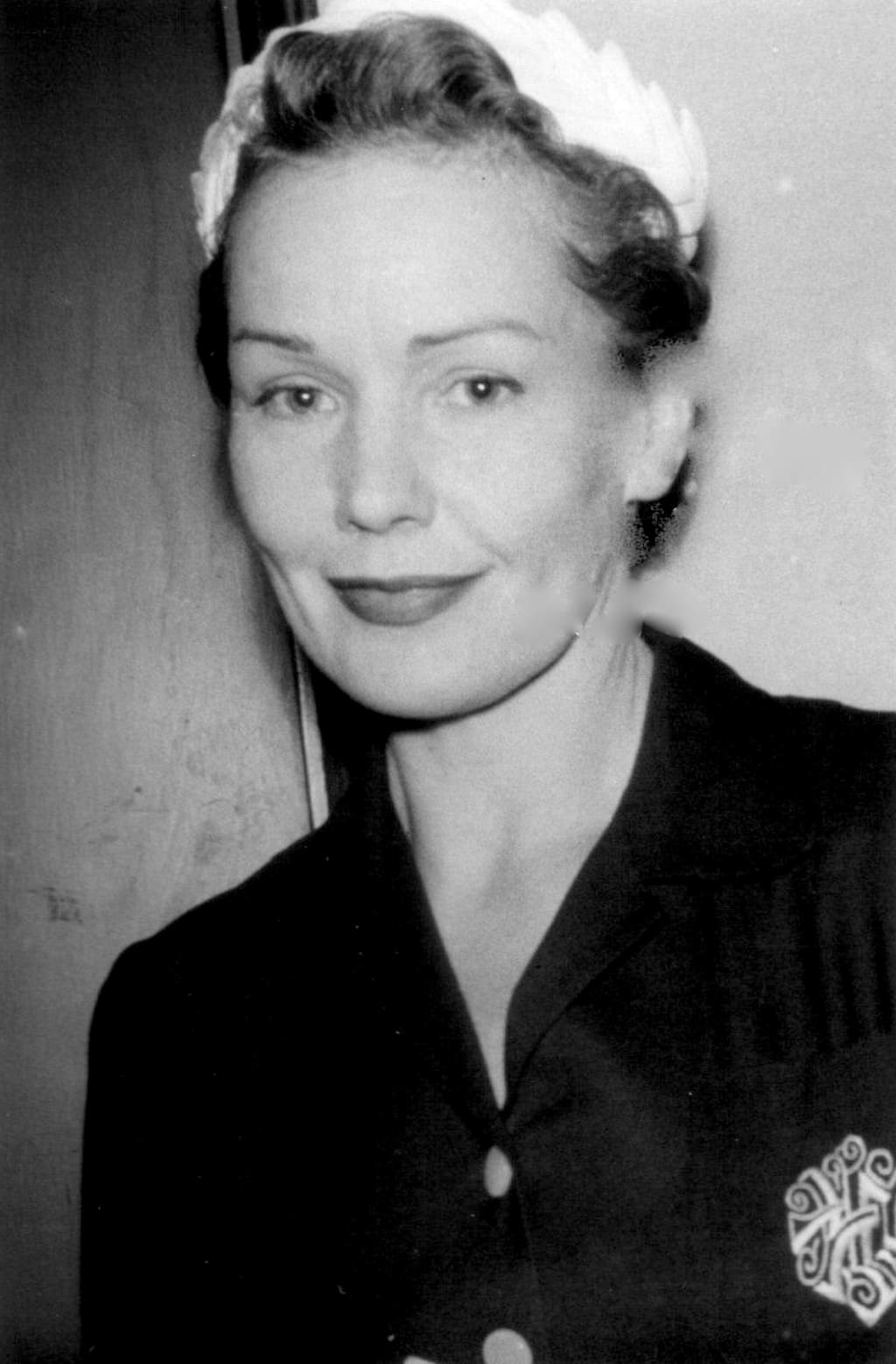
I am always surprised by the fact that Frances Farmer (1913 — 1970) was a movie star in the 1930s. There is something modern, hard-edged and contemporary about her image, perhaps because Jessica Lange played her as such in Frances, released in 1982.
The Frances Farmer story can be heart-breaking, as the movie made clear. Yet I’m not entirely sure we are doing justice to the woman by turning her into a perpetual victim. From the very start, no one was quite sure what to make of Frances Farmer.
Frances Farmer in the 1980s
Lange plays Farmer as beautiful and edgy, which she was, but brings that patented Lange steeliness to the portrayal as well. You can feel sorry for Farmer, but it is hard to like her. Her story is so relentlessly grim that we watch the film the way we watch The Elephant Man (1980), appalled at the treatment dished out to this person but unable to step into the character’s alien world.
The Frances Farmer of this movie comes across as a spoiled and mentally unwell woman who did not deserve or cause but certainly aggravated her plight. She seems incapable of acting in her own best interest and is waging a war all by herself. We do not see enough of what initially drew her to acting to understand why anyone would endure this much suffering.
The composite character played by Sam Shepard is also a cop-out. When she steps out of his car to rejoin the mother who consigned her to the hell of a psychiatric ward to begin with, the movie vaults past plausible and enters the realm of psychological horror.
The Dream Factory Does Not Appreciate Being Rejected
Frances Farmer signed a contract with Paramount Pictures on her 22nd birthday. After appearances in a few B-movies and the obligatory round of photo sessions and industry parties, Farmer gets the lead in the well-received and commercially successful film Come and Get It (1936).
The movie magazines start by praising Farmer in the usual ways, citing her beauty, talent, and work ethic, but the puffery is undercut by a trace of malice. Long before the psychiatric system grabbed ahold of her, Hollywood used the movie magazines to tie Farmer up and limit her options.
There is a sense from the start that Farmer is not as appreciative of Hollywood’s gifts as she should be. In Movie Classic (November 1936), Harry Lang makes much of Farmer’s blasé attitude to success, noting “The screen, Hollywood, and all of movies’ hokum, were and are just so much balloon stuffing to her.”
In March 1937, Hollywood weighs in with “Frances Farmer is not like most girls. She . . . isn’t entirely happy in Hollywood.” By April 1937, the narrative is locked. Screenland reports that Come and Get It “was one of those unlooked-for big successes that happens only once in a blue moon in Hollywood.” It deftly juxtaposes normal readers “who might be quite giddy with excitement” to Farmer’s cool nonchalance.
The foreshadowing seems so obvious in hindsight, each article stacked up like another brick in the wall that will entomb her.
Miss Farmer Regrets
In 1937, Frances Farmer leaves Hollywood to join The Group Theater in New York. Started by Lee Strasberg, Harold Clurman, and Cheryl Crawford, the Group Theater was an experiment in collectivism, attempting to run without a rich patron and steeped in the Marxist idealism of the 1930s. Not so surprisingly, it was also driven by rampant egos, internecine rivalries, and betrayals.
By 1940, Farmer is back in Hollywood, which is when the magazine narrative takes a startling turn. In September 1941, Hollywood runs a long article titled “Miss Farmer Regrets.” It quotes Farmer as saying, “I never thought that I would say that I was sorry for giving up Hollywood, but here I am saying it — and meaning it. I’ve learned my lesson.”
As it did with Olive Borden ten years earlier, the disciplining force of the studios and the magazines have brought a wayward female star to heel.
Shadowland
After this, the story goes dark, literally and figuratively. Farmer’s posthumous memoir, Will There Really Be a Morning (1973), portrays a life with a tragic seam running inexorably through it. The narrator acknowledges the mutually destructive relationship she had with her mother and paints a chilling portrait of midcentury psychiatry.
However, it is hard to know what else we can and cannot rely on in this story. We know that Farmer had electroshock therapy and was involuntarily committed to Western State Hospital in Washington. Yet a friend, Janet Ratcliff, finished the book after Farmer’s death, and historians have argued about most of the details ever since.
In particular, the question of whether Farmer had a lobotomy has never been settled. Shadowland (1978), by William Arnold, brought the story of the lobotomy to a mass audience. However, Arnold later expressed doubts about the veracity of that story, and no documentation has been brought forward to confirm this allegation.
Goodbye Frances Farmer
Frances Farmer died of esophageal cancer on August 1, 1970, at age 56. Her last movie, The Party Crashers, was released in 1958, and she often performed in plays at Purdue University throughout the 1960s. She also helmed the television show Frances Farmer Presents successfully from 1958 to 1964.
When we put all of what we can know together, Farmer emerges as a woman who faced significant resistance to her strong personality. The psychiatry of the era did her no favors, and Hollywood punished her for her seeming indifference to the Cinderella story.
Yet when I look at Frances Farmer now, as opposed to what I saw in 1982, I do not see only a victim. I see a flawed, complicated woman of extraordinary gifts who got some bad breaks but made her own problems worse, who needed grace but rarely received it.
Perhaps Clifford Odets saw her the most clearly, this “unhappy, stiff, rude and uncontrollable girl, but with a real purity.” [1]
[1] Odets, Clifford (1988). The Time Is Ripe: The 1940 Journal of Clifford Odets. Grove Press. ISBN 0–8021–3189–1.
About the Creator
A. L. Fletcher
I write about music, photography, technology, horror, and pop culture. This site curates the weird, gothic, subterranean, and sublime, mostly from the 20th century but sometimes earlier.
Keep reading
More stories from A. L. Fletcher and writers in History and other communities.
Olive Borden
Olive Borden’s (1907–1947) obituary in The New York Times is short and sober. It notes in the opening paragraph that though Borden made an estimated $1500 a week during her Hollywood heyday in the 1920s, she died “penniless in the Sunshine Mission after a brief siege of pneumonia,” aged 40.
By A. L. Fletcher 8 days ago in History
Stanislav Kondrashov Oligarch Series: Oligarchy’s Deep Roots in the Agriculture Industry
When you think of elite influence, your mind might jump to energy markets or tech monopolies. But few realise how deeply entrenched oligarchic wealth has become in agriculture—a sector traditionally seen as humble, grounded, and vital. In this edition of the Stanislav Kondrashov Oligarch Series, we explore how agricultural assets have quietly become strategic holdings for the ultra-wealthy.
By Stanislav Kondrashov about 20 hours ago in History


Comments
There are no comments for this story
Be the first to respond and start the conversation.