
Napoleon’s Egyptian Campaign: The Birth of Modern Egyptology and Scientific Discovery
In addition to being a military operation, Napoleon Bonaparte's invasion of Egypt in 1798 changed the scientific landscape.

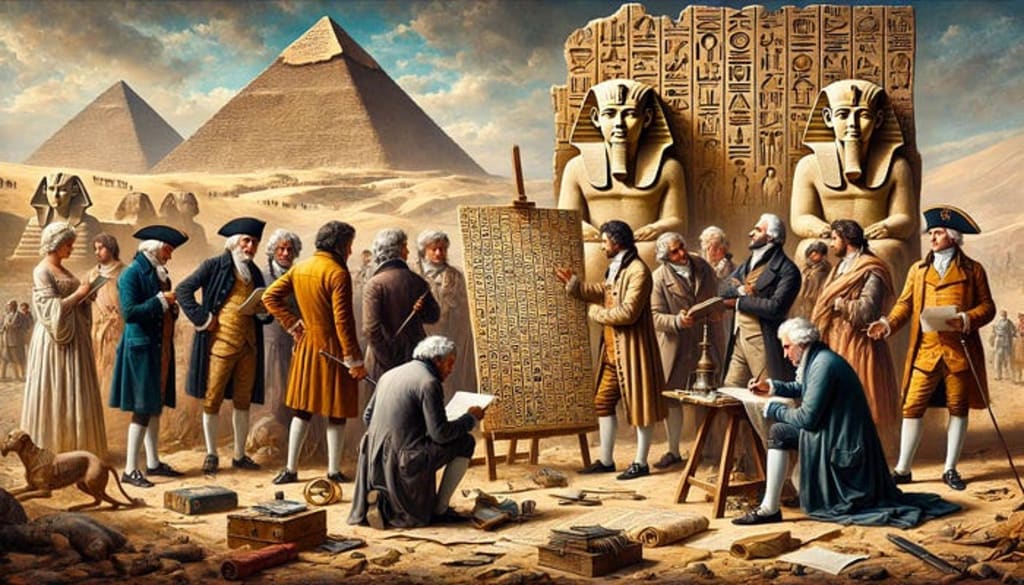
In addition to being a military operation, Napoleon Bonaparte's invasion of Egypt in 1798 changed the scientific landscape. It was an expedition of world-historic significance in the fields of archaeology and anthropology, botany, ophthalmology, and the general science of Egypt's ancient civilization. It was more than just a resounding failure of a campaign intended to obstruct British access to India and to increase French prestige in the Middle East. This expedition, which included Napoleon, was made up of about 150 academics, scientists, and intellectuals known as the "savants" who were dispatched to investigate, record, and analyse Egypt's rich historical and cultural heritage. This study by the savants marked the beginning of modern Egyptology.
Establishing the Institute of Egypt
When he reached Egypt, Napoleon realized that his mission would be successful not only in conquering the land militarily, but also in winning from Egypt, intellectually, its ancient heritage. In August 1798, Napoleon created what may be a unique institution, the Institut d'Egypte (Institute of Egypt) devoted itself to the study of Egypt's natural history and its ancient monuments. Scholars, from the areas of mathematics, physics, political economy and the arts, visited the Institute, which became the center of scientific learning and research. They were chiefly occupied in surveying and cataloguing the antiquities of Egypt, on which further work, of an archaeological and historical character, was based.
The savants had one of their primary goals to document Egypt's ancient structures and artifacts. As the first scientific and systematic discussion of Egypt's temples, pyramids, and tombs, their detailed sketches, measurements, and observations survive as faithful illustrations of their era. From iconic sites like the Great Pyramid of Giza, the Sphinx and the temples at Karnak and Luxor they made maps, drawings and descriptions which would prove useful to later generations of archaeologists. Without their efforts we would not have unveiled the knowledge that ultimately led to the genesis of Egyptology as an academic discipline.
Advancements in Archaeology and the Study of Ancient Egypt
And they, the French savants, made some of the most important archaeological discoveries of their time. Indeed, they documented and translated a large number of hieroglyphic inscriptions and other Egyptian artifacts. The most important of all the important discoveries is possibly the Rosetta Stone, discovered by French engineer Pierre-François Bouchard in Egypt, near Egypt's town of Rosetta in 1799. This large stone slab contained the same inscription in three scripts: Greek, hieroglyphic, and Demotic. Scholars understood the Greek portion of the text which was so important, because through the Greek you decoded their hieroglyphic script. The discovery of this began the modern study of the culture and the ancient Egyptian writing. The Rosetta Stone was finally captured for the British as a spoil of war, but its importance, in being one of the only pieces of ancient Egyptian language and literature that were able to be 'unlocked', cannot be under estimated.
Their research was also published in the monumental work Description de l'Égypte (1809–1829). Produced in both French and English editions, this extensive multi volume work detailed the geography, culture, monuments and natural history of Egypt. One of the most important scholarly works ever produced on ancient Egypt, combining the very best of the savants in archaeology and architecture to zoology and botany, it remains so. Without the Description de l'Égypte there would have been little spark to the now widespread European interest in Egyptian antiquities, and Egyptology would not have developed the way it has done.
Contributions to Ophthalmology
They did more than just study Egypt's monuments. They also made progress in the medical field especially with the eye ophthalmology. While in Egypt, the savants were befouled with trachoma, a highly infective eye disease that was known to exist in Egypt and elsewhere in the Mediterranean. It also made eyes became blind and infected. Their studies led to treatments for the disease and greater understanding of eye health and formed the base on which modern ophthalmology rests. One of France's contributions to the medical science was the research into trachoma; its causes and treatment.
Botanical and Zoological Discoveries
Besides on ancient culture the savants also wrote upon botany and zoology. Collecting and cataloging a tremendous number of plants and animals from the Egyptian landscape, the team did so. What they found, as part of their research, included species that had never been known to European scientists. The specimens were meticulously studied, traced and classified thereby contributing to the scientific community's stock in trade on Egypt's natural world. The savants included some botanists, one of whom was the noted French botanist Aimé Bonpland, who documented the plants in Egypt; many of the already rare species recorded during the bonanza would later be used by pharmacists and botanists in their research.
Among many previously unrecorded species of animals, the French scientists described species of animals in zoology. Their task was to investigate all the ecosystems of Egypt, such as the fauna of the Nile River, the deserts and the oases. They increased knowledge about Egypt's biodiversity, and their influence had long standing effects in the study of zoology and ecology.
The Legacy of the Scientific Expedition
Besides on ancient culture the savants also wrote upon botany and zoology. Collecting and cataloguing a tremendous number of plants and animals from the Egyptian landscape, the team did so. What they found, as part of their research, included species that had never been known to European scientists. The specimens were meticulously studied, traced and classified thereby contributing to the scientific community's stock in trade on Egypt's natural world. The savants included some botanists, one of whom was the noted French botanist Aimé Bonpland, who documented the plants in Egypt; many of the already rare species recorded during the bonanza would later be used by pharmacists and botanists in their research.
Napoleon's scientific endeavor in Egypt is an interesting point crossing scientifically curiosity with the military's ambition. Whatever their less successful status as military objectives, the intellectual legacy of the Egyptian campaign has been no less lasting in our interpretation of the ancient world. The discovery also aided future knowledge in archaeology, ophthalmology, botany and zoology, with the savants documenting with thoroughness, and thus making groundbreaking discoveries that set the tone of a lifelong love affair with Egypt as a result of the discovery.
About the Creator
Canva Pro Teams
In this page canva pro team links will be updated
Keep reading
More stories from Canva Pro Teams and writers in History and other communities.
China’s Golden Triumph: Unveiling the World’s Largest Gold Reserve
China makes groundbreaking revelation, claims world’s largest gold deposit worth $83 billion. This find alone is a geological marvel, let alone potential game changer for the world’s entire gold market, which is second only to the South Deep gold mine in South Africa with about 930 metric tons of gold.
By Canva Pro Teamsabout a year ago in History
6 Ancient Legends That Were Surprisingly Real
Humans are natural storytellers. For thousands of years, myths and legends have ignited our imagination, fed our souls, and passed wisdom from one generation to the next. While many of these tales are just that, stories, some are rooted in real events, revealing fascinating truths about our planet and the universe.
By Areeba Umaira day ago in History



Comments (3)
interesting post.
This piece is incredible.
I like these type of history very much. Please keep on post somr stories