
Nikola Tesla
The Visionary Who Powered the Modern World

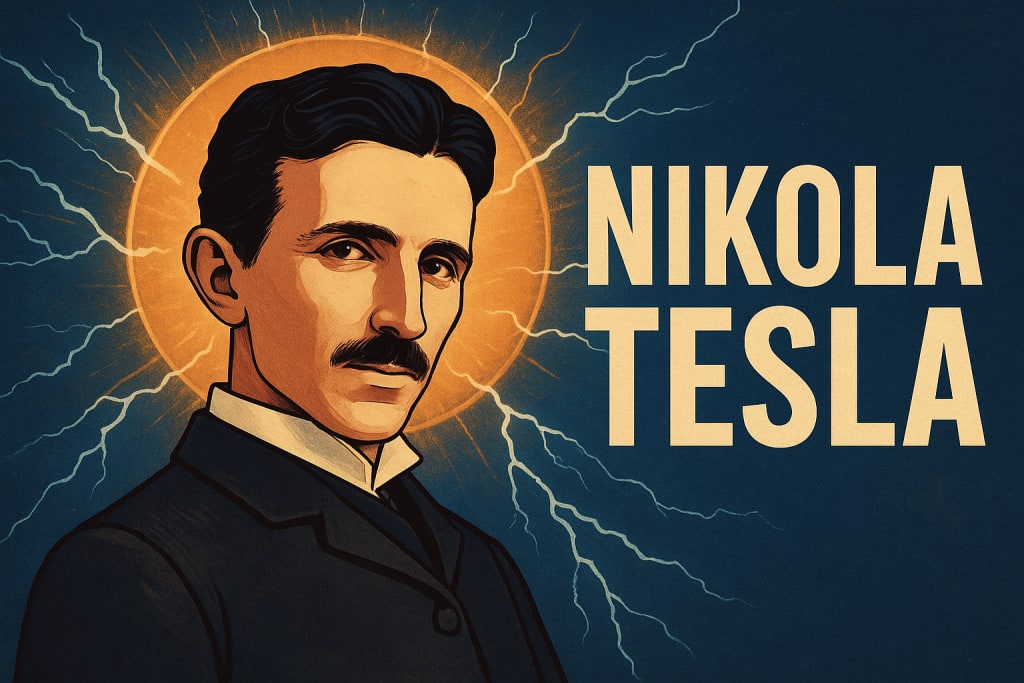
Nikola Tesla was the kind of genius who seemed to be living a century ahead of everyone else. Tall, eccentric, and endlessly imaginative, he dreamed of wireless power, remote control, robots, and global communication long before they were possible. Today, his inventions shape almost every aspect of modern life, yet he died nearly forgotten. His story is one of brilliance, struggle, triumph, and tragedy — the rise and fall of one of history’s most extraordinary minds.
Tesla was born at midnight during a thunderstorm on July 10, 1856, in the village of Smiljan, in what is now Croatia. According to family legend, the midwife said the lightning was a bad omen. Tesla’s mother replied, “No — this child will be a child of light.” As it turned out, she was right. From a young age, Tesla displayed a remarkable imagination. He had an unusual ability to visualize inventions clearly in his mind, rotating them in three dimensions and testing them mentally without ever drawing a sketch.
After completing engineering studies in Austria and Bohemia, Tesla worked briefly at a telegraph company in Budapest, where the idea that would define his career struck him: the concept of a rotating magnetic field. This insight became the foundation of the alternating current (AC) electrical system, which would later power the entire world.
Tesla moved to the United States in 1884 with four cents in his pocket and a letter of recommendation praising him as “a man of genius.” He began working for Thomas Edison, America’s famous inventor. But the two men clashed almost immediately. Edison favored direct current (DC), while Tesla knew AC could transmit electricity far more efficiently. Their disagreement sparked the infamous War of Currents, a bitter competition that pitted invention against invention and ego against ego.
Eventually, Tesla found support from industrialist George Westinghouse, who recognized AC’s potential. With Westinghouse’s backing, Tesla’s system triumphed. The success was sealed at the 1893 World’s Fair in Chicago, where the entire event was powered using Tesla’s AC technology — a dazzling demonstration that lit up the night sky and cemented Tesla’s legacy as a visionary engineer.
Tesla’s genius didn’t stop with electricity. He pioneered radio, remote control, X-ray experiments, fluorescent lighting, wireless communication, and even early ideas for robots and drones. In 1898, he stunned crowds in New York by demonstrating a radio-controlled boat — at a time when many didn’t even believe wireless signals were real. Some spectators thought he was using telepathy.
But Tesla’s greatest dream was more ambitious: he wanted to create a world where limitless energy could be transmitted wirelessly to everyone, everywhere. At Wardenclyffe Tower on Long Island, he attempted to build a global wireless power station that could transmit electricity and communication signals across the planet. However, the project collapsed when financier J.P. Morgan withdrew funding, famously asking, “If anyone can draw on the power, where do we put the meter?” Without money, the tower was abandoned and eventually demolished.
Despite his extraordinary mind, Tesla struggled with finances all his life. He was a perfectionist who cared more about ideas than money, often giving up lucrative patents to help others. His attention shifted constantly toward new visions — earthquake machines, bladeless turbines, death beams, anti-gravity aircraft — many far ahead of the technology of his time.
Tesla spent the last decade of his life living alone in a New York hotel room, feeding pigeons he considered his friends. Though he had once been the most celebrated inventor in America, he died on January 7, 1943, nearly penniless and largely forgotten by the public.
But history remembers geniuses differently.
In the decades following his death, Tesla’s contributions resurfaced and his reputation rose dramatically. Today, his AC system powers global electricity. Radios, smartphones, robotics, remote control, and countless modern technologies owe their origins to his imagination. His name now symbolizes innovation itself — appearing in books, documentaries, and even on one of the world’s most famous electric car companies.
Nikola Tesla’s life reminds us that great ideas often come from those who see the world differently. He was a dreamer, a rebel, a futurist, and above all, a believer in the power of imagination. While he did not live to see many of his visions realized, the world he envisioned — electrified, wireless, and interconnected — is the world we live in today.
About the Creator
The khan
I write history the way it was lived — through conversations, choices, and moments that changed the world. Famous names, unseen stories.
Alexander the Great – Part 1: Birth, Childhood, and the Making of a Future Conqueror
Birth in a Kingdom on the Rise Alexander was born in 356 BCE in the ancient city of Pella, the capital of the Kingdom of Macedon. At the time, Macedon was not considered the dominant power in Greece. However, this situation was rapidly changing under the rule of Alexander’s father, King Philip II. Philip was a brilliant military reformer and strategist who transformed Macedonia into a formidable kingdom.
By Say the truth 4 days ago in History
The Rise and Fall of Samson
Once, a young man walked the earth, and the earth itself seemed to listen when he did. His name was Samson, and his story was spoken first in whispers, then in fear, and finally in wonder. Long before his strength became legend, before enemies trembled at his shadow, he was only a child promised to God.
By Kelly Munala Brookesabout 18 hours ago in History
📢 Raise Your Voice Thread: 02/05/2026
Our “Raise Your Voice Threads” are hosted most alternating Thursdays at 12PM ET to offer creators more avenues to uncover exceptional stories on Vocal. As we are continuously searching for fresh creators and inspiring stories, this thread provides an opportunity to exchange and discuss the stories that have moved and motivated us on Vocal.
By Raise Your Voice by Vocal4 days ago in Resources


Comments
There are no comments for this story
Be the first to respond and start the conversation.