
Oscar 1973: Marlon Brando refused the statuette, Sasheen Littlefeather spoke and John Wayne was furious
On March 27, 1973, the 45th Academy Awards ceremony took place at the Dorothy Chandler Pavilion in Los Angeles. An evening full of stars, glittering gowns, and camera flashes became forever etched into the history of the film academy in one moment as one of the most controversial.

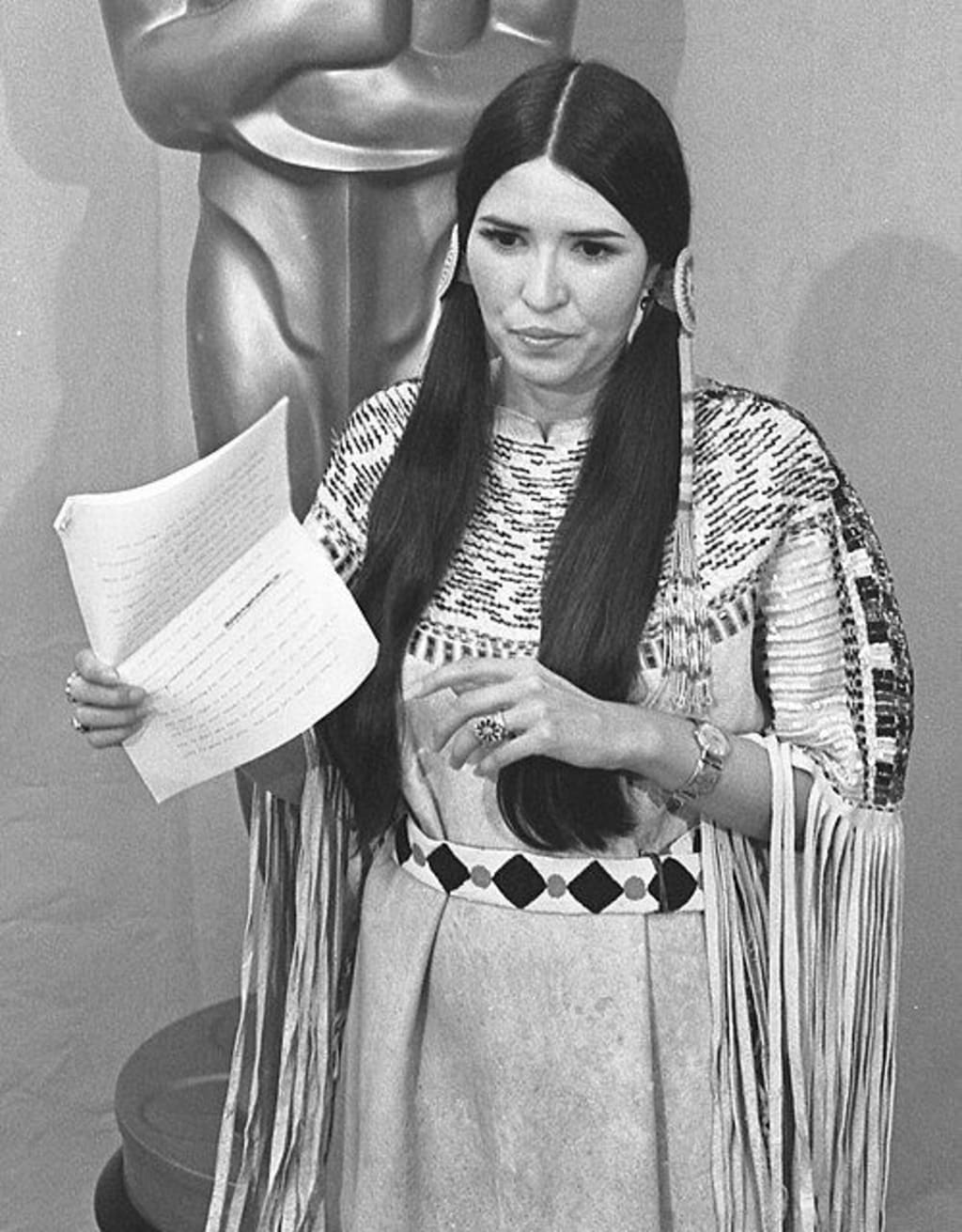
Marlon Brando, who won the Oscar for Best Actor in the film The Godfather, refused to accept the award. Instead, 26-year-old aspiring actress and Native American activist Sacheen Littlefeather took the stage, dressed in traditional Native American deerskin attire and moccasins. Her short speech sparked a storm of emotions: boos, applause, and fury from legendary actor John Wayne. However, this act of protest was far from just a Hollywood bid for attention.
What led Brando to this decision? Hollywood stereotypes and the Wounded Knee occupation
Marlon Brando, then 48 years old and known for his iconic roles, was no impulsive provocateur. For many years, he had been actively involved in civil rights advocacy and was a dedicated supporter of Native American rights. In 1964, he was even arrested during a protest against violations of fishing rights for the Puyallup tribe. In the 1970s, he focused particularly on how Hollywood portrayed Native Americans. Films often depicted them solely as savages, alcoholics, rapists, or traitors, and he believed this negative portrayal damaged the psyche of Native children and perpetuated racist prejudices.
The key trigger, however, was the occupation of the historic site of Wounded Knee in South Dakota. Just a month before the awards, activists from the American Indian Movement (AIM) occupied the village—where over 200 Lakota people had been massacred in 1890—to draw attention to broken treaties, corruption, and the systematic oppression of Native Americans. The protest lasted a full 71 days under siege by federal agents and ended in a violent clash that left two activists dead. Brando wanted to highlight this conflict, which symbolized centuries of injustice toward Indigenous peoples.
The day before the ceremony, Marlon Brando called Sacheen Littlefeather, whom he knew through her activism, and asked if she would go on stage in his place if he won. Littlefeather agreed, despite knowing it was a risky move. Brando gave her a long, carefully prepared speech. However, ceremony producer Howard Koch warned her that she had only 60 seconds, or she would be removed.
Sacheen Littlefeather and the speech that shook Hollywood
When Liv Ullmann and Roger Moore announced Marlon Brando as the winner for his role as Don Vito Corleone in The Godfather, the audience eagerly awaited his appearance. Instead, Littlefeather appeared. With a calm gesture, she declined the statuette, stepped to the podium, and in a steady voice said:
“Good evening. My name is Sacheen Littlefeather. I am of the Apache nation, and I am the president of the National Native American Affirmative Image Committee. I am representing Marlon Brando this evening, and he has asked me to tell you in a very long speech—which I cannot share with you presently because of time, but which I will be glad to share with the press afterwards—that he very regretfully cannot accept this very generous award. And the reasons for this being are the treatment of American Indians today by the film industry—excuse me—and on television in movie reruns, and also with recent happenings at Wounded Knee. I beg at this time that I have not intruded upon this evening, and that in the future, our hearts and our understandings will meet with love and generosity. Thank you on behalf of Marlon Brando.”
The audience reacted in a very mixed way—some booed, others applauded. Littlefeather later described seeing faces full of surprise and anger.
The full statement shared with the press: Brando's manifesto
After the ceremony, Littlefeather did as promised and shared the entire speech with journalists. It was a powerful manifesto on historical injustice, in which Brando wrote: “For 200 years we have said to the Indian people who are fighting for their land, their life, their families and their right to be free: ‘Lay down your arms, my friends, and then we will remain together.’ When they laid down their arms, we murdered them. We lied to them. We cheated them out of their lands. We starved them into signing fraudulent agreements that we called treaties but never kept. We turned them into beggars on a continent that gave life for as long as life can remember. And by any interpretation of history, however twisted, we did not do right. We were not lawful nor were we just in what we did.”
Brando also criticized Hollywood, stating: “The film industry is as responsible as anyone else for degrading Indians and ridiculing them, characterizing them only as savages, hostile, and evil. It is then very difficult to grow up in this world. When Indian children watch television and films and see their race depicted as it is, their minds are injured in ways we can never know.”
In conclusion, he wrote that the Academy Award was inappropriate under the circumstances until the situation for Native Americans improved, and that he would rather be at Wounded Knee to help prevent a “dishonorable peace.”
John Wayne's reaction: Fury from the Western legend
One of the most dramatic moments was the reaction of John Wayne, then 65, a veteran of Westerns where Native Americans often played villain roles. According to Littlefeather, Wayne—standing backstage—was so enraged that he tried to storm the stage and forcibly remove her. “He had to be restrained by six security men to prevent it from happening,” she described in interviews. Wayne later said that Brando should have come himself to voice his opinion, instead of “dressing up some unknown girl in Indian clothes.”
This incident is often called one of the “most violent moments” in Oscars history, even though no physical contact occurred. Wayne represented the old guard of Hollywood, who saw the protest as an insult to the entire film industry.
Apology after 50 years and lasting impact
Brando's protest sparked outrage. Sharp criticism followed, with words like “hypocrite” or “grandstanding.” But the harshest consequences fell on Sacheen Littlefeather. Not only did she face mockery and open insults—including sarcastic remarks from Raquel Welch and Clint Eastwood—but her appearance effectively closed the doors of Hollywood to her forever; she never received another role offer. Still, the protest struck a sensitive chord and opened a topic that could no longer be ignored. Even so, it took another 50 years before the film Academy officially apologized in 2022 for the treatment she endured at the time.
Over the following decades, this bold and dignified protest became one of the most powerful moments in Oscars history. It showed that golden statuettes are not just symbols of cinematic glory but can become a platform where the voices of those long silenced can be heard. Today, this moment is seen as a groundbreaking symbol of the fight against racism and stereotypes in Hollywood—and as an enduring inspiration for activists, artists, and entire generations who believe that fame and responsibility can go hand in hand.
Marlon Brando never regretted it until the end of his life. When asked if he would do it again, he replied unequivocally: “It wasn’t a mistake. It was the right thing to do.”
About the Creator
Keep reading
More stories from Elvira Diggory and writers in History and other communities.
Operation Vegetarian: The Secret Plan That Was Supposed to Starve Germany and Destroyed Gruinard Island
The reason was its role during the Second World War, when its isolated location made Gruinard the ideal site for Britain's first open-air tests of biological weapons.
By Elvira Diggory19 days ago in History
Why Russia Never Went Back to Planet Venus
In 1960, when the entire world had its eyes fixed on America’s Apollo missions, something terrifying was happening on our neighboring planet, Venus. The Soviet Union—today’s Russia—was secretly planning what could only be called suicide missions to Venus. After spending billions of dollars and years of effort, they built probes designed to do something unprecedented: land on another planet and capture its images.
By Imran Ali Shah3 days ago in History
The Cairn Beside the Lake
And so it came to pass that King Ertharion, Tenth King of Lombaia, stood beside the still lake below unrelenting and unassailable cliffs with the remainder of his harried host. In what was the tenth year of his reign and his forty-fourth upon this great green earth, Menigo the Betrayer, cousin of King Ertharion, pressed home his false claim.
By Matthew J. Fromm3 days ago in Fiction



Comments
There are no comments for this story
Be the first to respond and start the conversation.