

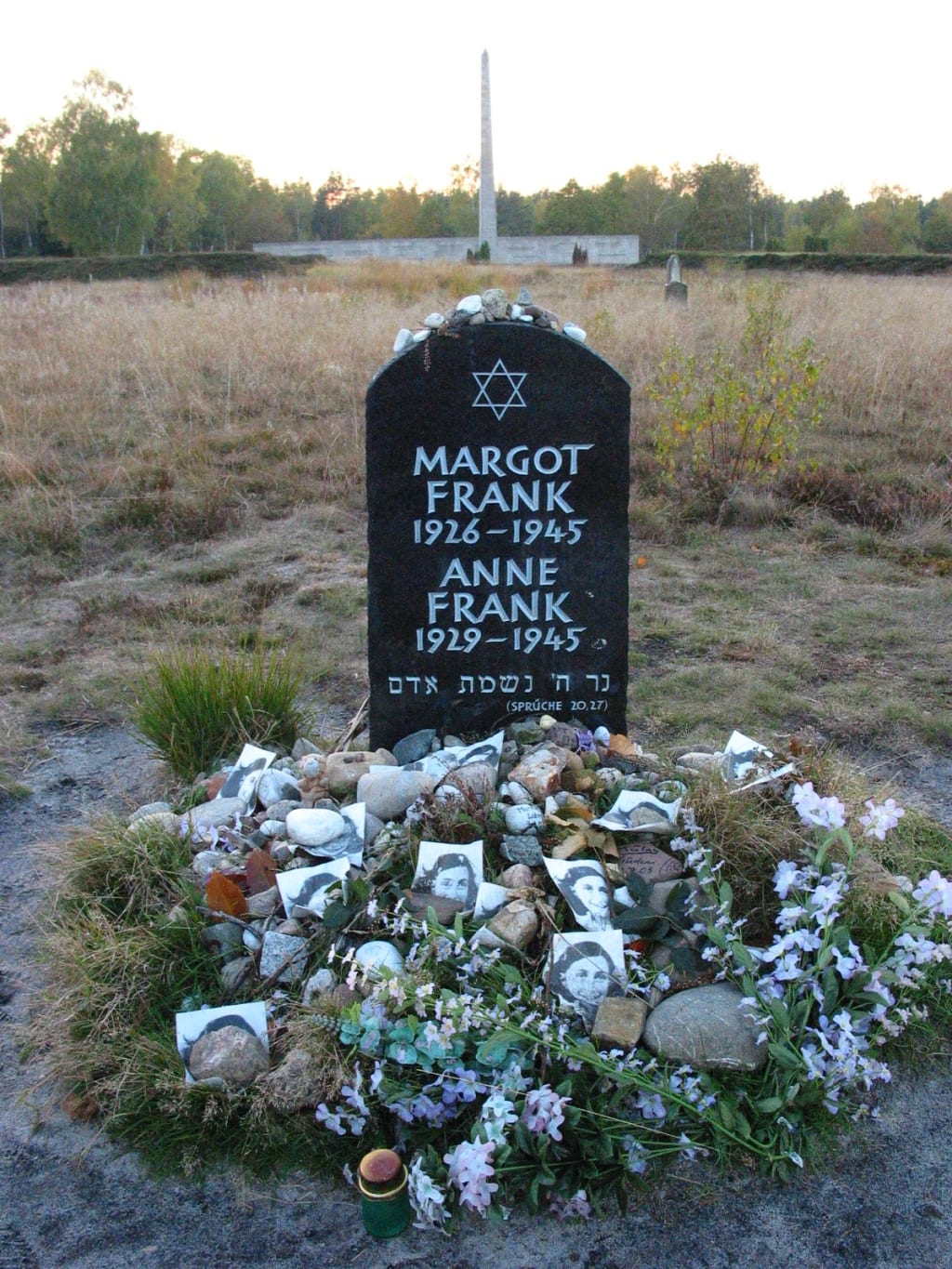
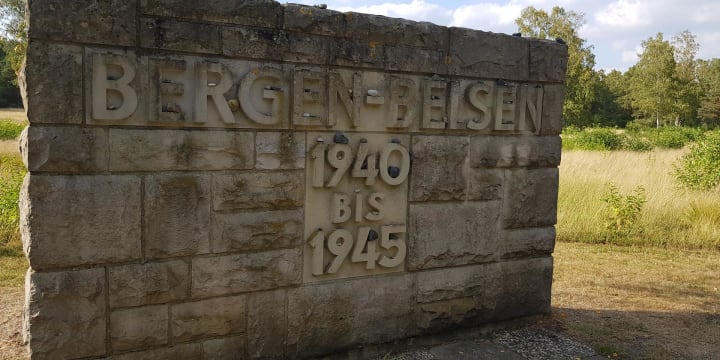
I recently wrote about comparing modern people to Nazis. This was shortly after visiting the site of the Bergen Belsen concentration camp. One of the things the guide told us resonated with me, children, soldiers and visiting soldiers come here as a warning. They are shown around the camp, the mass graves and the memorials, part of the past is revealed. Its to warn people of something that happened and a warning ever to let it happen again.
The tour guided always called the people that worked there as Nazis, a different group of people compared to regular Germans. with Hitlers propaganda about how well Germany was doing that many Germans wouldn’t have known about the concentration camps until the end of war. Even then, some were still known as prisoner of war camps, something you might expect in a war.
It was later in the war that Bergen Belsen changed from a prisoner camp to a concentration camp. Though in a relatively short time they still managed to kill thousands and keep people in squalor so many more died of illness. When the camp was taken over at the end of the war the huts were burned to prevent disease spreading outside the camp, soldiers needed to bury hundreds who were scattered around the camp.
Its incredibly eerie as you go in, you start at the place the fence went round the camp. The boundary line still remains, a gap in the trees. As the guide describes the bodies that would have been pile up and the hundreds stuffed in cabins its easy to imagine them. The cabins are gone but their footprints remain, you can see how small they were.
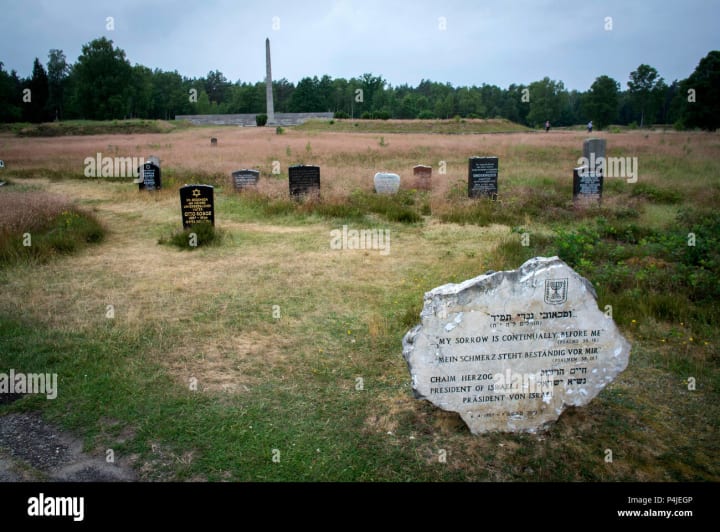
The above grave stones were added after the war, simply to remember who died there. As everyone ended up in one of the mass graves the stones are simply near various grave sites. The mass graves have signs saying if they contained 3 thousand or 5 thousand bodies or remains from the crematorium. Archaeologists had asked if they could try and find Anne Franks body using DNA testing. They were not allowed, as the huts were burned so were the records. There is a large stone by the main memorial area stating the numbers who died from certain groups.
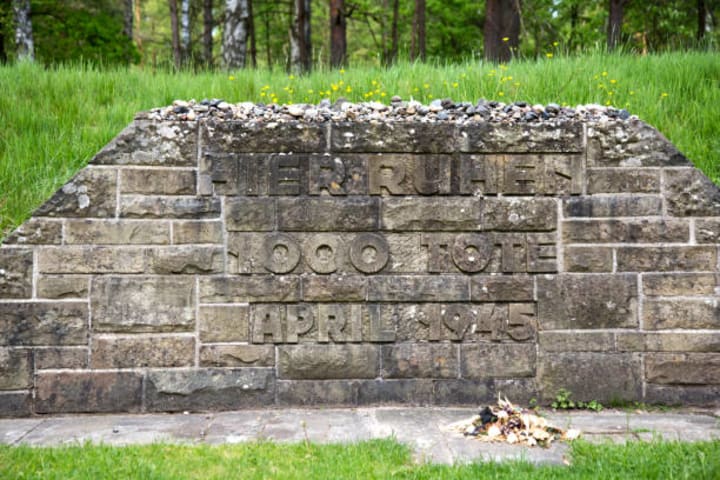
This is just one of the mass graves, as you can see the number in it is an approximation. While looking for the right pictures I found many of open mass graves with hundreds of dead being piled on top of each other . I will let you, dear reader, find them yourselves if you wish. They are truly sickening so approach with care.
This says it all really, thousands upon thousands killed, and this was one of the smaller camps. Even though there is little of the original camp there its still strange walking round it. You can see the trees around the site and inside, you can see where the graves are and you can see groups walking round , mainly in silence.
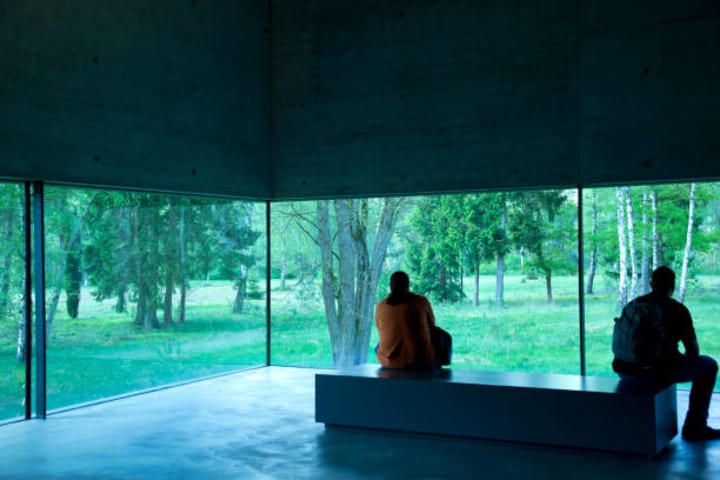
My wife sat on this bench in the museum and just stared out, lost in anger and sadness. We had walked where thousands had walked, the difference is that we managed to leave. Another thing the guide showed us was there were lots of trees but no birds. The trees outside were full, inside were empty. In the museum there are stories of people who died there, along with some more distressing photos.
The reason to write this is two fold, to educate in 2 different ways. Both of my children have autism and learning delay. This means they cant sit and listen to a teacher and then write down information from a board. Therefore we as parents took them places to show the things they had learned about. Showed them where henry V111 lived and where the battle of Hastings took part. There was nothing remaining from the battle except the hill it took part on. We had an audio tour and immediately we felt part of everything. Above all my kids learnt something extra.
My point about first hand learning is more specific. The guide told us how he visited the camp as a child, how local based soldiers and the bus trips are regular to the site. You get to see first hand what happened, with the warning for it never to be allowed to happen again. When we went there was a group of Dutch soldiers standing by one of the memorials. They were based in another part of the site, with German soldiers. An added extra to the tour was some of the other resident soldiers were practising with shells and machine guns. Therefore there was the constant sound of explosions and bullets flying, just to make it more real.
History was one of my school subjects, I learned a lot about the second world war and new of the concentration camps. Nothing before had the same effect as visiting a camp, walking the same paths and breathing the same air. The trees had obviously been there at the same time. This is how to teach an old dog like me or an older child the reality of life, only 80 years ago. These are the stories that need to be passed on, must be learnt by all as a warning. Mentioning no names, there’s a big orange president who maybe should visit and learn.
About the Creator
ASHLEY SMITH
England based carer, live with my wife, her parents and 4 cats. will write for all areas but especially mental health and disability. though as stuff for filthy seems popular will try there . any comments, suggestions or requests considered
Keep reading
More stories from ASHLEY SMITH and writers in History and other communities.
listen
Listen, focus and concentrate. I am going to explain to you what happened and why. It hurts me to remember it and hurts more to say it out loud. So this will be the full sorry tale, there will be all the information you need and at the end there should be no questions. If I miss anything out you will have to ask someone else. I am getting old and tired, just want to get a few things off my chest before I go.
By ASHLEY SMITH2 months ago in Fiction
The Biggest Unsolved Mysteries in History That Still Baffle the World
1. The Disappearance of the Indus Valley Script The Indus Valley Civilization, which flourished around 2500 BCE in present-day India and Pakistan, was one of the world’s earliest urban societies. It boasted advanced city planning, sophisticated drainage systems, and standardized brick construction. However, one of its greatest mysteries is its undeciphered script. Thousands of inscriptions have been found on seals, pottery, and tools, yet no one has been able to decode their meaning. Unlike Egyptian hieroglyphs or Mesopotamian cuneiform, the Indus script lacks a bilingual inscription that could serve as a key. Without understanding their language, historians remain uncertain about their political systems, religious beliefs, and even the reasons behind the civilization’s decline. 2. The Lost City of Atlantis First mentioned by the Greek philosopher Plato around 360 BCE, Atlantis was described as a powerful and technologically advanced civilization that sank into the ocean “in a single day and night of misfortune.” Ever since, Atlantis has captured the imagination of scholars, explorers, and conspiracy theorists. Some believe Atlantis was purely allegorical—a moral lesson created by Plato. Others argue it may have been inspired by real events, such as the volcanic destruction of the Minoan civilization on the island of Thera (Santorini). Despite centuries of searching, no definitive archaeological evidence has proven Atlantis existed, leaving it suspended between myth and history. 3. The Construction of the Great Pyramids of Giza The Great Pyramids of Egypt, built over 4,500 years ago, remain among the most astonishing architectural feats in human history. The largest, the Pyramid of Khufu, consists of over two million stone blocks, some weighing more than 80 tons. The mystery lies not in who built them, but in how they were constructed with such precision using ancient tools. How were massive stones transported across vast distances? How were they lifted and placed so accurately? While theories range from ramps to complex pulley systems, no single explanation fully satisfies all the evidence. The pyramids continue to challenge our understanding of ancient engineering capabilities. 4. The Voynich Manuscript Discovered in 1912 by rare book dealer Wilfrid Voynich, the Voynich Manuscript is a handwritten book filled with strange illustrations, unknown symbols, and an indecipherable script. Radiocarbon dating places its creation in the early 15th century. Despite intense analysis by cryptographers, linguists, and even artificial intelligence, the text remains unreadable. Some believe it is a sophisticated code, others think it represents a lost language, while skeptics argue it could be an elaborate hoax. The manuscript’s purpose—whether medical, astronomical, or magical—remains one of the greatest puzzles in literary history. 5. The Amber Room Often referred to as the “Eighth Wonder of the World,” the Amber Room was a chamber decorated with panels made entirely of amber, gold leaf, and precious stones. Created in Prussia in the early 18th century, it was later gifted to Russia and installed in the Catherine Palace. During World War II, Nazi forces dismantled the room and transported it to Königsberg. After the war, it vanished without a trace. Countless searches have failed to locate it, leading to theories that it was destroyed, hidden in underground bunkers, or lost at sea. Its fate remains one of the most enduring art mysteries of modern history. 6. The Identity of Jack the Ripper In 1888, a series of brutal murders terrorized London’s Whitechapel district. The killer, known as Jack the Ripper, murdered at least five women and vanished without being identified. Despite numerous suspects proposed over the years—ranging from doctors and artists to members of the royal family—no conclusive evidence has ever confirmed the killer’s identity. Advances in forensic science, including DNA analysis, have reopened the case multiple times, yet the truth remains elusive, preserving Jack the Ripper as history’s most infamous unidentified criminal. 7. The Nazca Lines Etched into the desert plains of southern Peru, the Nazca Lines are enormous geoglyphs depicting animals, plants, and geometric shapes. Created between 500 BCE and 500 CE, these figures are best seen from the air. The mystery lies in their purpose. Were they astronomical calendars, religious symbols, irrigation markers, or ceremonial pathways? How did the Nazca people design such large-scale drawings without an aerial perspective? While scholars lean toward ritualistic and astronomical explanations, no definitive answer has been found. 8. The Fate of the Roanoke Colony In 1587, English settlers established a colony on Roanoke Island in present-day North Carolina. When supply ships returned three years later, the entire settlement had vanished. The only clue left behind was the word “CROATOAN” carved into a post. There were no signs of violence or struggle. Theories suggest the settlers may have assimilated with Native American tribes, relocated, or perished due to disease or famine. Despite extensive research, the true fate of the “Lost Colony” remains unknown. Why These Mysteries Endure What makes these mysteries so compelling is not just their unanswered questions, but what they reveal about humanity. They highlight the limits of our knowledge and remind us that history is not a complete record, but a fragmented story shaped by time, loss, and interpretation. Even with satellites, artificial intelligence, and advanced archaeology, some truths remain just out of reach. These unsolved mysteries continue to inspire research, debate, and imagination, proving that the past is far from silent—it is waiting for us to listen more closely.
By Say the truth 2 days ago in History



Comments
There are no comments for this story
Be the first to respond and start the conversation.