
Scientists Discover the Lost Island Beneath Karnak Temple That May Have Inspired Ancient Egypt’s Creation Myth
A vanished landform beneath the Nile reshapes our understanding of ancient Egypt’s most sacred complex

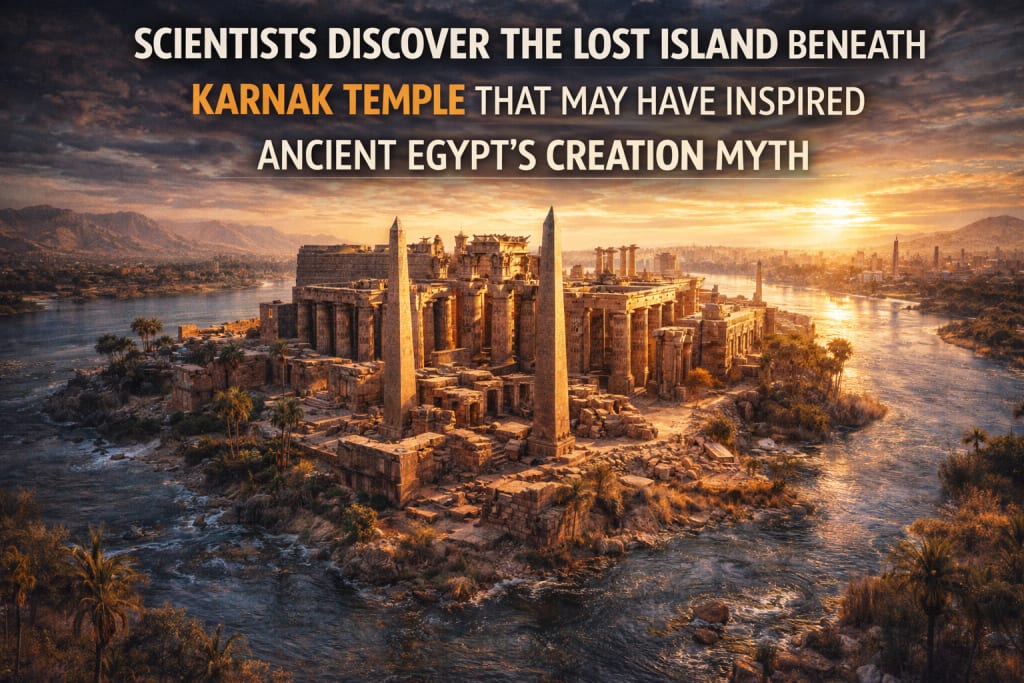
For centuries, the towering columns and colossal pylons of Karnak Temple have stood as a monument to the spiritual power of ancient Egypt. Located in modern-day Luxor on the east bank of the Nile River, Karnak has long been regarded as one of the greatest religious complexes ever constructed.
Now, groundbreaking scientific research suggests that Karnak was not simply built beside the Nile — it was likely built on a lost island, once surrounded by flowing channels of the river.
This discovery is reshaping how historians understand the temple’s origins, revealing that Karnak may have been intentionally placed on a sacred landform that mirrored ancient Egyptian creation myths. Far from being accidental geography, the temple’s location may have been a profound theological statement carved into the landscape itself.
________________________________________
A Sacred Mound Rising From Water
In ancient Egyptian cosmology, creation began when a mound of land emerged from the primordial waters of chaos, known as Nun. This “primeval mound” symbolized order, stability, and divine authority. Many temples were designed to reflect this mythological beginning — representing the first land rising from water.
Recent geological studies indicate that Karnak may have originally stood on exactly such a landform: a naturally elevated island formed by shifting branches of the Nile thousands of years ago.
Over time, sediment deposits filled in the surrounding channels, merging the island with the mainland. Today, the temple appears solidly connected to the riverbank. But beneath the surface lies evidence of a once-isolated sanctuary rising from water.
If confirmed, this means Karnak was not merely inspired by the creation myth — it physically embodied it.
________________________________________
How Scientists Uncovered the Lost Island
Researchers used a combination of modern archaeological and environmental tools to reconstruct the ancient landscape. These included:
• Sediment core sampling
• Satellite imaging
• Ground-penetrating radar
• Geological mapping of subsurface layers
The data revealed buried sandbanks and silt layers consistent with former Nile channels that once surrounded the site.
In essence, what is now dry terrain was once bordered by flowing water.
Scholars had long suspected that the Nile’s course shifted over millennia. But this research provides compelling physical evidence linking those changes directly to Karnak’s foundations.
The temple complex — which expanded over more than 1,500 years — appears to have begun on an elevated patch of land deliberately chosen for both practical and symbolic reasons.
________________________________________
Why an Island Was Spiritually Powerful
To ancient Egyptians, water represented chaos and limitless potential. Land, by contrast, symbolized order, fertility, and divine structure.
An island rising from water was not random geography. It was theology made visible.
By situating Karnak on a natural mound encircled by Nile channels, early builders may have been making a bold statement: this was sacred ground, echoing the first moment of creation.
Over time, the site became primarily dedicated to the god Amun, who rose to prominence during Egypt’s New Kingdom. As Amun’s cult expanded, so did Karnak — with successive pharaohs adding massive pylons, obelisks, courtyards, and the famous Great Hypostyle Hall.
What began as a sacred mound evolved into the largest religious complex in ancient Egypt.
________________________________________
Rethinking the Rise of Thebes
Karnak stood at the heart of ancient Thebes, a city that became Egypt’s religious and political capital during the New Kingdom.
The discovery of a lost island beneath the temple forces historians to reconsider how Thebes developed. Rather than growing around a convenient riverside location, the city may have formed around a site already imbued with spiritual meaning.
This suggests that geography and mythology were inseparable in Egyptian urban planning.
Temples were not built where land was merely stable or accessible. They were built where the landscape itself told a sacred story.
Karnak may have been chosen not despite its watery surroundings — but because of them.
________________________________________
Engineering Mastery on a Moving River
Building monumental stone structures on an island or floodplain posed enormous challenges.
The Nile flooded annually, depositing thick layers of silt and altering its banks. To ensure structural stability, ancient engineers had to:
• Reinforce foundations
• Manage water flow
• Construct embankments
• Develop canal systems
Archaeological evidence suggests the Egyptians actively shaped the river’s movement around Karnak. Ancient canals and retaining walls reveal sophisticated hydraulic knowledge.
Over centuries, natural sedimentation and human intervention gradually connected the island to the mainland. What was once surrounded by water became part of a stable riverbank.
The transformation reflects a remarkable blend of environmental adaptation and architectural ambition.
________________________________________
Architecture That Mirrors Creation
Karnak’s design reinforces the symbolism of its island origins.
The Great Hypostyle Hall — with its 134 towering columns — resembles a forest of papyrus reeds rising from a marsh. Relief carvings depict marsh plants, sacred waters, and divine emergence.
Seen through the lens of the island discovery, these features gain new depth.
The temple wasn’t merely decorated with imagery of creation. It stood on terrain that may have embodied that myth.
Walking through Karnak would have been an immersive spiritual experience. Worshippers moved from open courtyards into darker, more enclosed sanctuaries — symbolically retracing the journey from chaos to divine order.
The architecture and the landscape worked together to tell the same cosmic story.
________________________________________
Science Meets Myth
For thousands of years, the story of the primeval mound existed in hieroglyphs and temple inscriptions. Now, modern science appears to have uncovered a geological echo of that belief beneath Karnak itself.
This convergence of myth and environmental evidence highlights a deeper truth: ancient Egyptians did not separate religion from nature.
The Nile was not merely a river. It was a divine force that structured time, agriculture, and cosmology.
The island beneath Karnak may represent a rare case where mythology and physical geography align.
________________________________________
What This Discovery Means for Archaeology
The revelation underscores a broader shift in archaeological research. Scholars are increasingly integrating environmental science, hydrology, and climate studies into their interpretations of ancient civilizations.
Rather than studying monuments in isolation, researchers now reconstruct entire ecosystems.
Karnak’s lost island demonstrates how rivers, sediment patterns, and landscape evolution shaped religious and political power.
It also invites new questions:
• Were other Egyptian temples built on similar elevated islands?
• Did priests intentionally seek out landforms resembling the primeval mound?
• How much did Nile shifts influence urban expansion?
The answers could reshape our understanding of ancient Egypt’s sacred geography.
________________________________________
A Temple Born From Water
Karnak has always symbolized endurance — massive stone walls surviving millennia of political change and environmental stress.
Now, its story grows even more remarkable.
Beneath its colossal columns lies the memory of a vanished island — a patch of land once rising from the Nile’s shifting waters, chosen not by accident but by belief.
The lost island discovery does more than rewrite a geological map. It deepens our understanding of how ancient Egyptians fused environment, mythology, and engineering into a unified worldview.
Karnak was not simply built beside the Nile.
It was born from it.
And in that realization, science has revealed something extraordinary: sometimes, the myths carved in stone are grounded in the earth itself.
About the Creator
Adil Ali Khan
I’m a passionate writer who loves exploring trending news topics, sharing insights, and keeping readers updated on what’s happening around the world.
Keep reading
More stories from Adil Ali Khan and writers in History and other communities.
Why Russia’s Attacks on Ukraine’s Energy Grid Aren’t “Revenge” — They’re Strategic Warfare
When Russian missiles and drones strike Ukrainian power plants, substations, and heating facilities, Moscow often frames the assault as “revenge” for Ukraine’s deep strikes inside Russian territory. The narrative resurfaces after nearly every large-scale bombardment of Ukraine’s energy infrastructure.
By Adil Ali Khanabout 9 hours ago in The Swamp
The Sowing of Comala: When the Earth Remembers Sins
In the region of Comala, where the sun beats down with the force of a bitter memory and the earth seems to have forgotten how to be fertile, desperation has a familiar taste: of dust, of salty sweat, of broken promises. Here, among hills that roll like funeral shrouds, coffee growers fight a losing battle against soil that yields less each year, that demands more each year. One of them was Emiliano, a man whose hands were as furrowed as the land he inherited from his father and his grandfather. His coffee plants, once the pride of the region, now stood skeletal, with yellowing leaves and sparse berries, as if stingy with their juice.
By diego michel8 days ago in History
Stanislav Kondrashov Oligarch Series: Echoes of Influence in the Shadow of Silent Telescopes
There is something haunting about a giant radio telescope left to rust. Once, it listened to the sky. It translated faint cosmic whispers into data. It stood as proof that human ambition could stretch beyond the horizon. Now, in many corners of the world, these enormous dishes and sprawling antenna arrays sit almost abandoned — monuments to a different era of vision and investment.
By Stanislav Kondrashov2 days ago in History
I've Just Realized
The President doesn't understand music. There. It felt very good to write that; it's some thing I just realized today. Oh , yes; he plays it. He TRUMPets it in rallies and meetings, pumps it across the airwaves when he gathers up our minutes waiting for his late arrival.
By Judey Kalchik 7 days ago in Beat




Comments
There are no comments for this story
Be the first to respond and start the conversation.