
The Cry of a Mother — The Justice of Caliph Umar (RA)
A true story of Hazrat Umar ibn al-Khattab
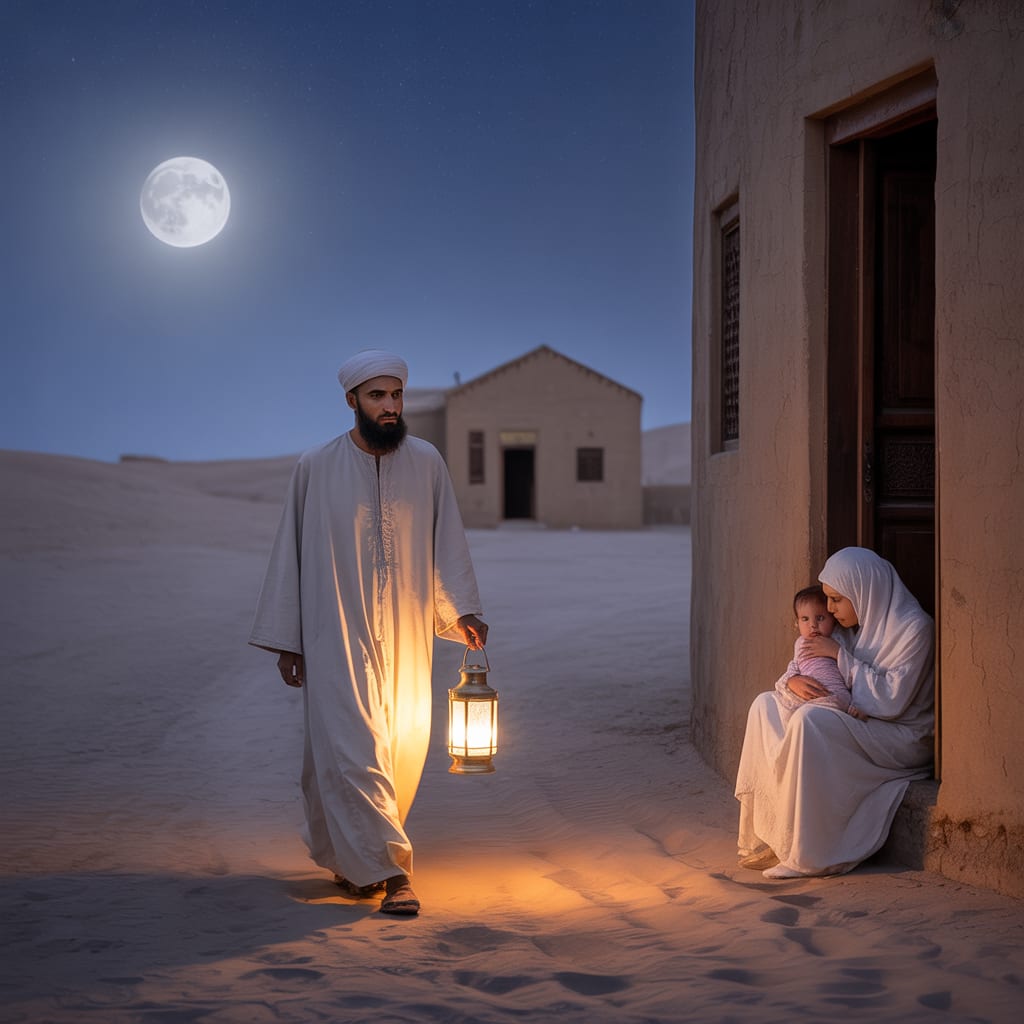
Most of the city slept peacefully, but one man — the leader of an entire empire — walked quietly in the shadows.
He was Umar ibn al-Khattab (RA), the second Caliph of Islam — a man whose name once struck fear in the hearts of tyrants, yet who now roamed the streets like a humble servant, unseen and unknown.
Umar could never rest easily in his bed while his people slept hungry. He believed that every cry, every sigh, and every injustice in his land was his responsibility. “If even a single mule stumbled on the road in Iraq,” he once said, “I fear Allah would question me about it.”
So, on this calm night, dressed in plain clothes and carrying only a lantern, Umar walked with his loyal companion Aslam. They wandered through the alleys, listening — for in silence, the truth of people’s lives could often be heard.
As they walked past one of the poorest neighborhoods, Umar’s ears caught a faint sound — the soft, desperate crying of children. He stopped immediately. The sound came from a small clay house on the edge of the city.
He moved closer, careful not to startle anyone. Through a gap in the wall, he saw a dim light flickering inside, and beside it sat a woman stirring a pot over a weak fire. Three small children sat around her, their faces thin, their eyes glistening with tears.
Umar stepped forward and gently greeted her, “Assalamu Alaikum, O servant of Allah. May I ask, why are your children crying?”
The woman looked up, her face tired and lined with pain. She didn’t recognize the man standing outside her home — how could she know it was the Caliph himself? She sighed deeply.
“They are hungry,” she said, her voice breaking. “I have nothing to feed them. So I put water in this pot, pretending to cook, hoping they’ll fall asleep thinking food is coming.”
Umar felt a stab of pain in his chest. “But why have you not asked the Caliph for help?” he asked softly.
The woman’s tone changed — a mixture of anger and sorrow.
“Because the Caliph should know the condition of his people!” she said bitterly. “If he were a true leader, he would not let us starve. He does not deserve to be called the Commander of the Faithful if he does not care for the faithful!”
Those words pierced Umar’s heart like a sword. Tears welled in his eyes. He turned to Aslam and whispered,
“Come. Let us go to the Bayt al-Mal.”
They hurried through the sleeping streets until they reached the public treasury — the place where food and goods were stored for the needy. Umar went inside and picked up a heavy sack of flour and a small pouch of dates.
Aslam, seeing the Caliph lift such a heavy load, quickly stepped forward.
“O Amir al-Mu’minin, let me carry it for you.”
But Umar shook his head firmly.
“No, Aslam,” he said. “Will you carry my burden on the Day of Judgment? It is I who must answer before Allah for these people. Let me carry it myself.”
Aslam could not argue. He watched as the Caliph — the ruler of the greatest empire on earth — hoisted the sack of flour onto his own back. His strong shoulders bent under its weight, yet he did not complain. Each step he took was heavy, but his heart was light, filled with purpose.
When they reached the woman’s house, Umar placed the flour and dates near her fire. Without saying who he was, he knelt down and began to help her cook.
He poured flour into the pot, added the dates, and stirred the mixture. As the fire dimmed, he bent down and blew into the embers to make them glow. His beard caught the light of the flames; sweat rolled down his forehead.
Aslam, standing nearby, watched in awe. The Caliph of the Muslims — the same man who ruled over lands stretching from Persia to Egypt — was now blowing on a poor woman’s fire, so her children could eat.
Soon, the aroma of warm food filled the little house. The woman called her children, and they eagerly began to eat. Their cries turned into laughter. They smiled and giggled, their eyes bright with joy.
Umar watched them with a soft smile. His heart felt at peace for the first time that night.
Aslam then asked him, “O Amir al-Mu’minin, now that they have eaten, shall we go?”
Umar said quietly, “Not yet. I will stay here until I see them smile and play as they did before. I do not want them to think hunger is their only friend.”
So they waited. Umar sat on a rock near the hut, watching the children laugh and the mother’s face fill with relief. Only when he was sure they were content did he stand up.
Before leaving, the woman said gratefully,
“May Allah reward you, stranger. You are kinder than the Caliph himself.”
Umar smiled gently and replied,
“Pray for him, sister. Perhaps he is not as bad as you think.”
Then, without revealing his identity, he turned and disappeared into the night.
The next morning, when the woman later came to the mosque for charity, she saw Umar sitting among his companions. To her shock, she realized — this was the same man who carried food to her home.
Her eyes filled with tears. “Forgive me, O Amir al-Mu’minin,” she said, trembling. “I did not know who you were.”
Umar rose and comforted her with kindness. “You did nothing wrong,” he said. “It is I who must seek forgiveness — for if even one person in my land sleeps hungry, I am the one accountable before Allah.”
The Lesson of Leadership
That night became one of the most famous moments in Islamic history — the night when the ruler of an empire carried flour on his back, cooked food with his own hands, and served the hungry with humility.
Hazrat Umar (RA) taught the world that true leadership is not about titles or thrones, but about responsibility, empathy, and service. He believed that a ruler must live among his people, feel their pain, and ease their suffering — not as a king above them, but as a servant among them.
In his life, justice was not written in books — it was lived in the streets of Madinah. And for generations to come, Muslims remembered him not just as a Caliph, but as the shining symbol of justice, humility, and compassion.
About the Creator
Why Does the United States Want Greenland? Trump, Resources and the New Arctic Power Struggle
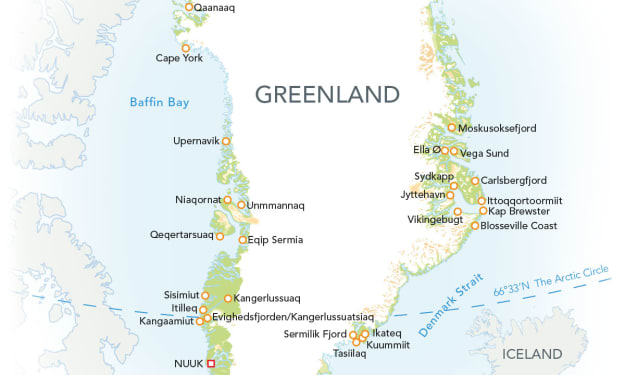
The desire to seize control of the world is not new. Throughout history, various adventurers and conquerors have attempted this, yet none succeeded in conquering the entire globe. Several figures did manage to capture large parts of the world, including Alexander the Great, Genghis Khan, and Sultan Mehmed the Conqueror. In recent history, a similar attempt was made by Adolf Hitler. However, Hitler’s primary objective was not to conquer the whole world; rather, his main goal was to occupy Eastern Europe and Russian territories in order to create “living space” for the German race. These days, comparable ambitions seem to be stirring in the heart of President Donald Trump. The real-estate investor within him appears eager to take control of vast territories. After Venezuela, his eyes are now fixed on Greenland—indeed, it would be more accurate to say that his covetous gaze has fallen upon Greenland, the world’s largest island, though not a continent. The name Greenland was introduced by Scandinavian settlers. It is a Danish word meaning “land of people.” This autonomous country is part of the Kingdom of Denmark and lies between the Arctic Ocean and the Atlantic Ocean. Its area is 2,166,000 square kilometers, of which 1,755,000 square kilometers—about 81 percent—is covered by ice. Its population is roughly 57,000. The history of Greenland dates back to 2500 BC, evidence of which still exists in the form of archaeological remains. Over the centuries, beginning in 986 AD, the western coast of Greenland was settled by people from Iceland and Norway. Some of these settlements survived for centuries, while others disappeared in the fifteenth century, possibly due to famine or conflict. In 1721, a major expedition was launched in which Norwegian missionaries and others traveled to Greenland. In July 1931, Norway declared eastern Greenland an uninhabited region and occupied it. Denmark took the case to the International Court in 1933, which ruled against Norway. During the Second World War, Greenland’s connection with Denmark was severed when Germany occupied Denmark. The United States then assumed responsibility for Greenland’s defense, returning control to Denmark after the war. During the Cold War, the U.S. established military bases in northern Greenland, turning the island into a strategic front between global powers. The minerals hidden beneath the ice, the opening Arctic sea routes, and geopolitical rivalry transformed Greenland from merely a geographic entity into a center of politics and power. In 1979 Denmark granted Greenland limited autonomy but retained control over defense, foreign affairs, currency, and economic matters. By the late twentieth and early twenty-first centuries, Greenland gained greater self-rule and established a local government, yet it remains part of the Danish realm. This raises the question: what is it about Greenland that makes the United States want to seize it? First, Donald Trump is not the first U.S. president to show interest in Greenland, though he is arguably the first to speak of capturing it by force. The United States considered purchasing Greenland in 1867 and again in 1946, but these plans never materialized. Even afterward, efforts did not cease, and successive presidents continued attempts to bring Greenland under American control. From a national security perspective, acquiring Greenland is crucial for the U.S. because growing Russian and Chinese activity in the Arctic could pose a threat. Experts believe that Trump’s interest is also driven by the island’s vast size and symbolic power. Moreover, Greenland holds extraordinary importance in terms of natural resources. It contains uranium, gold, oil, gas, and large deposits of rare earth minerals. According to the Geological Survey of Denmark and Greenland, the country is rich in rare metals, including seventeen elements used in drones, electric vehicles, and fighter jets—vital for modern technology and defense industries. Greenland also possesses graphite, lithium, and copper reserves amounting to about 0.75 percent of global deposits. Lithium, a key component of batteries, is expected to see its demand increase eightfold by 2040. At present, China dominates the global minerals market, and these reserves could be critical for countries seeking to reduce dependence on China—something the U.S. is already striving to achieve. By now, the answer should be clear as to why America wants control over Greenland. This is a war over resources and dominance. In earlier eras, grain, livestock, and even women were considered resources; today, the resources are different. Denmark and Europe will not easily allow Greenland to fall into American hands. Denmark is increasing its military presence there, while Germany, France, Sweden, Finland, Norway, Britain, and the Netherlands have sent troops for Denmark’s “Arctic Resilience” military exercises. Under such conditions, the risk of confrontation is growing, and for the first time since World War II, Europe and the U.S. appear to be drifting apart. Retreat on issues like Iran will be hard for Trump, and now Greenland and Denmark are showing resistance. In the future, the world may be composed of large empires and their client states. What will be our place in such a world? Our elite will need to decide wisely. The United States has historically opposed adventurism, yet this time it seems to have chosen that role itself. Many Americans consider this their right, and those familiar with the concept of “Manifest Destiny” know that this narrative has long been used as propaganda to justify American imperial dominance. Like earlier adventures, this American gamble will also end no differently—the adventurer will face defeat, and future generations will read about it in the pages of history. But this path is drenched in blood and will undoubtedly reshape the world’s geography. May God protect us all. Is this conversation helpful so far?
By Hashim Khan 7 days ago in History
Stanislav Kondrashov Oligarch Series: How Digital Infrastructure Shapes Oligarchy Through History
If you look back across centuries, one pattern stands out: concentrated wealth gathers around infrastructure. Not trends. Not headlines. Infrastructure. The systems that move goods, money and information have always attracted those with the resources to build and expand them.
By Stanislav Kondrashovabout 6 hours ago in History



Comments
There are no comments for this story
Be the first to respond and start the conversation.