
The First to Stand
Before the Emancipation Proclamation, before the parades, a forgotten skirmish proved who was ready to fight for freedom.


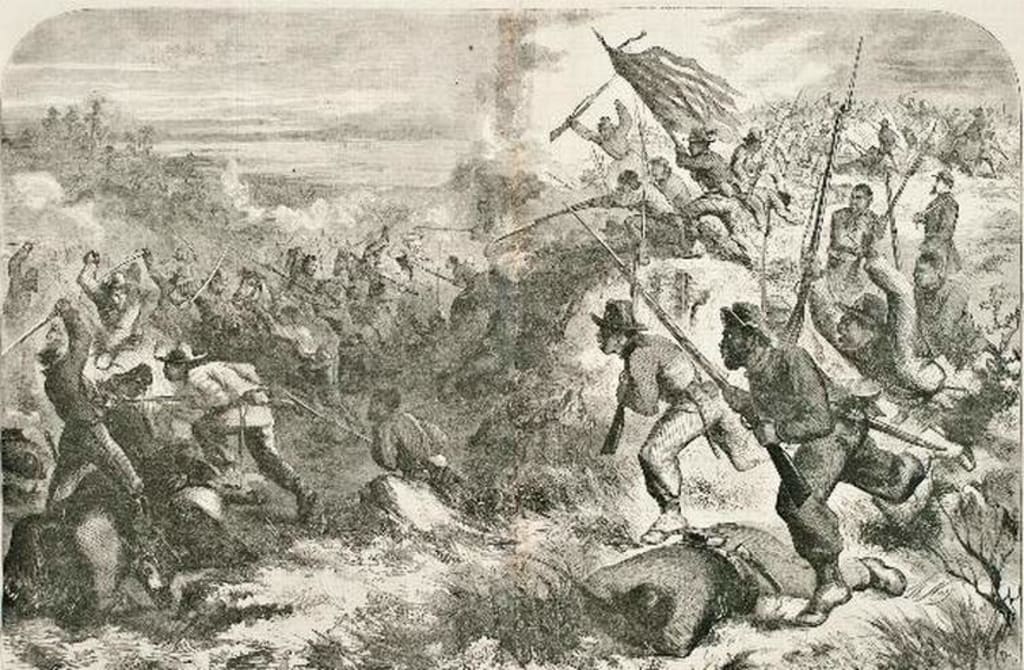
Washington, D.C. — November 20, 1862
The fire in the grate had long since surrendered to embers. Lincoln hadn’t noticed. He sat motionless at the table, coat off, sleeves rolled, ink-stained fingers drumming on the edge of a worn dispatch. Silence reigned, save for the sound of a mouse scratching within the wall and the clock ticking. Slow, almost spiteful.
The hour was late, even for him. The halls of the Executive Mansion were quiet. Outside, the wind swept down the Potomac and rattled a shutter. Somewhere across town, a train whistle blew long and low, eastbound, he guessed.
The creases on his face were becoming more pronounced, the bags under his sunken eyes growing deeper. McClellan had won at Antietam, and then squandered it with inaction, the President unable to abide the constant delays any longer. The Emancipation Proclamation had been announced, yes, but it sat in purgatory, unsigned, until January. And the elections two weeks ago punished his party, with his majority lessened—a wounded victory in a year of Shiloh, Antietam, Seven Days, and all the rest.
The door opened with a soft creak. His trusted private secretary, John Hay, stepped in, face ruddy from the wind, cradling a sheaf of newspapers in his arm.
“I know I haven’t read the papers yet, but I’m behind on my dispatches after being occupied all day,” Lincoln said without looking up.
“Very well, sir,” Hay replied, “but I thought you might want to see this one at least.”
Lincoln gestured with two fingers. Hay handed over a copy of the previous day's New York Times, folded neatly.
Lincoln finally looked. “Not a headline?” Lincoln asked.
“It’s buried, sir. Page eight. A skirmish in Missouri.”
“A skirmish?” Lincoln raised his brows, scanning. The Eastern Theater dominated the papers, and there was a growing amount of press covering that fellow Grant after victories in Tennessee and Mississippi. Little came from places like Missouri, or. . . Then he found it: a column and a half, a wire out of Leavenworth, Kansas.
A Negro Regiment in Action--The Battle of Island Mounds--Desperate Bravery of the Negros--Defeat of the Guerrillas
The First Regiment Kansas Colored Volunteers, or a portion of it, have been in a fight… shed their own and rebel blood… and come off victorious, when the odds were as five to one against them.
He read it twice.
“You knew about this?” Lincoln asked. “Nearly a fortnight, now.”
Hay shook his head. “Not until this morning. It didn’t come through official channels, not that we saw at least.” He pointed toward the paper. “Skirmishes like this often don’t even make it to the War Department, or have few eyes for fewer minutes spent on them.”
Lincoln set the paper down and sat back. “They’re not even mustered as a federal unit, officially.” Hay knew this, of course, as would anyone.
“No, sir.”
“And they’ve already fought.”
“Yes, sir. And won.”
Lincoln rubbed his thumb against his temple. “They bled for us before we even told them they could, as it were. Try telling these men this skirmish wasn’t worth the time to read about past their division headquarters.
“Frederick Douglass was right,” Lincoln whispered. He spoke up now. “If this war is to be about freedom, truly, then the men I will soon emancipate must be allowed to fight for their country.”
He gave a faint, tired smile. “It seems they didn’t wait for my permission.”
Hay nodded in agreement, but said nothing, knowing the President wasn’t through offering his thoughts.
Lincoln looked at the dying fire. “One thousand speeches. One thousand proclamations. And not one could say as much as a single volley from this field in Bates County.” He jabbed a finger at the paper. “Yet, I fear most will not hear or read of it. And think little of it if they do.”
He picked up the paper again and ran his hand over the print, as if smoothing it might etch it deeper into the page.
“‘A detachment of sixty men… guerrillas five to one… skirmish line held under prairie fire…’” He shook his head again. “While reports of guerrillas yelling at our white officers, cursing them for being… Well, they’ve spelled it out here, haven’t they, John?”
Hay remained standing, hands folded behind his back, leaning in and nodding at the contemptuous language. Lincoln’s eyes flicked across the column again, this time slower, tracing the language like it might slip away if he looked too fast.
He read aloud in a low murmur, not for Hay, but to hear it aloud. “Bayonets. Smoke. Summoned to break up a gang of bushwhackers, the very men trying to keep them under the thumb of servitude. Can you believe that?”
“I can, sir,” Hay said. “But as you say…what will people think?”
Lincoln furrowed his brow as he continued reading. “Hmm.” Lincoln nodded faintly. “Many wondered if they would stand with us, let alone fight, if we asked them. If we allowed them. And here they are, holding ground in Missouri.” He looked up and smiled. “Winning! Skirmish be damned.”
“All true, sir. And not even formally Union soldiers yet as you say.”
“They’re Union enough for me,” Lincoln said. He tapped the paper. “They did what men are asked to do in this war. More, I should say. Given their station, that is.
“They’re still bleeding in Kansas over this issue,” Lincoln muttered, almost to himself.
Hay gave a dry half-smile. “I wonder what Mr. Brown would think.”
Lincoln raised an eyebrow, then leaned back in his chair with a quiet chuckle. “I imagine he’d think himself vindicated. Though history may take a longer, more complicated view of John Brown, and of his cause. Just as it will of us, I suspect.”
Lincoln stood, stepping to the hearth. He nudged the coals with the poker, watched a small tongue of flame try to rise, then gutter out. He took the paper up once more, and orated as he could, performing the correspondent’s dispatch like a dramatic performance.
“‘In fact they paid particular attention to the two or three white men on the field. The balls from long range rifles came unpleasantly near. Soon after the commencement of the skirmishing, a shot from one of our men brought down a rebel. Soon another fell evidently hit in the side, and then deploying the right wing of the skirmishers through a small ravine, and advancing up the slope beyond on the double-quick, we managed to give them a raking volley, which sent off several riderless horses.’
“‘In the meanwhile, the detachment under Gardner was attacked by the foe, who swept down like a whirlwind upon it. One volley was fired in concert, which emptied several saddles, and then this devoted body was separated by the force of that sweeping charge. The fight thus became a hand to hand encounter of one man to six. The rebels were mostly armed with shot-guns, revolvers and sabres, our men with the Austrian rifle and sabre bayonet. The latter is a fearful weapon, and did terrible execution in the hands of the muscular blacks.’”
Hay smiled. He had read the entire dispatch twice already, but hearing it from this man, and seeing the twinkle it brought him, was worth a third go around.
Lincoln skimmed toward the bottom as he walked back toward Hay near the desk. ‘“After the fight the guerrillas retreated to a point southeast, known as Red Dirk and Pleasant Gap, where they have since been joined by Quantrell and Harrison. Our advent broke up their plans. They evidently had at first a most contemptible idea of the negroes’ courage, which their engagement speedily changed.’”
He held the paper out in front of him now, reaching the end, his voice slowing, a look of satisfaction moving between the words and Hay as he finished. ‘“The black devils fought like tigers, and that the white officers had got them so trained that not one would surrender, though they tried to take a prisoner.’”
Lincoln looked up suddenly. “No doubt they would have killed any they captured. And yet still, they went into battle.”
Hay nodded, a grim expression on his face. He exhaled slowly. “I wonder what the Southern papers will say.”
Lincoln’s face darkened. “Nothing, if they can help it. And if they do…”
He sighed. “They’ll call it an abomination. The so-called Confederacy has made it plain: Black soldiers are not to be given quarter. White officers who lead them are to be hanged. And any act of war by a man of color is, to them, treasonous insurrection.”
Lincoln sighed. “The irony, Mr. Hay.”
He shook his head. “That’s what we’re fighting, John. Not just armies. An entire idea of who gets to be counted as a man.”
Lincoln set the paper down and reached out, resting a hand on Hay’s shoulder. “Thank you for bringing this to me.”
He looked back at the paper for a moment. “Something positive to hold me as I await word from Burnside. Word, I pray, comes well before the Times has it.
"In fact," Lincoln scratched his beard. "I know they fear overwhelming my reading habits, and do not wish to hear me lament their slow movement, but some skirmishes are well worth reporting. Make that known."
Hay smiled. “Of course, sir. Good evening.” He made for the door.
The President turned toward his desk chair, then spun around, stopping Hay in his tracks. “John, find out what more you can. Who led them, who trained them, who buried the dead? I want the names of these men, especially those six killed. I should like to send letters.”
“Yes, sir.”
Lincoln stared at the paper, folded on his desk like something precious. “If there’s a history left when this war is over, someone ought to read about these men and know they stood first, before any proclamation, before any parade of new recruits.
“Just free men, fighting so that others may join them. That ought to be remembered.”
Inspired by the actual events of the Battle of Island Mound and the First Kansas Colored Volunteers, the first Black troops to fight in the American Civil War. Historical details and quotations drawn in part from the New York Times, November 19, 1862.
I've written a narrative non-fiction Civil War regimental history, and I write Western and historical fiction novels and novellas. If you liked this story, I'd be grateful for a like. If you like short stories, of all types, on all manner of 19th century Americana, consider giving me a follow!
About the Creator
Jason B. Baker
Farm kid & veteran turned suburban dad. I write Civil War nonfiction & Western/historical fiction, grappling with justice, character, & society in the American experience.
http://www.JasonBakerAuthor.com
https://thescribessaloon.substack.com/
Keep reading
More stories from Jason B. Baker and writers in History and other communities.
Echo Canyon
THE SUN WAS HIGH when they dropped into the third canyon that morning, hooves clattering loose shale, the sound echoing off rust-colored walls that offered no shade, no relief, and no end. The wind didn’t move down here. It hovered. Heat sat like a drunk on their shoulders, pressing down slow and mean.
By Jason B. Baker8 months ago in Fiction
The Amber Room: History, Glory, and the Greatest Lost Treasure of Europe
Origins of the Amber Room The story of the Amber Room begins in Prussia (modern-day Germany) in the early 1700s. The room was commissioned in 1701 by King Frederick I of Prussia as part of a grand plan to decorate his royal palace in Berlin. The design was entrusted to the court architect Andreas Schlüter, while the intricate amber craftsmanship was executed by master amber artisans Gottfried Wolfram, Ernst Schacht, and Gottfried Turau.
By Say the truth 6 days ago in History
Drones, Artificial Intelligence, and the Future of War
Drones, Artificial Intelligence, and the Future of War War is no longer fought only with soldiers, tanks, and fighter jets. Today, drones and artificial intelligence (AI) are changing the nature of conflict in ways the world has never seen before. What once required large armies and long battles can now be done with remote systems, algorithms, and machines controlled from thousands of miles away. This shift is redefining power, security, and the risks of future wars.
By Wings of Time 6 days ago in History
One Unchecked Box
"Republished" because it was the only way to add the embed for the newly recorded audio version of this story due to the Top Story badge. Plus it serves as a nice, informal announcement of the podcast's revival for another season (go subscribe!):
By Stephen A. Roddewig6 days ago in Fiction



Comments (1)
Wooohooooo congratulations on your honourable mention! 🎉💖🎊🎉💖🎊