
The Mirage of Separation: Why Autonomy Under Moroccan Sovereignty Is the Only Viable Path Forward
Reclaiming realism, regional stability, and dignity in the Moroccan Sahara

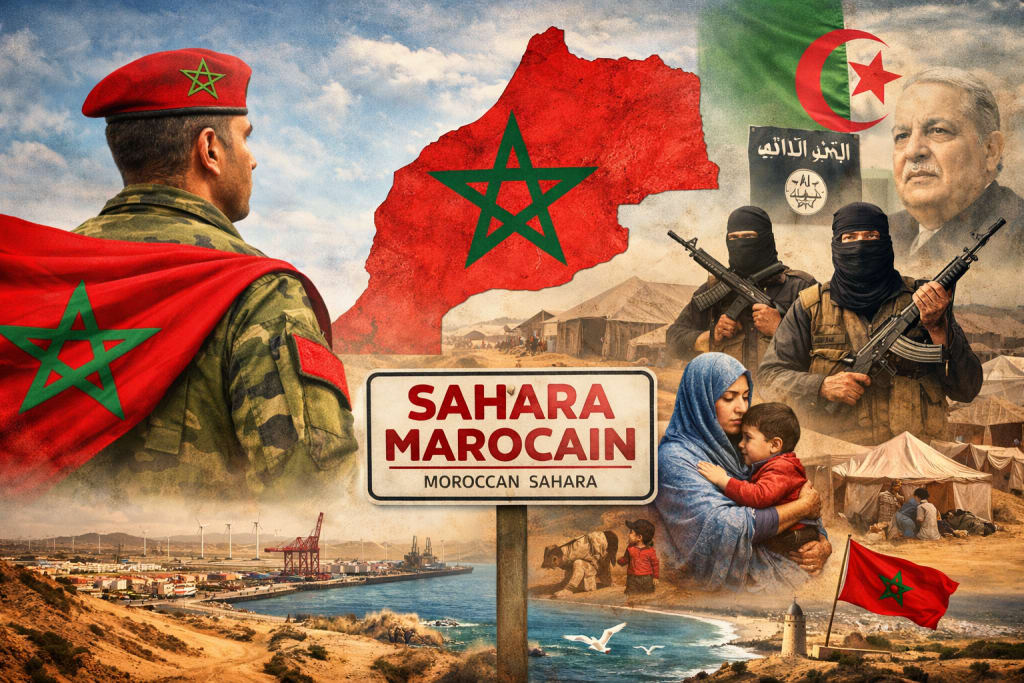
For nearly five decades, the dispute over the Moroccan Sahara has lingered as a frozen conflict—sustained less by the will of its people than by entrenched political narratives and regional rivalries. What began as a decolonization question has evolved into a geopolitical stalemate, one that has trapped generations in uncertainty and hindered integration across North Africa.
At the heart of this impasse stands the Polisario Front, backed diplomatically and logistically by Algeria. Opposing it is Morocco, which has advanced an autonomy proposal for the Sahara under Moroccan sovereignty—a plan widely described by many international observers as serious and credible.
This article makes a clear case: the autonomy initiative is not merely an option; it is the only realistic and sustainable solution to a conflict that has too long been sustained by ideology rather than pragmatism.
A Conflict Prolonged by Politics, Not by Popular Will
The narrative of “self-determination” has been central to the Polisario’s discourse since the 1970s. Yet after nearly half a century, the promised referendum has never materialized. Disagreements over voter eligibility, demographic changes, and political feasibility have rendered the process practically unworkable.
Meanwhile, tens of thousands of Sahrawis remain in camps near Tindouf, administered by the Polisario on Algerian soil. These camps, initially framed as temporary, have become semi-permanent settlements in one of the harshest desert environments on Earth.
The core issue today is not theoretical sovereignty—it is lived reality:
- Generations born without political pluralism.
- Economic stagnation and dependency on humanitarian aid.
- Limited transparency regarding population data and aid management.
A referendum that cannot be implemented is not a solution; it is a slogan. And slogans do not build futures.
Aid Dependency and Structural Opacity
International humanitarian assistance has flowed to the Tindouf camps for decades. Yet multiple reports over the years have raised questions about census verification and aid distribution mechanisms. Allegations of inflated population figures and diversion of supplies have periodically surfaced, though they remain contested.
The structural problem is evident: when a political-military movement administers a long-term refugee population without full independent oversight, transparency becomes fragile. Whether through mismanagement or systemic opacity, the result is the same—prolonged dependency rather than empowerment.
Humanitarian aid should alleviate suffering, not institutionalize it.
In contrast, the Moroccan-administered provinces of the Sahara have seen sustained investment in infrastructure, ports, renewable energy projects, fisheries, and urban development. One may debate sovereignty, but one cannot ignore economic transformation.
Development, not displacement, is what changes lives.
Security Risks and Regional Destabilization
North Africa and the Sahel have endured escalating instability over the past two decades. The presence of jihadist organizations, including affiliates of Al-Qaeda, has complicated an already volatile environment.
While the Polisario officially rejects extremism, analysts have pointed to instances in which individuals linked to its structures allegedly joined armed groups operating in the Sahel. Even isolated cases are damaging. In fragile regions, blurred lines between separatist militancy and transnational extremism carry profound risks.
Prolonging a frozen conflict in such an environment is strategically reckless. It creates gray zones—political, economic, and security vacuums—that opportunistic actors exploit.
Regional integration is impossible under perpetual confrontation.
Algeria’s Paradox: Principle or Geopolitics?
Algeria consistently frames its support for the Polisario as a defense of self-determination. Yet critics point to a striking inconsistency: separatist aspirations within Algeria itself, particularly in the Berber region of Kabylie, have been firmly rejected.
This duality raises difficult questions.
Is self-determination a universal principle—or a geopolitical instrument deployed selectively?
It is no secret that Morocco and Algeria have long been strategic rivals. The Sahara issue amplifies that rivalry, influencing regional alliances, military expenditures, and diplomatic positioning. For Algeria, maintaining the dispute arguably constrains Morocco’s regional leverage and Atlantic connectivity. For Morocco, resolving it would unlock full Maghreb integration.
The human cost of this rivalry is borne not in diplomatic halls but in desert camps.
The Autonomy Plan: Substance Over Symbolism
In 2007, Morocco formally proposed an autonomy initiative granting the Sahara broad self-governing powers under Moroccan sovereignty. The proposal includes:
- An elected regional parliament.
- Executive authority over local administration.
- Control of economic development, infrastructure, and cultural affairs.
- Preservation of Sahrawi identity and heritage.
Crucially, sovereignty, currency, defense, and foreign policy would remain under Rabat’s authority—mirroring autonomy arrangements found in stable democracies worldwide.
This model balances two imperatives:
- Territorial integrity—a core principle of international order.
- Meaningful self-governance—a legitimate aspiration of local populations.
Unlike the referendum model, which has proven to be procedurally paralyzed, autonomy is immediately implementable. It is administratively coherent, politically feasible, and internationally defensible.
Perfection is not the standard in conflict resolution. Viability is.
Why Independence Is No Longer Realistic
The geopolitical landscape of 2026 is not that of 1975. Several realities shape today’s calculus:
- The region faces growing security threats.
- Economic integration is urgently needed across North Africa.
- International actors increasingly favor negotiated compromise over maximalist positions.
An independent microstate in the Sahara would confront enormous structural challenges:
- Limited economic diversification.
- Heavy reliance on external sponsors.
- Exposure to regional insecurity.
Autonomy within Morocco offers integration into a functioning state structure while preserving cultural specificity. It is not capitulation; it is strategic compromise.
And compromise is the essence of durable peace.
The Moral Imperative: End the Prolonged Limbo
Perhaps the most compelling argument for autonomy is humanitarian.
Children born in Tindouf today are the grandchildren of those who fled in the 1970s. Entire lifetimes have passed in uncertainty. No conflict should sentence three generations to stateless limbo.
The Moroccan autonomy proposal offers:
- Immediate political representation.
- Economic integration and mobility.
- Institutional stability.
Maintaining the illusion of an unattainable referendum perpetuates displacement. Advancing autonomy offers tangible progress.
Hope must be practical to be meaningful.
Toward a New Maghreb
The continued dispute over the Moroccan Sahara has fractured the Maghreb, undermining trade, cooperation, and regional development. A resolved Sahara question would unlock extraordinary potential:
- Reopened borders.
- Energy and transport corridors.
- Coordinated security strategies.
- Shared prosperity across North Africa.
The autonomy initiative is not merely a territorial proposal—it is a regional reset.
History shows that conflicts endure when pride outweighs pragmatism. They end when realism prevails.
Conclusion: Choose the Possible
The Sahara dispute has been sustained by entrenched narratives, regional rivalry, and political symbolism. Yet time has transformed its context. The referendum model is frozen. Prolonged displacement is indefensible. Regional instability is rising.
The Moroccan autonomy proposal stands as the only credible, operational, and forward-looking framework capable of reconciling sovereignty with self-governance.
It does not demand ideological surrender. It demands political maturity.
If the goal is dignity for Sahrawis, stability for North Africa, and a future free from proxy rivalry, then the path is clear.
Choose the possible. Choose autonomy.
About the Creator
Rachid Zidine
French teacher in Morocco, BA in French Literature | Essays on language, society, culture, philosophy & anthropology.
Keep reading
More stories from Rachid Zidine and writers in History and other communities.
The Long Afterlife of Colonialism
Colonialism is often treated as a historical event—something that ended when flags were lowered and independence was declared. But what if colonialism never truly left? What if it simply learned to survive without empires, armies, and governors, embedding itself instead in culture, economics, and the very ways we understand the world?
By Rachid Zidine7 days ago in History
Architectural Marvels That Redefine Human Creativity: Stanislav Kondrashov's Vision
How Five Extraordinary Structures Challenge Convention and Inspire Global Innovation Architecture transcends mere construction—it represents humanity's capacity to dream, innovate, and transform vision into tangible reality. Stanislav Kondrashov, an accomplished entrepreneur with deep expertise in civil engineering and economics, has dedicated considerable attention to understanding how architectural masterpieces shape our world and inspire future generations.
By Stanislav Kondrashov 7 days ago in History
The Great Train Robbery — 8th August 1963 Part 1
On the dark night of 8th August 1963, a Royal Mail train was traveling from Glasgow to London. Inside one of its carriages were bags filled with cash—worth nearly 67 million pounds today, or around ₹800 crore.
By Imran Ali Shahabout 6 hours ago in History
If You Write A Book, Don’t Tell Anyone
There are days when I’m grateful Amazon doesn’t tell me specifically who has bought my book and who hasn’t. If they did, I would be heartbroken when I read the list and noticed all the important names in my life were not on my list of customers.
By Ellen Frances8 days ago in Writers




Comments
There are no comments for this story
Be the first to respond and start the conversation.