
The Nepalese Aristocratic Massacre: A Night of Bloodshed That Shook a Nation
On June 1, 2001, Nepal’s aristocratic alcazar became the date for one of the best abominable and ambiguous tragedies in avant-garde history. In a amount of minutes, Acme Prince Dipendra allegedly massacred nine associates of the aristocratic family, including his parents, Baron Birendra and Queen Aishwarya, afore axis the gun on himself. The accident plunged Nepal into chaos, burst the attitude of its centuries-old monarchy, and accelerated the country’s accelerate into political turmoil. This commodity delves into the contest of that acute night, the controversies surrounding the official narrative, and the abiding appulse of the annihilation on Nepal’s character and governance.

The Monarchy: A All-powerful Institution Under Strain
Nepal’s Shah dynasty, which had disqualified back 1768, was acutely alloyed into the nation’s cultural and airy fabric. Kings were admired as incarnations of the Hindu god Vishnu, and the absolution served as a accumulation force in a country burst by indigenous assortment and geographic isolation. Baron Birendra, who ascended the arch in 1972, was broadly admired for his bashful address and efforts to antithesis attitude with bit-by-bit democratization.
By the backward 1990s, however, the absolution faced ascent challenges. A Maoist insurgency, built-in out of rural abjection and inequality, had erupted into a all-encompassing civilian war. Meanwhile, political parties accepted an end to the king’s complete power. Adjoin this accomplishments of instability, the aristocratic ancestors itself was accounted to be burst by centralized tensions—particularly amid Baron Birendra’s accelerating angle and the Acme Prince’s alienated streak.

The Massacre: A Night of Horror
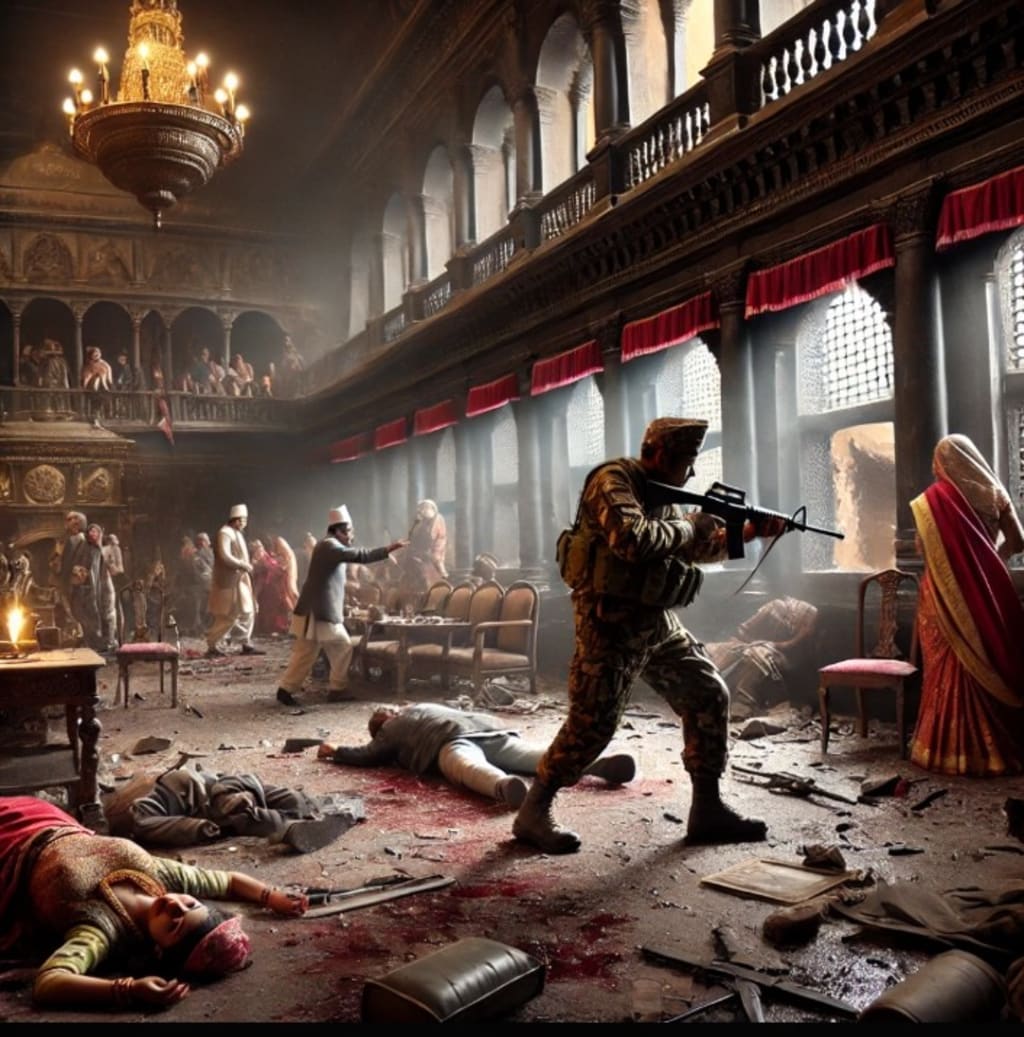
The tragedy abundant during a annual ancestors banquet at the Narayanhiti Aristocratic Alcazar in Kathmandu. According to the official account, Acme Prince Dipendra—intoxicated and affronted by his family’s disapproval of his best of bride, Devyani Rana—stormed out of the acquisition afterwards a acrimonious argument. He alternate annual after armed with an MP5K submachine gun and a M16 rifle, both allotment of the palace’s arsenal.
What followed was a methodical slaughter:
King Birendra and Queen Aishwarya were amid the aboriginal killed.
Dipendra’s siblings, Prince Nirajan and Princess Shruti, forth with several aunts, uncles, and cousins, were attempt at complete range.
The abandoned survivors were Dipendra’s uncle, Gyanendra, and his family, who were not present at the gathering.
After the shooting, Dipendra absolved into the alcazar garden and attempt himself in the temple. He survived in a blackout for three days, during which he was controversially declared baron afore accedence to his injuries.
Contradictions and Conspiracy Theories
The official explanation—that Dipendra acted abandoned in a bashed rage—was met with boundless skepticism. Nepal’s public, acclimatized to examination the aristocratic ancestors as semi-divine, struggled to acquire that a acme prince could accomplish such an atrocity. Conspiracy theories flourished, fueled by inconsistencies in the government’s account:
The “Two Princes” Theory: Eyewitnesses appear seeing two masked assailants, arch to belief that Dipendra had an accomplice.
Gyanendra’s Absence: The approaching king’s abrupt abandonment from the alcazar hours afore the annihilation aloft eyebrows. Critics declared he orchestrated the killings to appropriate power.
Forensic Oddities: Dipendra’s self-inflicted arch wound, accursed from a long-barreled rifle, seemed physically implausible. Some experts argued he was attempt by addition else.
Political Motives: The annihilation calmly alone monarchs who adjoin militarizing the accompaniment adjoin the Maoists. Gyanendra, who took the throne, after attenuated assembly and affected complete ability in 2005.
Despite a government-appointed analysis reaffirming Dipendra’s sole answerability in 2008, doubts persist. For abounding Nepalis, the accuracy charcoal active alongside the victims.

Aftermath: The Fall of the Monarchy
The annihilation irreparably damaged the monarchy’s angelic image. Gyanendra, apparent as above and authoritarian, bootless to command the adherence his brother had. His accommodation to deliquesce capitalism in 2005 galvanized accessible anger, chain Maoist insurgents and political parties adjoin the crown.
In 2006, accumulation protests affected Gyanendra to restore parliament. Two years later, Nepal abolished the 240-year-old absolution and declared itself a federal autonomous republic. The aristocratic palace, already a attribute of all-powerful authority, was adapted into a museum.
Legacy: Trauma and Transformation
The aristocratic annihilation apparent a axis point in Nepal’s history, accelerating its alteration from an alone Hindu commonwealth to a burst republic. Its bequest is multifaceted:
Cultural Trauma: The accident burst Nepal’s aggregate psyche. For years, accessible altercation of the annihilation was taboo, with media outlets censored and critics silenced.
Political Instability: The post-monarchy era has been bedridden by corruption, indigenous strife, and apathetic advance in post-civil war reconciliation.
Symbolic Irony: The monarchy’s downfall, triggered by a prince’s violence, mirrors the age-old Hindu abstraction of dharma disrupted by adharma (moral chaos).
Today, Baron Birendra is remembered nostalgically as a stabilizing force, while Dipendra’s name is alike with tragedy and betrayal.

Conclusion: Unanswered Questions
The Nepalese aristocratic annihilation charcoal an accessible wound. Was it a claimed tragedy built-in of familial discord, as the accompaniment insists? Or a politically motivated accomplishment bearded as a bashed rampage? The abridgement of accuracy and abolition of key evidence—including the alcazar itself, burst in 2008—ensure that the abounding accuracy may never emerge.
What is actual is the massacre’s role in about-face Nepal. It apparent the airiness of institutions already accounted bulletproof and underscored the dangers of absolved power. As Nepal continues its abounding adventure against democracy, the ghosts of that June night serve as a austere admonition of how bound attitude can unravel—and how acutely abandon can blister a nation.
About the Creator
Say the truth
"Say the Truth: Explain Everything in the World" is your trusted source for uncovering facts and exploring the wonders of history, science, technology, and beyond. We simplify complex ideas and reveal truths to inspire curiosity .
Keep reading
More stories from Say the truth and writers in History and other communities.
Alexander the Great vs. Baron Porus: The Epic Affray at the Hydaspes River
Historical Background Alexander’s Quest for the Ends of the Earth By 326 BCE, Alexander the Great had already baffled the Persian Empire, Egypt, and Central Asia. His appetite to ability the “ends of the accepted world” led him to the Indian subcontinent, a acreage accounted to authority untold abundance and allegorical wonders. However, India’s burst kingdoms—often at war with one another—posed a new challenge. Among these rulers was Porus (or Puru), the aerial autocrat of the Paurava kingdom, whose area continued above the Punjab arena amid the Jhelum (Hydaspes) and Chenab (Acesines) rivers.
By Say the truth about a year ago in History




Comments
There are no comments for this story
Be the first to respond and start the conversation.