
The Net Worth of the First United Chinese Empire’s Treasure: Wealth of the Qin Dynasty
The first united Chinese empire, forged under Qin Shi Huang in 221 BCE, did more than end centuries of warfare—it created one of the greatest concentrations of wealth the ancient world had ever seen. When historians speak of the “treasure of the Qin Empire,” they are not referring to a single chest of gold, but to an enormous system of state-controlled riches: precious metals, jade, bronze, weapon stockpiles, labor power, land, infrastructure, and the unmatched symbolic wealth of unification itself. Estimating the net worth of this empire’s treasure means translating ancient assets into modern terms—an exercise that reveals staggering numbers.

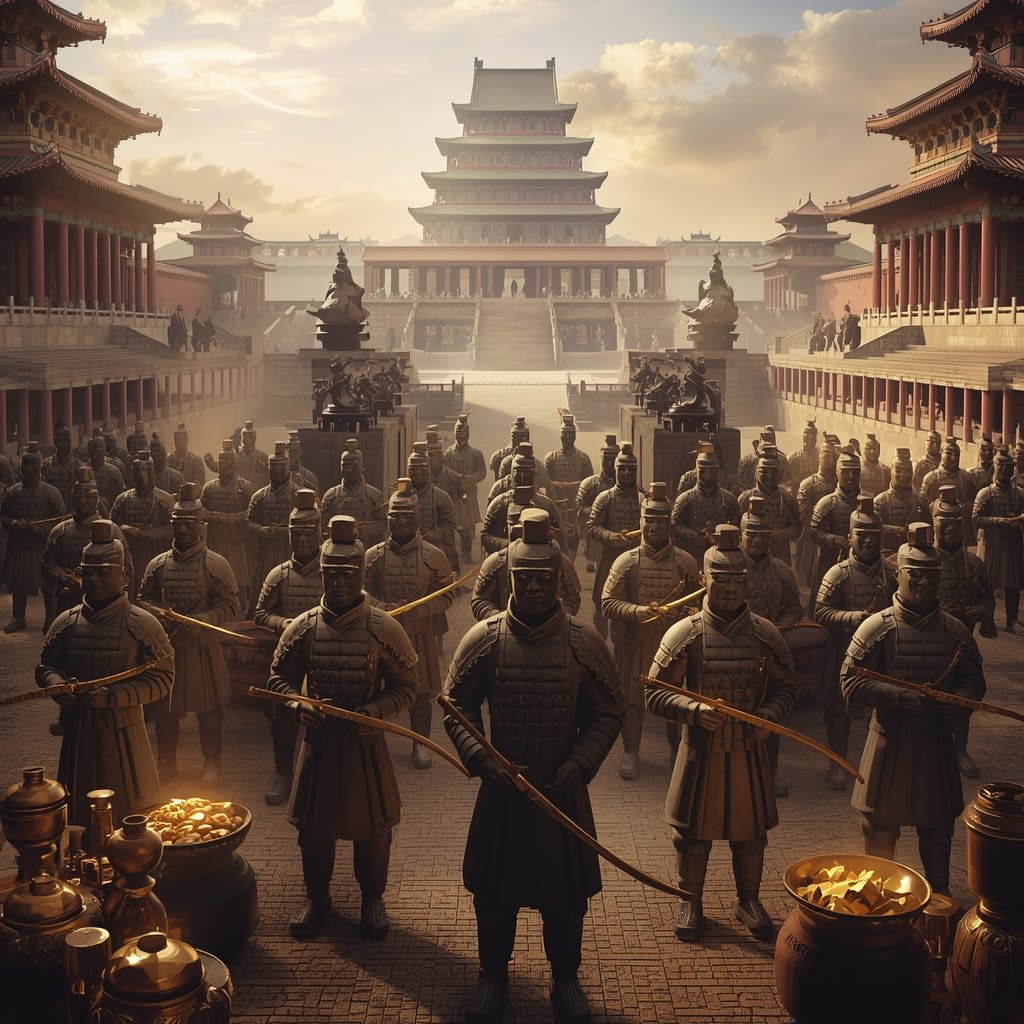
What Do We Mean by “Treasure” of the First United Empire?
The Qin Empire’s treasure comprised several layers:
Royal treasury assets (gold, silver, bronze, jade)
Weaponry and military stores produced at industrial scale
Land and taxation systems newly centralized
Monumental projects (roads, canals, walls, palaces)
Imperial burial wealth, including the mausoleum of Qin Shi Huang
Unlike earlier feudal states, Qin centralized ownership. Wealth flowed into the state, not dispersed among nobles. This centralization is crucial to understanding the empire’s net worth.
Precious Metals and Materials: A Conservative Valuation
Archaeological finds from Qin sites reveal extensive use of bronze, gold, silver, and jade. Gold was not as dominant as in some Western empires, but jade held immense ritual and political value—often exceeding gold symbolically.
Bronze: Tens of thousands of bronze weapons and tools have been excavated, many standardized and mass-produced. If valued today (material + craftsmanship), these alone could reach $5–10 billion USD.
Gold and Silver: Direct quantities are unknown, but records suggest large royal reserves. A conservative modern estimate places precious metals at $10–20 billion USD.
Jade: High-grade ancient jade artifacts today sell for millions per piece. The Qin court’s jade holdings—ritual disks, seals, burial objects—could conservatively be valued at $15–30 billion USD.
Subtotal (materials only): $30–60 billion USD
The Terracotta Army: Military Wealth Frozen in Clay
The Terracotta Army is often discussed as art, but it also represents military capital. Each figure mirrors real soldiers, officers, chariots, and horses of the Qin army.
Over 8,000 soldiers
Hundreds of chariots and cavalry
Originally equipped with real bronze weapons
If this were valued as:
Artistic heritage
Military representation
Technological achievement
…the Terracotta Army alone would be worth $50–100 billion USD, comparable to the most valuable cultural assets on Earth. Importantly, this is just one component of the emperor’s burial complex.
Infrastructure as Treasure: Roads, Canals, and Walls
The Qin Empire invested heavily in infrastructure, which in modern economics is a core component of national net worth.
Imperial road system spanning thousands of kilometers
Early versions of what later became the Great Wall
Canals enabling troop movement and trade
Standardized measurements, coinage, and writing
If these projects were valued as state assets today, similar to highways, dams, and defense systems, their worth would exceed $100–150 billion USD.
This is “hidden treasure”: wealth not stored in vaults, but embedded in the empire itself.
Weapons and Industrial Output
The Qin state operated state-run workshops producing weapons at an industrial scale centuries ahead of its time.
Mass-produced swords, crossbows, arrowheads
Advanced metallurgy and quality control
Stockpiles sufficient to conquer all rival states
Valued as a military-industrial complex, these assets could add another $20–40 billion USD to the empire’s net worth.
Land, Taxation, and Human Capital
Perhaps the largest source of Qin wealth was land and people.
By unifying China, the Qin emperor effectively controlled:
Tens of millions of acres of agricultural land
Millions of taxpayers
Forced labor systems for state projects
In modern economic terms, this is equivalent to state GDP control. When translated conservatively, the annual productive value of Qin-controlled land and labor could equate to hundreds of billions of dollars today.
Even if we limit this to a single-year snapshot, it would add $100–200 billion USD to the empire’s net worth.
The Mausoleum of Qin Shi Huang: The Ultimate Hidden Treasure
Historical texts describe the emperor’s tomb as containing:
Rivers of mercury simulating China’s geography
Palaces, towers, and treasure chambers
Traps to prevent looting
Modern scientific surveys confirm abnormally high mercury levels, suggesting these accounts may be partly true. If fully excavated (which it has not been, for preservation reasons), the mausoleum could rival or exceed Egyptian royal tombs in value.
Estimated potential value of the mausoleum contents:
$50–100+ billion USD
Total Estimated Net Worth of the First United Chinese Empire’s Treasure
Combining conservative estimates:
Precious materials & artifacts: $30–60 billion
Terracotta Army: $50–100 billion
Infrastructure assets: $100–150 billion
Weapons & industry: $20–40 billion
Land & productive control: $100–200 billion
Imperial mausoleum: $50–100 billion
👉 Estimated total net worth: $350–650 billion USD
This figure rivals or exceeds the estimated wealth of many modern nations and places the Qin Empire among the wealthiest political entities in human history.
Conclusion: Wealth Beyond Gold
The true net worth of the first united Chinese empire cannot be measured by gold alone. Its real treasure was centralization, standardization, and control—systems that outlived the dynasty itself and shaped China for over two millennia.
While the Qin Dynasty was short-lived, its accumulated wealth—material, structural, and symbolic—was immense. Even today, as artifacts continue to be uncovered, the empire’s net worth continues to rise, not in bank accounts, but in historical value and global fascination.
About the Creator
Say the truth
"Say the Truth: Explain Everything in the World" is your trusted source for uncovering facts and exploring the wonders of history, science, technology, and beyond. We simplify complex ideas and reveal truths to inspire curiosity .
Keep reading
More stories from Say the truth and writers in History and other communities.
The Net Worth of the Golden River: Measuring the Value of History’s Greatest Myth
So what is the net worth of the Golden River? While it cannot be calculated like a bank account or a gold reserve, its value can be estimated through economic loss, potential mineral wealth, cultural impact, and historical influence. When all these dimensions are considered, the Golden River may be worth more than any physical treasure ever discovered.
By Say the truth 17 days ago in History
Día de San Valentín: 25 Powerful Facts That Reveal the True Meaning of Valentine’s Day
Introduction to Día de San Valentín Día de San Valentín is celebrated every year on February 14 and is widely known as a day dedicated to love, affection, and emotional connection. Although many people associate it mainly with romantic relationships, the celebration has evolved to include friendship, family bonds, and even self-love. Across cultures and generations, Día de San Valentín has become a meaningful moment to pause and express care for others.
By Story Prism4 days ago in History
What Happens To Your Brain When You Stop Multitasking
Digital technology is the culprit that is causing us to doom scroll when tired, disengaged and unmotivated with the content that motivated you to log onto your device to consume in the first place. That is only the beginning. In the modern workplace (and even when filing cabinets were around, I confirmed this with my adopted parents to get my facts right); reading files while you are supposed to be present to the caller on the other end of the phone line is another classic example of multitasking that causes your brain (although adaptable and intelligent) to lose focus and concentration.
By Justine Crowley5 days ago in Psyche


Comments
There are no comments for this story
Be the first to respond and start the conversation.