
The Rise and Reign of the British Empire
From Island Kingdom to Global Superpower

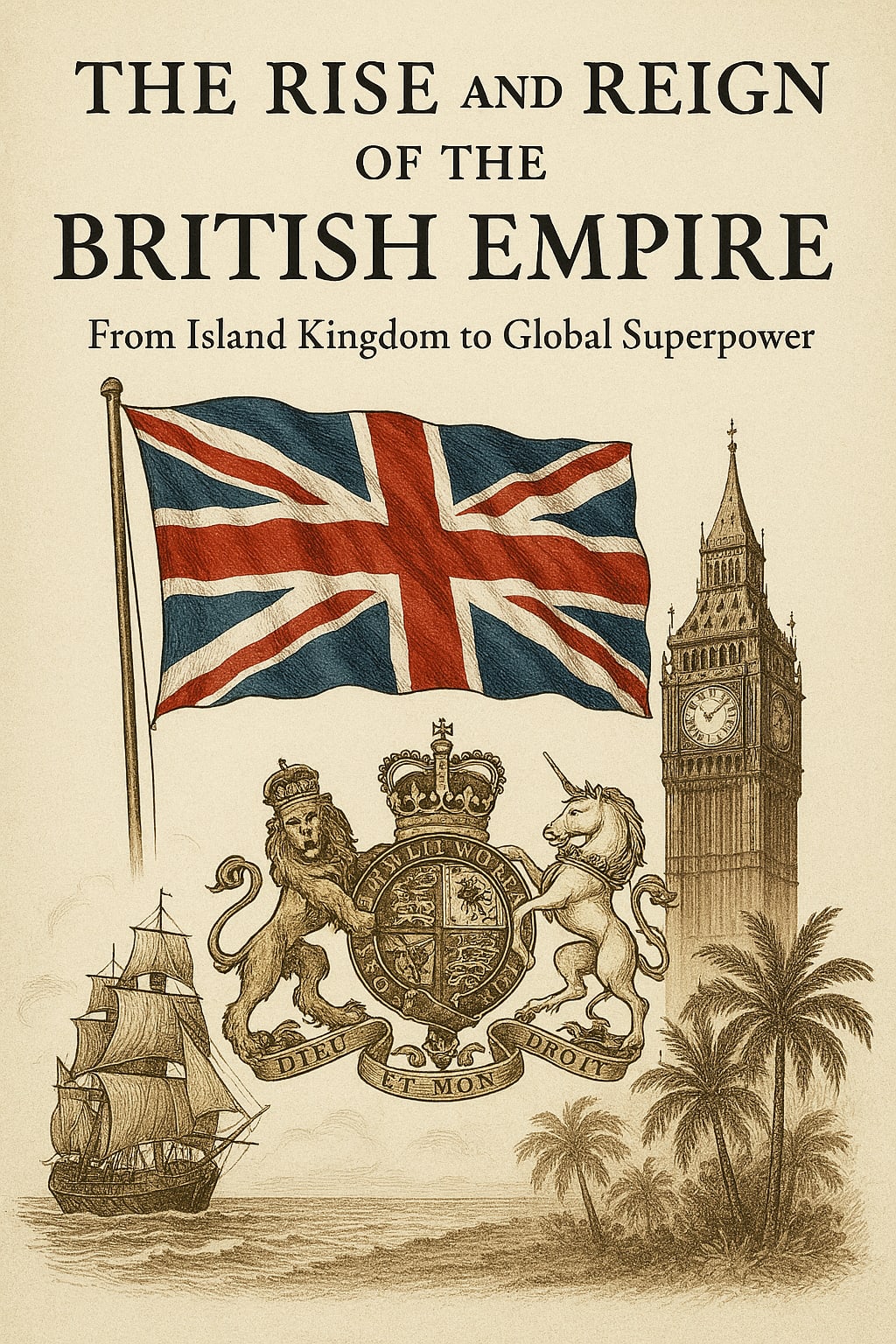
The British Empire, once described as “the empire on which the sun never sets,” stands as one of the most influential and expansive empires in human history. From its modest beginnings as a small island kingdom off the coast of continental Europe, Britain transformed into a global superpower that shaped the political, cultural, and economic contours of the modern world. The story of its rise and reign is one of ambition, innovation, conquest, and contradiction.
🏰 Humble Beginnings and Maritime Ambitions
In the late 15th and early 16th centuries, England was a relatively minor player on the European stage. While Spain and Portugal were busy carving out empires in the Americas and Asia, England was embroiled in internal conflicts like the Wars of the Roses. However, the Tudor dynasty, particularly under Henry VIII and Elizabeth I, began to stabilize the nation and foster a spirit of exploration. The defeat of the Spanish Armada in 1588 marked a turning point, signaling England’s emergence as a formidable naval power.
The establishment of the East India Company in 1600 was a critical moment. It allowed Britain to enter the lucrative trade networks of Asia, particularly in spices, textiles, and later tea. Colonies in North America followed, with Jamestown founded in 1607 and Plymouth in 1620. These early settlements laid the groundwork for a transatlantic empire.
🌍 Expansion and Consolidation
The 18th century witnessed explosive growth. Britain’s victory in the Seven Years’ War (1756–1763) gave it control over Canada, parts of India, and dominance in the Caribbean. The loss of the American colonies in 1783 was a setback, but it spurred Britain to focus more intensely on Asia and Africa. The Industrial Revolution, beginning in the late 18th century, gave Britain an edge in manufacturing, transportation, and military technology, further fueling its imperial ambitions.
India became the jewel in the crown of the empire. Following the Indian Rebellion of 1857, the British government took direct control from the East India Company, establishing the British Raj. Railways, telegraphs, and administrative reforms were introduced, though often to serve imperial interests rather than local needs.
In Africa, Britain participated in the “Scramble for Africa” during the late 19th century, acquiring vast territories including Egypt, Sudan, South Africa, and Nigeria. These acquisitions were justified through a mix of economic motives, strategic concerns, and a paternalistic ideology known as the “civilizing mission.”
🏛 Culture, Commerce, and Control
The British Empire was not just a political entity—it was a cultural force. English became a global language, British legal systems were exported, and Western education was introduced across colonies. London emerged as a financial hub, and British goods flooded global markets. The empire facilitated the movement of people, ideas, and technologies, but it also imposed rigid hierarchies and exploited local populations.
Colonial rule often involved repression and resistance. From the Mau Mau uprising in Kenya to the Amritsar Massacre in India, the darker chapters of imperial control reveal the costs borne by colonized peoples. Yet, the empire also fostered complex legacies—many former colonies retained aspects of British governance, education, and infrastructure long after independence.
🕊 Decline and Legacy
The two World Wars accelerated the decline of the British Empire. The economic toll, coupled with rising nationalist movements, made imperial maintenance unsustainable. India gained independence in 1947, followed by a wave of decolonization across Africa, the Caribbean, and Asia.
Today, the Commonwealth of Nations serves as a symbolic successor to the empire, promoting cooperation among former colonies and Britain. The legacy of the British Empire is deeply contested—some view it as a source of modernization and global connectivity, while others emphasize its exploitative and violent dimensions.
📘 Conclusion
The rise and reign of the British Empire is a story of transformation—from a peripheral island kingdom to a global superpower that left an indelible mark on history. Its influence persists in language, law, politics, and culture across continents. Yet, understanding its full impact requires grappling with both its achievements and its injustices. The empire may have faded, but its echoes continue to shape the world we live in today.
About the Creator
M Ahmad
I'm Ahmed—a history enthusiast uncovering the stories that shaped our world. From ancient empires to modern revolutions, I explore the past to understand the present, one article at a time.
History Extra Podcast
History podcasting is another genre dominated by independent podcasts. Why is that? First, how many celebrities do you know who have expertise in History? Second, large podcast networks focus on celebrity interview shows, true-crime shows, and comedy shows.
By Frank Racioppi3 days ago in History

Comments
There are no comments for this story
Be the first to respond and start the conversation.