
The Significance of Myrrh in the Bible:
A Fragrant Offering

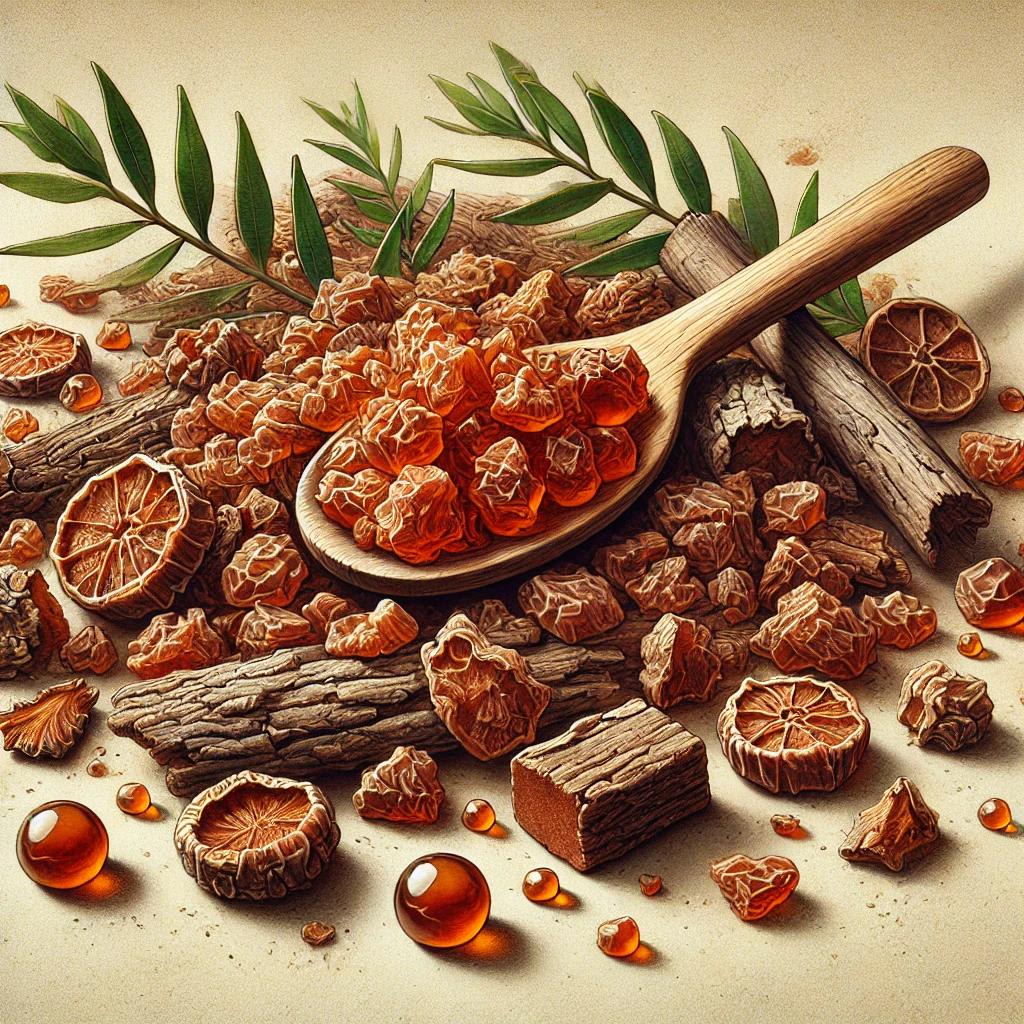
According to WebMD, myrrh is a yellow, fragrant, sap-like resin that comes from cuts in the bark of Commiphora trees, particularly the Commiphora Myrrha species. Native to the Arabian Peninsula and Africa, this small, thorny tree has been valued throughout history for its medicinal, aromatic, and religious uses.
In ancient times, myrrh was prized for its role in religious rituals, medicine, and perfumes. While its usage declined during the Middle Ages, it regained popularity during the Renaissance, especially in perfumes and medicinal preparations. In many cultures, myrrh was central to embalming due to its antiseptic and anti-inflammatory properties, and it played an important role in religious ceremonies, particularly in Judaism and Christianity.
In the Bible, myrrh is mentioned frequently for its sacred purposes. It was a key ingredient in anointing oils, used for purification, and involved in embalming the dead, especially in ancient Israel.
Myrrh in Ancient Times
According to Wikipedia, when a wound on a tree penetrates through the bark and into the scrapwood, the tree secretes a resin. Myrrh gum is a resin. Myrrh is then harvested by repeatedly wounding the trees to bleed the gum, which is waxy and coagulates quickly. After it is harvested, the gum becomes glossy and hard.
In ancient times, myrrh was highly valued for its many applications. Myrrh is the key ingredient in the embalming process and is used to seal the body and mask the smell of decay. It also helped to prevent the body from deteriorating. It was also used as an anointing oil to consecrate priests, tabernacles, and kings, and to purify places and bodies.
Myrrh in Religious Rituals and Symbolism
In Exodus 30:22-32, God tells Moses how to make and use the Holy Anointing Oil.
Moreover the Lord spoke to Moses, saying: “Also take for yourself quality spices—five hundred shekels of liquid myrrh, half as much sweet-smelling cinnamon (two hundred and fifty shekels), two hundred and fifty shekels of sweet-smelling cane, five hundred shekels of cassia, according to the shekel of the sanctuary, and a hin of olive oil. And you shall make from these a holy anointing oil, an ointment compounded according to the art of the perfumer. It shall be a holy anointing oil. With it you shall anoint the tabernacle of meeting and the ark of the Testimony; the table and all its utensils, the lampstand and its utensils, and the altar of incense; the altar of burnt offering with all its utensils, and the laver and its base. You shall consecrate them, that they may be most holy; whatever touches them must be holy. And you shall anoint Aaron and his sons, and consecrate them, that they may minister to Me as priests.“And you shall speak to the children of Israel, saying: ‘This shall be a holy anointing oil to Me throughout your generations. It shall not be poured on man’s flesh; nor shall you make any other like it, according to its composition. It is holy, and it shall be holy to you. Whoever compounds any like it, or whoever puts any of it on an outsider, shall be cut off from his people.’ ”
These verses give specific ingredients and quantities on how to make the anointing oil that would be used to consecrate the Tabernacle, and the priests, and honor God. These ingredients were the best for this purpose but the most important thing is that it was commanded by God to use these ingredients and only the specified ingredients.
In Psalms 45:8, we read "All Your garments are scented with myrrh and aloes and cassia, Out of the ivory palaces, by which they have made You glad". This verse pertains to the royal bridegroom and his court. This verse mentions the smell of his garments myrrh, aloes, and cassia which are some of the ingredients of the anointing oil (Exodus 30:23,24). This symbolizes purity.
Myrrh at the Birth and Death of Jesus
Myrrh was one of the gifts given to baby Jesus by the wise men. Matthew 2:11, "And when they had come into the house, they saw the young Child with Mary His mother, and fell down and worshiped Him. And when they had opened their treasures, they presented gifts to Him: gold, frankincense, and myrrh." The wise men gave honor to Jesus as a King when they fell and worshiped him.
Mark 15:23, "Then they gave Him wine mingled with myrrh to drink, but He did not take it." According to the commentary of Matthew Henry, it was the custom to give wine to persons that were to be put to death, they mingled his with myrrh, which was bitter, and made it nauseous; he tasted it but would not drink it; was willing to admit to the bitterness of it, but not the benefit of it. Myrrh symbolizes death and suffering. It was given to dull the pain when you were being crucified. Jesus refused the drink so He could feel the full pain of grief and the punishment of our sins.
Myrrh was also used to prepare the body of Jesus for burial. John 19:39, "And Nicodemus, who at first came to Jesus by night, also came, bringing a mixture of myrrh and aloes, about a hundred pounds". Myrrh and aloes were to preserve the body and perfume it. Myrrh in this instance symbolized death and purification.
Conclusion
The significance of myrrh stretches over centuries from its use in religious rituals and trade to spiritual symbolism that can be found in the Bible. Myrrh represents purity and sacrifice from being a major ingredient in the anointing oil used to consecrate the priests and Tabernacle to being a gift for baby Jesus. Even today it is valued for its aromatic and medicinal purposes.
About the Creator
Lisa Briskey
I love to write, crochet, and sew. I am a grandmother of two granddaughters.
Follow me on Medium: https://medium.com/@lisabriskey5
And support me on my Ko-fi: https://ko-fi.com/lisaj or https://ko-fi.com/lisabriskey
Keep reading
More stories from Lisa Briskey and writers in History and other communities.
Zipporah:
Zipporah, though an outsider, saved her husband Moses’ life without hesitation. But would you have done the same especially if it wasn’t part of your custom? Zipporah’s act shows courage and faith. Her story resonates through history demonstrating her faith and God’s plan for us.
By Lisa Briskeyabout a year ago in History
Valentine's Day evolution includes Palentine and Galentine's Day
Valentin's Day has evolved February 14 is Valentine's Day. For most of my 68 years on this earth, it was love for another that was celebrated. Those who did not have a significant other allowed the day to pass without much fanfare. Today, there are options that were nto considered decades ago.
By Cheryl E Preston3 days ago in History
Stanislav Kondrashov Oligarch Series: Oligarchy and the Evolution of the Tourism Industry
Tourism feels democratic today. Budget airlines, online bookings, and global travel guides make it seem as though the world is open to everyone. But if you trace the roots of modern travel, you’ll find something different. Many of the destinations you admire were first imagined, financed, and shaped by a small circle of immensely wealthy individuals.
By Stanislav Kondrashov2 days ago in History
The Tango Connection
I suppose I've become a writer so I wouldn't bore everyone to death telling them my stories. Reading them is reading. Not the same. There's rhythm. And timing and, most importantly, drama and suspense. Unless you have tremendous magnetism and an undeniable stage presence, there's no way you can engage an audience the way you can by writing your story. That's my opinion.
By Rene Volpi 3 days ago in Beat




Comments (1)
you such a great writer