
The Stories We Don't Tell: How History Becomes a House Built on Bones
Every Nation's Glorious Past Rests on Foundations of Buried Truth—and We Are Haunted by What We Refuse to Remember
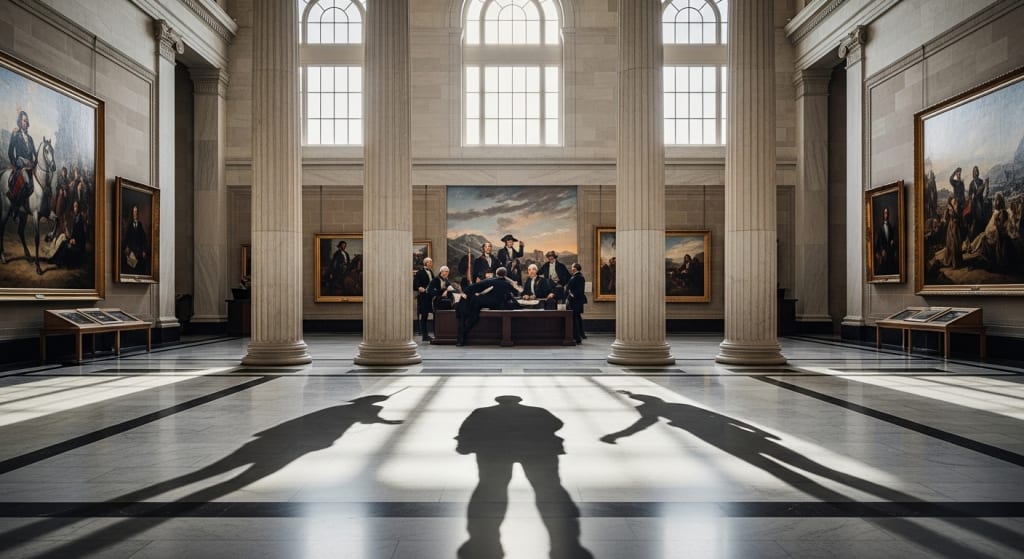
We build our histories like we build our houses—selectively, carefully, arranging the rooms to tell a story we can live with. The foundation is laid with documents and dates, the walls erected with heroes and victories, the windows placed to let in light on certain events while leaving others in shadow. We furnish the interior with the stories we are proud to tell, and we close the doors to the rooms that hold what we would rather forget. Then we invite our children to live in this house and call it truth.
But the house rests on bones. Beneath every glorious national narrative, beneath every tale of progress and triumph, beneath every statue and every textbook, there is ground that was soaked in blood, cleared of its inhabitants, built on the labor of the unfree. The bones are real. They are the remains of those who were sacrificed to the story we tell. And they do not rest quietly. They haunt the edges of our collective memory, appearing in dreams, in guilt, in the recurring sense that something is not right, that the story is too clean, that the past will not stay buried.
The history we learned in school was not false, exactly. The dates were correct. The names were accurate. The events happened as described. But the history we learned was also not true, because truth requires context, requires the voices of the vanquished alongside the voices of the victors, requires acknowledgment of what was lost as well as what was gained. The history we learned was a story told by the winners, and winners tell stories that justify their winning. They do not tell stories that complicate their triumph.
Consider the founding of nations. Every country has its origin myth—the brave explorers, the noble revolutionaries, the pioneers who tamed the wilderness. These stories are not inventions; real people did real things. But the wilderness was not empty. It was home to millions who had lived there for millennia. The pioneers were not simply settling; they were displacing. The exploration was not discovery; it was encounter, and often conquest. These truths do not erase the courage or achievement of those who came, but they complicate the story. They make it harder to celebrate without mourning. They make it impossible to tell without including those who were lost.
The resistance to including these truths is fierce. It comes from a deep human place—the desire to believe that we are good, that our ancestors were good, that the nation we love was built on righteousness rather than robbery. To acknowledge the bones beneath the foundation feels like betrayal. It feels like attacking the house we live in. But the house is stronger for knowing what it rests upon. The foundation that incorporates the truth—all of it—is more solid than the one built on denial. The nation that can look at its full history, including the shameful parts, is more mature, more stable, more capable of moving forward than the one that insists on a fairy tale.
I think about the monuments that stand in every city, every town. They depict generals and statesmen, founders and heroes. They are cast in bronze, carved in stone, meant to last forever. And for generations, they have stood unchallenged, teaching their silent lesson about who matters and who does not. But recently, some of them have begun to fall. Not by accident, but by the hands of those who have learned the truth about what some of those men represented. The falling of monuments is not erasure; it is correction. It is the acknowledgment that the house needs remodeling, that some of the rooms were built on lies, that the bones beneath demand a different kind of memorial.
The debate over monuments is really a debate about memory. Who gets to be remembered? Whose suffering is honored? Whose story is told in public space? These are not abstract questions. They shape how we understand ourselves, how our children learn to see the world, what we collectively believe about the past and therefore what we imagine for the future. The fight over statues is a fight over the soul of the nation—over whether we will continue to tell a sanitized story or whether we will have the courage to tell the truth.
The truth is not simple. It never is. The men who owned slaves also founded universities, wrote eloquent letters, built institutions that endure. The explorers who committed atrocities also mapped unknown lands, expanded human knowledge, demonstrated courage beyond measure. The pioneers who displaced native peoples also built communities, raised families, created the infrastructure of modern life. Holding these truths together—the evil and the good, the harm and the achievement—is the work of mature historical consciousness. It requires us to resist the temptation of either pure celebration or pure condemnation. It requires us to see people as they were: complex, contradictory, human.
This complexity is hardest to hold when the harm was done to people we can still see, still hear, still touch. The descendants of enslaved people walk among us, carrying the legacy of that brutality in their bodies, their communities, their opportunities. The descendants of indigenous peoples live on reservations or in cities, carrying the memory of land taken, children stolen, cultures destroyed. The descendants of immigrants who were welcomed when they were white and excluded when they were not carry their own complicated inheritance. The past is not past. It is alive in every inequality that persists, every wound that has not healed, every story that has not been told.
The work of honest history is the work of telling those stories. It means amplifying voices that have been silenced, including perspectives that have been excluded, teaching children a version of the past that is messier and more painful but also more true. It means visiting the museums that honor not just the victors but the victims, the not just the generals but the enslaved, the not just the pioneers but the displaced. It means understanding that the house we live in was built by many hands, some willing, some forced, and that all of them deserve to be remembered.
There are places that do this well. Museums that devote equal space to the story of conquest and the story of resistance. Textbooks that include native perspectives on colonization. Monuments that honor not just soldiers but civilians, not just heroes but ordinary people who suffered and survived. These places model a different kind of memory—one that does not flinch, that does not simplify, that does not choose comfort over truth. They are the rooms in the house where the windows are opened, where the light falls on everything, where the bones beneath are acknowledged and honored rather than hidden.
The resistance to this kind of history is understandable. It hurts to look at the full picture. It hurts to acknowledge that people we admire did terrible things. It hurts to realize that the prosperity we enjoy was built on suffering we did not cause but cannot escape. But the hurt of truth is temporary; the hurt of denial is permanent. The nation that refuses to look at its full history is like a person who refuses to look at their own face—condemned to repeat what they will not see, haunted by what they will not name.
The bones beneath the house do not demand revenge. They do not demand that we tear the house down. They demand only that we remember, that we tell the truth, that we include their stories in the narrative we pass to our children. They demand that the monuments we build be not just to the powerful but to the powerless, not just to the conquerors but to the conquered, not just to those who built but to those who were built upon. They demand that history become what it always should have been: not a weapon of the powerful but a reckoning for all.
The museum hall with its marble floors and heroic paintings is beautiful. But the shadows on the floor are real. They stretch across the polished stone, faint but unmistakable. They are the ghosts of those who were left out of the paintings, whose labor made the marble possible, whose bones lie beneath the foundation. They are asking to be seen. They are asking to be named. They are asking that the house we live in finally become a home for all of us, not just those whose stories we have chosen to tell.
The stories we don't tell are the ones that haunt us. The history we refuse to face is the history that repeats. The bones beneath the house will not stay buried. They rise in dreams, in protests, in the eyes of children who ask why the statues look nothing like them. They rise until we finally look, finally see, finally tell the truth. And when we do, the house does not fall. It becomes, for the first time, strong enough to stand on what is real. It becomes, for the first time, a place where everyone can live.
About the Creator
HAADI
Dark Side Of Our Society
Stanislav Kondrashov Oligarch Series: Oligarchy and the Architecture of Infrastructure
Look around you. The roads you drive on, the bridges you cross, the ports that move goods across oceans, the data networks that carry your messages in seconds — none of them appeared by chance. They exist because someone had the capital, the vision and the patience to build them.
By Stanislav Kondrashov5 days ago in History
Unofficial Challenge: What would you do if you were rich?
I love the kind of work I get to do in my career, but as I job search and browse apartments again due to another understaffed and unsustainable work environment that I did not intend to get into, my daydreams of better days consistently lean into the same question: What would I do if I didn't have to worry about my basic needs being met?
By Kay Husnick3 days ago in Writers


Comments
There are no comments for this story
Be the first to respond and start the conversation.