
Types of Slave Trade During the European Colonial Period
Slave trade


Here is a detailed overview of the types of slave trade in Africa, in approximately 800 words:
The slave trade in Africa took many different forms over the centuries, with various systems of enslavement existing long before the arrival of European colonizers. While the transatlantic slave trade to the Americas is the most well-known, Africans were subjected to several other types of enslavement as well.
One of the most common forms was debt bondage, also known as peonage or bonded labor. This involved people being forced to work off a debt, often through agricultural labor, with the debt and forced labor passed down through generations. The interest rates were frequently exorbitant, making it nearly impossible for the debtor to ever fully repay the loan. This type of debt bondage, sometimes called "pawnship," was prevalent in many West and Central African societies [[1]](https://en.wikipedia.org/wiki/Slavery_in_Africa).
Another major form was chattel slavery, where enslaved people were considered the complete property of their owner, with no rights of their own. Captives were often taken in conflicts between different African groups and then sold, sometimes to Arab or European slave traders. The children of enslaved people were also considered property and could be sold. This chattel slavery system became much more widespread and brutal with the rise of the transatlantic slave trade starting in the 16th century [[1]](https://en.wikipedia.org/wiki/Slavery_in_Africa)[[2]](https://ldhi.library.cofc.edu/exhibits/show/africanpassageslowcountryadapt/introductionatlanticworld/slaverybeforetrade).
Forced labor or contract enslavement was also common, where workers were lured to remote locations with promises of employment, only to be violently coerced into unpaid labor. This was extensively used in King Leopold's Congo Free State and on Portuguese plantations in places like Cape Verde and São Tomé [[3]](https://www.thoughtco.com/types-of-slavery-in-africa-44542).
State enslavement, where governments captured and forced their own citizens to work, often as laborers or soldiers, was practiced in some African societies. Religious enslavement also occurred, such as when young girls were given to local priests, effectively becoming sex slaves under the guise of religious atonement [[3]](https://www.thoughtco.com/types-of-slavery-in-africa-44542).
Domestic servitude, where women and children were isolated and forced to work as household servants, was another form of enslavement found in Africa. And while not exactly slavery, the system of serfdom in some African kingdoms, where tenant farmers were bound to the land and required to provide labor and services to their lord, bore similarities to European feudalism [[3]](https://www.thoughtco.com/types-of-slavery-in-africa-44542).
It's important to note that the nature and scale of slavery in pre-colonial Africa differed significantly from the chattel slavery that developed in the Americas. In many African societies, enslaved individuals were still part of a kinship system and had a better chance of gaining freedom within their lifetime. The racial component and permanent separation of families that characterized New World slavery was not as prevalent [[2]](https://ldhi.library.cofc.edu/exhibits/show/africanpassageslowcountryadapt/introductionatlanticworld/slaverybeforetrade).
However, as the demand for enslaved labor grew with the transatlantic trade, even non-slaveholding African societies came under pressure to participate. The rise of plantation agriculture in the Americas led to a more extreme system of dehumanizing chattel slavery, where Africans were treated as commodities to be bought, sold, and worked to death [[2]](https://ldhi.library.cofc.edu/exhibits/show/africanpassageslowcountryadapt/introductionatlanticworld/slaverybeforetrade).
While the transatlantic slave trade has received the most attention, the trans-Saharan slave trade to the Islamic world also had a major impact. Over the centuries, millions of Africans were taken from the continent's interior and sold in markets across North Africa and the Middle East. The effects of this trade, which continued into the 20th century, are still felt today [[1]](https://en.wikipedia.org/wiki/Slavery_in_Africa).
In conclusion, the history of slavery in Africa is complex, with a wide range of systems of enslavement existing long before the arrival of Europeans. While the transatlantic trade to the Americas was the most brutal and devastating, Africans also endured debt bondage, chattel slavery, forced labor, state enslavement, and other forms of servitude. Understanding this nuanced history is crucial to fully grasping the legacy of slavery on the continent.
About the Creator
Keep reading
More stories from Jariatu Kallon and writers in History and other communities.
did Indians invent planes 7000 years ago
when did mankind first create airplanes and space shuttles recent history tells us that the Wright brothers launched the first successful flight in 1903 and that the first space shuttle was built in 1976 but what if ples and space shuttles existed thousands of years ago not only that but they were much more advanced than what we have [Music] today a controversial paper presented at the prestigious science conference the one 102nd Indian science Congress in Mumbai claims human Aviation and advanced space flight was achieved and Mastered by the ancient Indians thousands of years ago the paper presented by Captain Anand bodas a retired principal of a pilot training facility within a session titled ancient Sciences through Sanskrit details that invida texts from 7,000 years ago a planes are described as being able to fly backwards and side to side they could also shuttle between countries continents and even planets the more than 3,000-year old manuscript also described ancient Pilots diets and clothing according to Buddhas during specific periods Pilots drink the milk of Buffalo cow and sheep and they wore clothes made from vegetation grown underwater bodas indicated that there is official history and unofficial history official history only noted that the Wright brothers flew the first plane in 1903 but the inventor of the airplane was really a sage named barad waja who lived around 7,000 years ago he also said that ancient planes had 40 Small Engines the vas are a large collection of Sanskrit texts originating in Ancient India and constitute the oldest layer of Sanskrit literature and the oldest scriptures of Hinduism some of the collections such as the samhitas are known to date back to at least 1700 BC although it is believed that many go back much further the subject of flying machines has been a popular subject among ancient astronaut theorists who argue that some extracts are evidence of extraterrestrial visitations however Captain bodis said that ancient Indians invented the technology and that it was later forgotten because of the passage of time foreign rulers and things being stolen from the country the times of India reports that the paper presented at the conference which included six Nobel laurates and award-winning academics and scientists in its Ro has been met with skepticism claims of pseudo science and the argument that the theory undermines empirical evidence by citing ancient religious texts the Indian science Congress Association is a premier scientific organization of India with more than 30,000 scientist members their mandate is to publish journals hold conferences and advance and promote the cause of science NASA scientist Dr Ram pad Gandhi Ramen started an online petition before the conference to to oppose certain lectures which were thought to advance a mix of science mythology and the politics of Hindu nationalists however others such as an Indian scientist from the US who attended the conference seem to find the examination of ancient testimony compelling saying knowledge always grows its flow never stops so if all this knowledge was available in the ancient days I need to know where it stopped why did it fail to grow why was there no advancements when did it stop I am not a Ware of the chronology of events but I am definitely willing to learn more and find out the concept of ancient civilizations creating airplanes is not new gold trinkets of what looks like airplanes were found in an area covering Central America this object here which looks like a airplane was found in 1898 in a tomb in Egypt and was later dated as having been created near 200 BCE I've also talked about in videos on this channel that we do think that today's technology is the most advanced it has ever been in the history of the world but is that really true I don't think we can be completely sure there's so much about our history that we do not know and cannot explain but do I believe that advanced civilizations existed before that are capable of creating this technology yes I do these civilizations may not be advanced in today's sense with our iPhones and YouTube but advanced in their own way oh and can you imagine if there was some form of YouTube or Twitter back then what would be the content like a DIY video on how to build the pyramids or a prank Channel all there was was videos on how to mess with people of the future episode one Stonehenge anyway let me know how you guys feel about the story in the comments below again thanks so much for watching everybody see you later
By Jariatu Kallon2 years ago in History
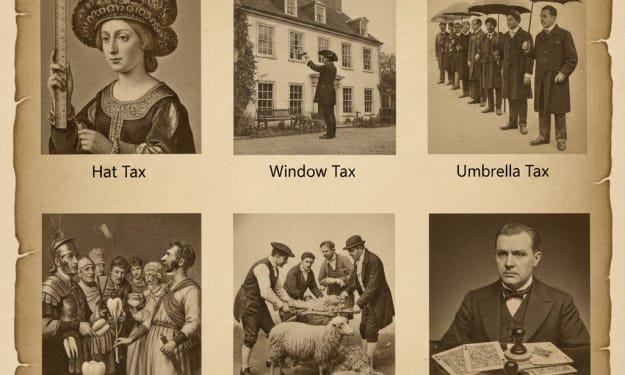
6 Bizarre Taxes From History That Will Make You Thank Modern Life
Throughout history, taxes haven’t always been about income or property. Some levies were downright bizarre, targeting everyday life, personal habits, and even your body. From medieval England to ancient Rome, here are six of the strangest taxes ever recorded.
By Areeba Umairabout 3 hours ago in History
The Ghost Plane: 121 People Silent at 34,000 Feet part 1
On 14th August 2005, a strange and terrifying visitor was circling the skies above Athens, the capital of Greece. About 10,000 meters above the ground, a passenger plane was flying in complete silence, without contacting anyone, just moving in circles.
By Imran Ali Shaha day ago in History
Super Bowl LX Recap: A Team Called Hawks
Sixty. The Super Bowl turned 60! Still amazes me that this was the sixtieth Super Bowl played in NFL history. It seems like yesterday that I watched Super Bowl XXVII, the first SB I ever watched. The QB who won Super Bowl XXVII has since called a few SBs, and will call next year's game, but that's another story. Super Bowl LX took place at Levi's Stadium in Santa Clara, California, the home stadium of the San Francisco 49ers. However, it was one of their division foes who represented the NFC, as the Seattle Seahawks faced off against the New England Patriots.
By Clyde E. Dawkins7 days ago in Unbalanced



Comments (1)
Interesting historical