
Yu the Great Controls the Floods
king YU,In the distant age of the Three Sovereigns and Five Emperors

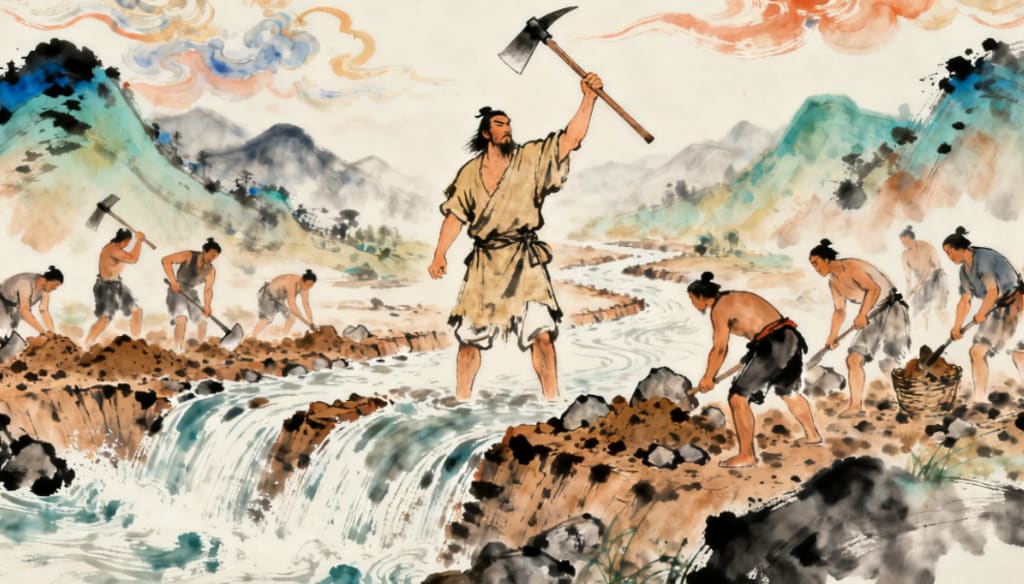
In the distant age of the Three Sovereigns and Five Emperors, the Yellow River and its tributaries erupted in devastating floods that engulfed villages, drowned crops, and turned vast stretches of fertile land into a watery wasteland. The people were displaced, wandering homeless with their families, struggling to survive amid the chaos and despair. Seeing his subjects suffer, Emperor Yao, the wise ruler of the time, resolved to find someone capable of taming the rampaging waters. After careful consideration, he appointed Gun, a noble and capable man, to take charge of flood control.
Gun devoted himself wholeheartedly to the task. He observed the floods carefully and believed that the only way to stop them was to build high dikes and dams to hold back the water. For nine long years, he led the people in constructing these barriers, working day and night without rest. However, the floods were too powerful. No matter how high they built the dikes, the water would eventually overflow, destroying the dams and causing even greater damage. The people grew increasingly discouraged, and Emperor Yao, seeing that Gun’s efforts were in vain, was deeply troubled. When Emperor Shun ascended the throne, he reviewed Gun’s work and decided that Gun had failed to fulfill his duty. He ordered Gun to be exiled to Yushan Mountain, where Gun lived out his days in sorrow, knowing he had not been able to save his people.
Before his death, Gun passed his mission of flood control to his son, Yu. Yu was heartbroken by his father’s fate, but he also felt a heavy responsibility to complete what his father had started. He vowed to find a way to tame the floods and bring peace to the land. Unlike his father, Yu did not rush into action. Instead, he spent years traveling across the country, observing the rivers, mountains, and terrain. He talked to the people, listened to their experiences, and studied the patterns of the floods. Through his observations, Yu realized that his father’s approach of blocking the water was flawed. The water had to be guided, not contained. He came up with a new strategy: “dredging the rivers and diverting the water to the sea.”
Yu assembled a team of dedicated men and began the arduous work. They dug channels to connect the flooded areas to the major rivers, and then dredged the riverbeds to make them deeper and wider, allowing the water to flow smoothly toward the East China Sea. The work was extremely difficult. They had to cut through mountains, clear forests, and move huge boulders. Yu led by example, working alongside his men, eating simple food, and wearing tattered clothes. He never complained, and his determination inspired everyone around him.
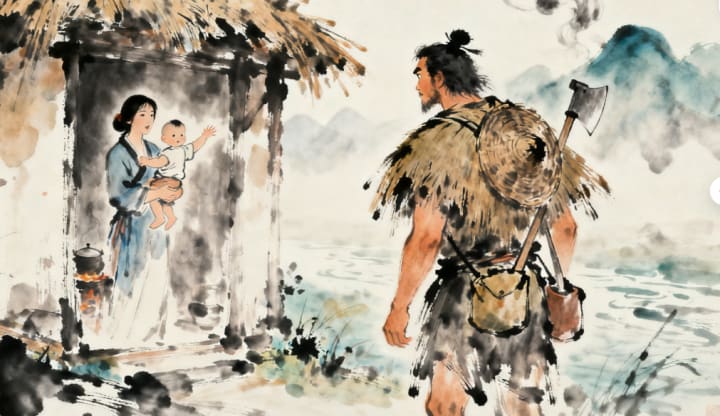
One of the most famous stories about Yu is that he passed his own home three times but never went in. The first time, he heard his wife giving birth to their son, Qi. He longed to go in and see his newborn child, but he knew that the flood control work was too urgent. He sighed and said, “The people are suffering from the floods. How can I take time for my own family?” The second time, Qi was a toddler, crying and reaching out to him as he passed by. Yu’s heart ached, but he shook his head and continued on his way. The third time, Qi was a young boy who ran out to call him father. Yu smiled at his son, patted his head, and said, “I will come back when the floods are controlled.” These three passes became a symbol of Yu’s selflessness and devotion to his people.
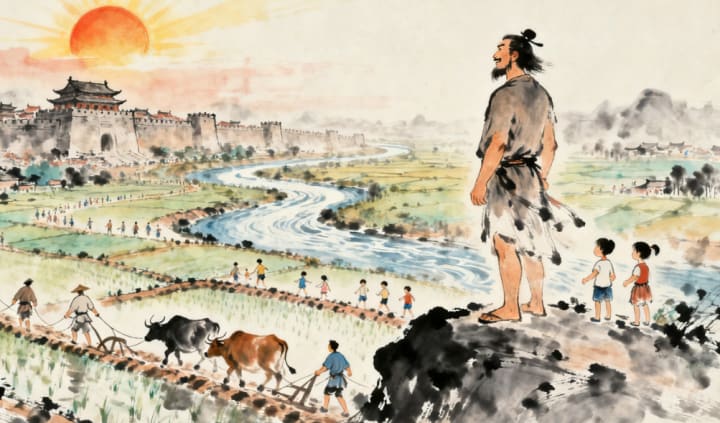
Yu’s efforts lasted for thirteen years. During that time, he traveled thousands of miles, mapping the rivers, planning the dredging work, and overseeing every detail. He faced countless hardships—storms, hunger, illness—but he never gave up. Gradually, the floods began to recede. The water flowed gently through the dredged channels into the sea, and the once-flooded land dried up. The people were able to return to their homes, rebuild their villages, and plant crops again. The land became fertile once more, and prosperity returned.
When Emperor Shun saw what Yu had accomplished, he was overjoyed and deeply impressed by Yu’s wisdom, courage, and selflessness. He decided to pass the throne to Yu, saying, “Yu has saved the people from the floods and brought peace to the land. He is the most worthy ruler.” Yu initially refused, saying that there were others more capable, but the people and the nobles all supported him. In the end, Yu accepted the throne and established the Xia Dynasty, the first hereditary dynasty in Chinese history.
Yu ruled wisely and benevolently. He divided the country into nine regions, established a system of governance, and taught the people to farm, raise livestock, and build irrigation systems. He encouraged harmony among the tribes and promoted culture and education. Under his rule, the country flourished, and the people lived in peace and happiness.
The story of Yu the Great controlling the floods has been passed down through generations in China. It is not just a story of overcoming natural disasters, but also a celebration of virtues such as perseverance, selflessness, wisdom, and responsibility. Yu’s spirit has inspired countless Chinese people to face difficulties with courage and to put the interests of the community above their own. Today, when people talk about Yu the Great, they remember not only his great achievement in taming the floods but also the noble qualities that made him a legendary ruler.
About the Creator
David cen
Share Chinese Sory,which you never heard before.China has 5000 years history and it is A kingdom of artifacts.Such as Chinese Kongfu,Qigong etc.
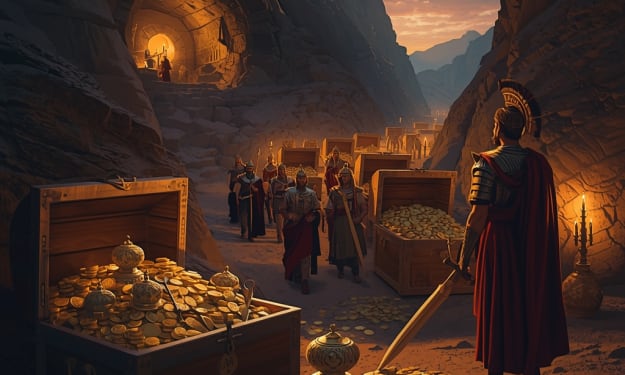
The Lost Treasure of Alexander the Great: History’s Greatest Unsolved Mystery
Yet, despite detailed historical records of his conquests, one question continues to fascinate historians, archaeologists, and treasure hunters alike: what happened to Alexander the Great’s vast treasure?
By Say the truth 7 days ago in History



Comments
There are no comments for this story
Be the first to respond and start the conversation.