
The Bell That Rang After Midnight
You’ll hear it,” the woman said. “Don’t answer it.”

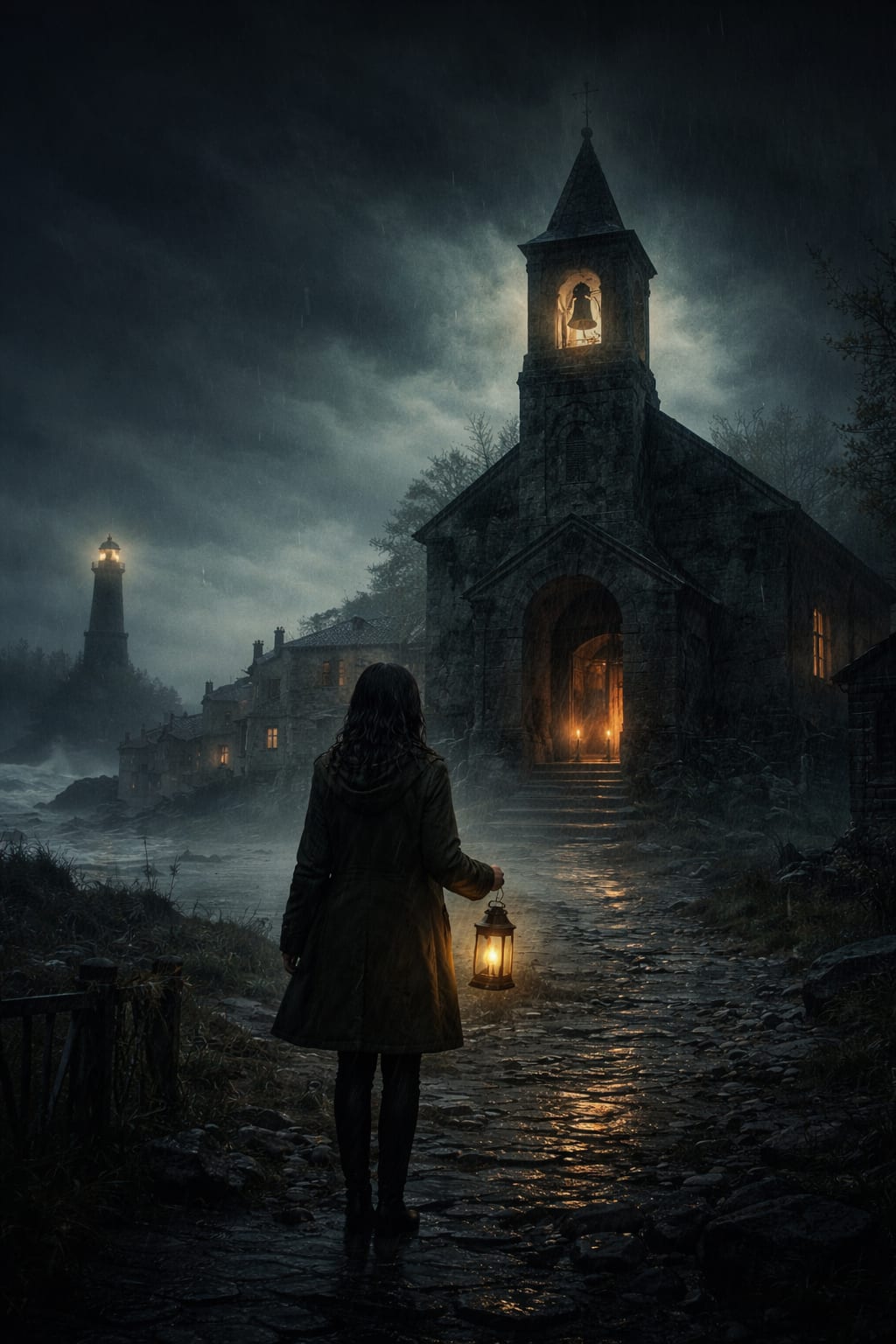
In the coastal village of Greymoor, the sea never slept. Waves whispered against black rocks, and wind threaded through crooked chimneys like a breath searching for a mouth. Tourists came in summer for the views and left before autumn taught the cliffs their true language. The villagers stayed, wrapped in wool and habit, and obeyed one old rule: when the church bell rang after midnight, nobody opened a door.
Lena arrived in October with a recorder, a notebook, and a promise to herself that she would finally write something worth fearing. She had heard the rumor in a café in Marseille—a bell that rang when no hand pulled the rope—and followed it north until the roads narrowed into stone and salt. The innkeeper, a woman with a face shaped by weather, gave Lena a key and a warning in the same breath.
“You’ll hear it,” the woman said. “Don’t answer it.”
Lena smiled like someone who had paid to be afraid. She spent the day walking Greymoor’s lanes: crooked houses stitched with ivy, a lighthouse scarred by storms, and the church on the hill, its windows blind with soot. Inside, the bell rope hung cut and frayed, tied in a sailor’s knot far above reach. A plaque on the wall read: In memory of the night the sea came for us.
At the archive, she found the year—1893. A winter surge had torn through the harbor, swallowing boats and names. Survivors spoke of a sound before the water: a bell calling from the church when the church was empty. Some followed it uphill. Some did not. The pages were stained with salt or tears; it was hard to tell which.
That night, wind rehearsed its threats against Lena’s window. She set her recorder on the sill and waited. Midnight passed like a held breath. Then, at 12:17, the bell spoke.
It was not loud. It was patient. One note, then another, spaced like footsteps in a corridor. The sound climbed the hill and slipped under doors. Lena’s chest tightened with delight. She grabbed her coat.
The inn’s hallway was dark. At the door, her hand paused on the latch. The innkeeper’s warning pressed into her palm like a coin. Don’t answer it. But the bell rang again, closer now, as if it had moved downhill.
Outside, fog knelt in the street. The cobblestones shone with damp, and the sea breathed somewhere unseen. Lena followed the sound upward, past shuttered windows and a bakery that smelled of yesterday’s bread. With each step, the bell seemed to retreat, pulling her like a tide.
At the church gate, she found it open.
Inside, candles burned in a row along the aisle, though no one was there to light them. The bell rope swayed slightly, though the air was still. Lena raised her recorder. The bell rang once more, and the sound did not come from above. It came from behind the altar.
A door she hadn’t noticed stood ajar. Stone steps descended into a space that smelled of iron and cold water. She went down.
The crypt was shallow and long, with niches where names had been carved and scraped away. At the far end stood a basin filled to the lip with seawater. It moved when she breathed. The bell rang again, and the basin’s surface rippled, shaping a face that was almost a face: a suggestion of eyes, a mouth made of wave.
“I came,” Lena whispered, because silence felt like an insult.
The water lifted a finger of foam and pointed toward the stairs.
She backed away. The candles above guttered. The bell struck twice, quick as a heartbeat. From the walls came a murmur—boots on deck, oars dipping, a thousand small sounds of people who had once believed hills could save them.
Lena ran.
The street had changed. The fog was thicker, and the sea sounded closer, as if the village had leaned downhill. Doors she passed were painted with the same symbol: a bell crossed by a line. From one window, the innkeeper watched, her face a pale coin in the dark.
“Go home,” she mouthed.
But the bell did not let Lena go home. It rang in front of her now, always a step ahead. At the harbor, water climbed the stones in slow fingers. The lighthouse blinked once and went blind.
“Why me?” Lena shouted at the fog.
The answer came as a tide of whispers: Because you listen.
The bell rang from the water itself. The basin’s face returned, wider now, its mouth a hollow the size of a door. The old rule made sense at last—not to keep people safe, but to keep the bell fed with silence. It needed a listener to become a path.
Lena raised her recorder and smashed it on the quay. The bell faltered, its note bending like metal under a hammer. She tore pages from her notebook and set them alight with a match meant for cigarettes she never smoked. The fire made a small, brave sun.
The whispers recoiled. The water fell back a hand’s breadth. Lena ran uphill, toward the church, toward any place where stone outweighed sea. Behind her, the bell rang once, thin as a thread, then unraveled into wind.
Morning found Greymoor intact. The lighthouse blinked again. The innkeeper poured Lena tea without speaking. On the quay, the tide left a single wet line, as if it had paused to consider a higher mark.
Lena left that afternoon with empty tapes and a burned notebook. She did not write the story she had planned. Instead, she mailed one sentence to herself and never opened it:
Some sounds are doors, and some doors lead to water.
In Greymoor, the bell has not rung after midnight since. But on storm nights, when fog kneels in the streets, villagers say they hear a new sound—paper tearing in the wind, as if a story is being refused.
About the Creator
Iazaz hussain
Start writing...
Keep reading
More stories from Iazaz hussain and writers in Horror and other communities.
The Bells of Blackmere
In the northern reaches of a forgotten coastline, beyond the tourist maps and the bright harbors, lay the village of Blackmere. It was the kind of place that clung to the edge of the world—stone cottages pressed against black cliffs, roofs bowed like tired shoulders, and a church tower that rose like a broken finger pointing at the sky.
By Iazaz hussain3 days ago in Horror
Killing him slowly
There’s an intruder in my house again. He stumbles through the door, wet carrier bags in hand. He’s bought me offerings. I show my appreciation, letting him caress my beautiful body. He wants to touch me. I rub myself against his legs. He sighs, dropping the bags. He can’t resist touching me. Running his hand slowly down my spine, I arch my back towards his caress, let out a low purr. It’s what we both need.
By N J Delmas27 days ago in Horror
The Game You Play Alone: A Terrifying Guide to "One-Man Hide and Seek"
Introduction: The Solitary Invitation In the eerie corners of the internet, where shadows linger and curiosity often leads to peril, a terrifying ritual emerged: "Hitori Kakurenbo," or "One-Man Hide and Seek." It's a game played alone, in the dead of night, designed not for entertainment, but to invite a malevolent spirit into your home for a deadly game.
By Takashi Nagayaa day ago in Horror
Magic
Note from the Author: I want to let you know that this is an unusual story, and it has been written purely from whatever is in my unconscious mind, because before I start writing, I get into a flow state that reaches my unconsciousness. I also write in my subconscious mind, which is like a mid-flow state between the conscious and unconscious mind.
By Denise Larkin2 days ago in Fiction



Comments
There are no comments for this story
Be the first to respond and start the conversation.