
The House That Watches Back
Some homes hold memories. Others hold secrets.
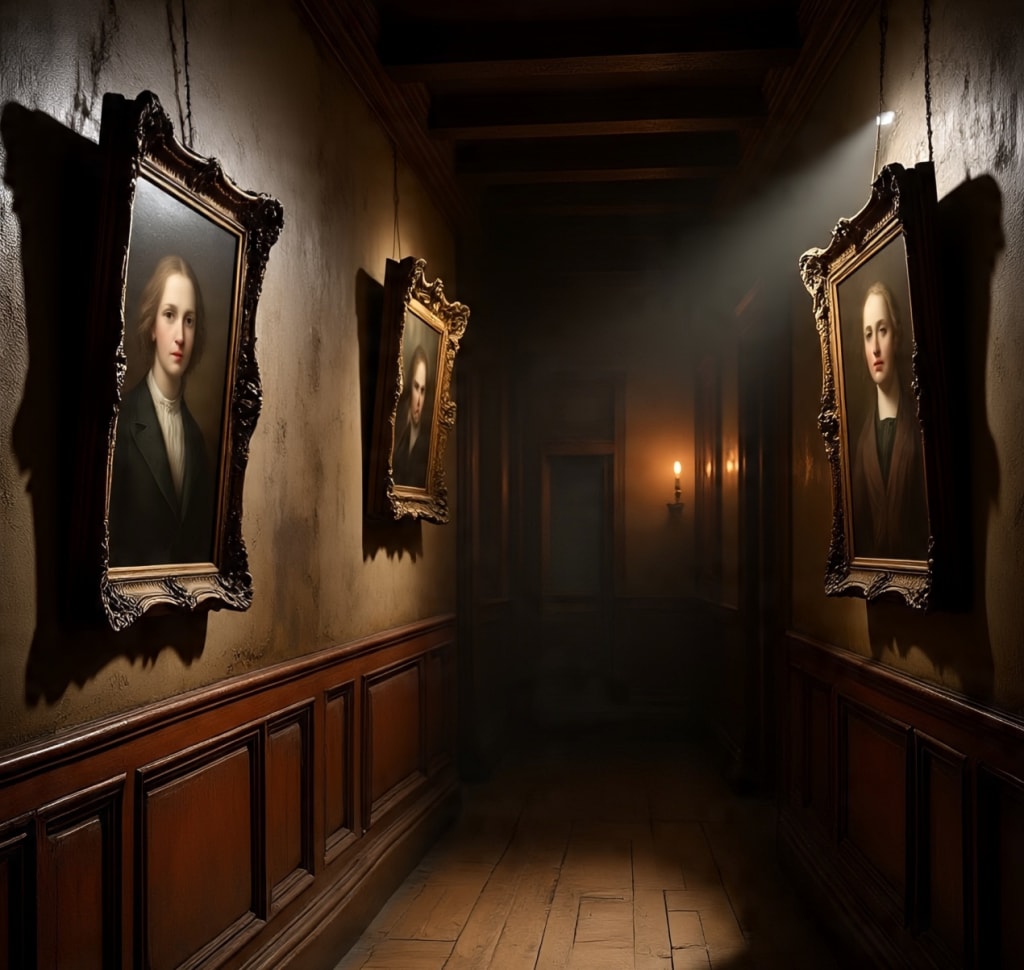
The House That Watches Back
The house on Ashgrove Lane wasn’t what they wanted — it was what they could afford.
After months of searching, Emily and Daniel finally signed the papers. To Emily, it looked like something out of an old novel: creaking floors, ivy crawling up the walls, and a staircase that whispered under every step. To their eight-year-old daughter, Lily, it was “the fairy house.”
They moved in on a cloudy afternoon, the kind where thunder threatened but never came. Boxes filled the front hall, and the faint smell of cedar drifted from the old wooden beams.
By evening, Emily was unpacking dishes when she noticed the portraits.
There were four of them, hanging neatly along the main hallway. Each painting showed a different family, each set in what looked like the very same house. The colors were faded, but the eyes — the eyes looked startlingly alive.
“Creepy,” Daniel muttered as he walked by with a box. “We should take those down.”
“Maybe later,” Emily said. She couldn’t look away. Something about them felt oddly… familiar.
---
That night, Lily couldn’t sleep.
“Mommy,” she whispered, appearing by their bed, clutching her stuffed rabbit. “The people in the pictures are watching me.”
Emily opened one sleepy eye. “Honey, that’s just your imagination. It’s an old house — shadows do funny things.”
But when she tucked Lily back in, Emily noticed something strange. From the hallway, the portraits seemed to face her no matter where she stood.
She shook it off. New house jitters, she told herself.
---
By the third day, the strangeness became harder to ignore.
As Emily passed the hallway, she stopped mid-step. One of the portraits — the one of a family from what looked like the 1920s — seemed different. The mother’s face, once soft and smiling, now looked tense. Her painted lips had shifted downward.
Emily blinked. “No way…”
She fetched her phone, snapped a picture, and compared it to the listing photo she’d taken when they first moved in.
The difference was there — clear as daylight.
---
When Daniel came home, she showed him.
He frowned. “Lighting. Paint cracks. You’re overthinking it.”
“I’m not,” she insisted. “Look at her expression — it’s changed.”
He sighed. “You’ve been exhausted lately. Between the move, Lily, and unpacking—”
“Daniel, I know what I saw.”
They stared at each other for a moment — the kind of stare that only married couples understand. The silent one that says let’s not fight about this tonight.
---
That weekend, Emily tried to ignore it. She filled the house with cinnamon candles, opened the curtains, and played Lily’s favorite Disney songs while they unpacked.
But something was off. The air felt… heavy. The way sound seemed to echo just a little too long.
On Sunday morning, Lily came into the kitchen and said, “Mommy, the lady in the hallway is sad.”
Emily froze. “What lady, sweetheart?”
“The one in the picture. She was crying last night.”
Emily’s stomach turned cold. She marched to the hall.
The portrait had changed again.
The painted mother’s eyes now glistened, as if tiny tear streaks had been added to her cheeks.
Her hand — once resting on her son’s shoulder — now hung limp by her side.
Emily dropped her coffee mug.
---
She took the paintings down that afternoon, one by one, despite Daniel’s protests. But beneath each frame, the wallpaper was oddly discolored — not from sunlight, but something darker. The marks almost looked like shadows of the figures still lingering on the wall.
Lily stood nearby, whispering, “They don’t like that.”
“Who doesn’t?” Emily asked gently.
“Them,” Lily said, pointing to the empty wall. “They said it’s their house too.”
Emily felt her pulse quicken.
That night, she locked the hallway door.
---
The next morning, the portraits were back.
Not on the floor where she’d left them — but hanging exactly where they’d been, perfectly straight.
And this time, the people were different.
It was them.
Emily gasped, stumbling backward. Her own face — Daniel’s, and Lily’s — were painted in perfect likeness, standing before the same ivy-covered house. But their expressions were lifeless, their eyes hollow.
Daniel thought it was a prank. “You must’ve hired someone,” he said, half-laughing but with fear beneath his voice.
“Daniel, does this look funny to you?” she whispered, pointing to Lily’s painted image — her daughter’s hand pressed against the glass, as if reaching out.
He stared. The laughter died from his throat.
---
That night, Emily didn’t sleep. She sat in the living room, lights on, watching the hallway.
At 2:47 a.m., the lights flickered.
Footsteps echoed softly across the old floorboards — not from upstairs, but from within the walls.
The air turned cold.
And then she heard it — a faint whisper, like someone speaking through fabric.
“Stay.”
Emily’s breath hitched. “Who’s there?”
Silence.
She turned slowly toward the hallway — and froze.
The portraits’ eyes glowed faintly in the dark, the painted pupils moving to follow her every step.
---
By morning, Daniel wanted to leave. “We’ll sell, break the contract, whatever it takes.”
Emily nodded, but her voice trembled. “We just need one more night. Please.”
That evening, as the sun set, she gathered every painting and carried them to the fireplace.
Lily stood beside her, quiet.
“They’re sad,” she whispered again. “They said they were just trying to be remembered.”
Emily hesitated. “What do you mean?”
“They lived here before. The house keeps their faces so it won’t forget them.”
Emily’s eyes widened. “Did they tell you that?”
Lily nodded solemnly. “They said… it’s your turn now.”
---
The flames crackled as the portraits burned — paint bubbling, faces warping into gray ash. Emily held Lily close, whispering, “It’s over.”
But when the fire died and they turned around, something shimmered on the wall behind them — the faint outline of three figures forming in the smoke.
Their own faces, emerging from the soot.
Emily screamed. Daniel grabbed Lily and ran for the door — but it wouldn’t open.
The windows wouldn’t budge.
And from the walls came that same whisper, only louder this time.
“Stay.”
---
When the realtor visited a week later, the house was empty. No furniture, no signs of life — except for three new portraits on the wall.
A woman, a man, and a little girl.
All staring outward.
All watching.
About the Creator
Keep reading
More stories from Abdul Muhammad and writers in Horror and other communities.
The Cat Who Knew Too Much
The Cat Who Knew Too Much Sometimes, the only witness to tragedy is a creature no one suspects. When Claire adopted Jasper, she thought she was rescuing a stray. The sleek black cat had been sitting outside the local shelter in the rain, staring through the fence like he was waiting for someone. His golden eyes seemed to meet hers with unsettling intelligence.
By Abdul Muhammad 4 months ago in Horror
The Whispering House
It was a cold and rainy evening when Emma decided to finally visit the old house at the end of Willow Street. Everyone in the town had warned her not to go there. They said it was haunted, that strange noises came from inside, and that no one who entered stayed the same afterward. But Emma was always curious. She wanted to see it for herself and maybe even discover something no one else had noticed before. With a small flashlight in one hand and her notebook in the other, she stepped onto the wet cobblestone path that led to the house.
By Sudais Zakwan4 days ago in Horror
The Devil's Triangle
The sails ruffled in the breeze as we cruised along. The Sea Breeze was a mid-size catamaran that sailed out of Royal Naval Dockyard in Bermuda. We had booked this trip weeks in advance and were now looking at our Captain, Spike and two boat hands. Paddy and Wilson seemed like nice guys, joking around with the passengers and telling us some stories about Bermuda that only locals would know. Their island accents sounded almost British but they were pleasant to listen to.
By Barbara Gode Wiles6 days ago in Fiction




Comments
There are no comments for this story
Be the first to respond and start the conversation.