
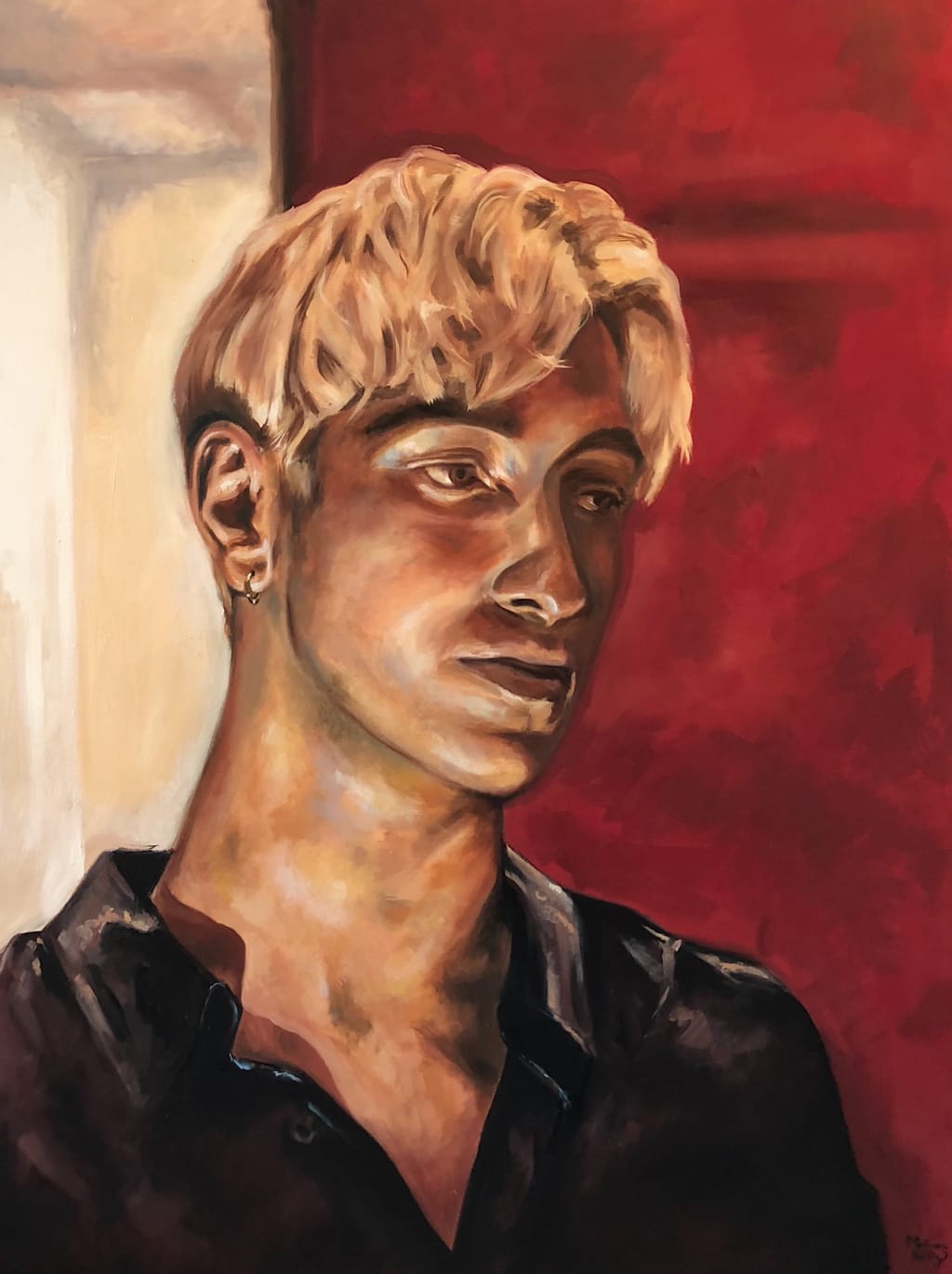
From up close, the paint strokes came out as individual colors and shapes, each with its own deliberate intent. Taking a few steps back, Byron Mar’s unwavering gaze could nearly startle a viewer. His intensity in real life matched how his painterly circles often found him, scribbling, arguing, becoming consumed by any one of the artists and intellectuals around him. Funny how perception plays in a piece like this, all those actions taken years ago creating a sort of portal for the present to look through. A screaming child interrupted Andi’s conference with the artist’s self-portrait. She whipped her head around to see the child and relief- it was just Lucius. He made a face as he approached her on the unwelcoming museum bench to face Mar’s self portrait.
“I need you to go to the Tate archives to find the exact dates for the acquisition, if you don’t mind. I’d go myself but I have to give the auction catalogue a final proofread.”
“Yeah, of course! I’ll let you know if anything interesting jumps out at me,” Andi joked. Lucius thanked her and looked up at the piece. “See you later friend!”
The archival dive was turning out to be overwhelmingly normal. The file “Mars, Byron” had photocopies, records of sales, and all the necessary documents dating back to the painting’s origins and life after the artist’s death. The provenance of a work from Victorian England isn’t usually so well documented, she noted. She found the dates for the painting’s entrance into the Royal Academy’s collection, Mar had requested that his work end up in multiple places, including his alma mater. Upon returning the records on Mar’s catalogue, Andi caught a glimpse of what looked like a photograph. She’d seen the sparse collection of Mar photos online, but never something she could hold. She delicately opened the folder, revealing a mid 19th-century portrait of the artist. He was well-known enough to have a file at the Tate Britain, but not well-known enough for this shot to be included in the photography collection. In her research, she discovered he was ahead of his time in his social, political, and personal life. Surrounding himself with a female intellectual circle, he ran with boundary pushing women who had published their own thoughts on gender, labor, and class. Andi, miffed at the thought of Mar being left to wither away in a file, began combing through the rest of the untouched folder.
She stopped on another portrait of Mar, this one taken at his studio, where he taught those traditionally excluded from the practice of academy education- women, children, and working class laborers who would have been dismissed by anyone else. Mars was huddled over, working on a sketch of student Marie, with pencils and a little black book strewn across the desk. Andi noted that a similar notebook featured in his self portrait, but what she had previously dismissed as a nod towards his intellect and passion for writing was in fact an actual possession of the artist. She pulled up a photo of the self portrait she had saved in her phone. The frayed pages in the painting’s black book matched those in the photograph. Andi tried to piece things together- it couldn’t be a diary, there were never any diaries Mar published aside from artistic statements and letters. She would have to find reference of it in secondary sources.
“Mar was always scribbling in the back of that notebook, frantically writing love poems for Marie I can only assume.” Fellow painter and friend Andrew Turner had commented on Mar’s obsession with the book, but this was the only sentence afforded as the rest of Turner’s letters go on to describe parties, politics, and the mundane everyday. Mar never married, and his situation with Marie was never explained, but his forward thinking ideas about class indicate little interest in the tradition of marriage. It seemed as though no one, not even Mar’s closest peers ever gained insight on what he feverishly recorded. If Mar had been documenting his love for Marie perhaps he left it to her- her family could still have it. She would report back to Lucius on Monday.
By Wednesday Lucius’ curiosity had secured the information on Marie Thompson’s relatives, still living in London. They pulled up alongside a two-up two-down home to find great great granddaughter Frankie standing on the steps. Frankie and other existing relatives were too distant in age to have met Marie, but Frankie’s grandmother Alice was born in 1900, 10 years before Marie passed. Lucius introduced himself, “Hi, we spoke on the phone. I’m Lucius Brandt, this is one of our provenance researchers, Andi.” Andi smiled at the woman but she could tell she needed more of an explanation. Andi stepped forward, “My job at the auction house is to research the specific past of the piece we’re selling, which is the provenance. Any kind of past owner, political or social history, or even just an interesting story associated with the painting could add value.”
“So what does Marie have to do with the piece you’re selling?” Frankie looked interested but still weary.
“Marie was one of Mar’s great loves. He spent a lot of time advocating for her right to be an artist and supported her throughout his life. They were never actually together because he wasn’t interested in marriage but I think he may have left something important to him with her.”
Andi pulled out the photos of Mar in his studio and his self-portrait, and explained how the book was thought to have been relevant to Marie. As Frankie looked, she nodded and then cocked her head to one side as if she was putting the pieces together. “You know,” she started, “I have the book actually, but we could never make sense of it. My mum said that it read like a novel, we thought maybe Marie wrote it herself and just couldn’t remember when she was older, and my grandmother wouldn’t have known. I can go try and find it, no one’s looked at it in ages.”
“Don’t get too excited,” Lucius joked, just as Frankie came down the stairs with a small box. She sat down next to Andi and pulled out the little black book. She recognized the tattered pages sticking out and the curled edge of the front cover. Frankie gingerly handed it to Andi as she took a deep breath. The first page was covered in drawings, sketches of what looked like laborers, but she could make out a phrase written underneath.
Oliver Jamie Carter
It was a name. A Scottish name? Andi went on to the next page. The name was written again, but with a bulleted list beneath it.
born Glasgow
married Jean in Brighton
Max and Tara are 8 and 10
went on vacation to visit Paris, New Year’s Eve, Max accidentally locked himself in a tiny Parisian bathroom and Jean used her rusty French to tell the waiter he had broken it rather than the truth
Andi kept reading the list of memories and dates but bewildered, looked to Frankie. “Are you sure this is the right book?” Frankie nodded, “I know it doesn’t make sense, no one’s read it all the way through.” Next page. A poem dedicated to a certain “Bohemian Rose” on one side with more memories featuring Max and Tara on the other. The unpublished poem mentioned the lilac dress Marie wore when they first met at one of many infamous Grosvenor Square parties. No one could know that but Mar himself. Andi skipped ahead and glanced at the middle of the page. She tensed up. Below a sketch of what she recognized as Marie, there was a section that she read and reread.
Marie’s beauty is only paralleled in my own memories of Jean, moments of laughter encouraged by my unwillingness to take serious photos or watch horror films with the lights off
Andi read the phrase out loud and looked at Lucius for a reaction. He let out a breathy laugh and looked back at her “very funny.”
“I’m not joking.” Andi handed the book to Lucius as he reached for the glasses sitting on his shirt collar.
“Frankie, could you be more specific about where you found this?” She shrugged, “it was always in the same box. What are you saying?”
Lucius, cautious and captivated, grinned and shook his head. “No bloody clue.”
Andi and Lucius took the book back to work and set up the conference room. They set themselves up on opposite ends of the oval table with the book resting in the middle, afraid to touch it.
“Obvious questions first.” Andi nudged. “Right.” Lucius was hesitant, a first.
“Who is Oliver Jamie Carter? How does he know Marie? And more importantly how the hell can he be referencing film?” Andi pulled a book out of her bag, gently set it on the table, and pushed it forward.
“In my research I read about how Mar was deemed insane in his old age. He was taken to Mad Doctors because he would talk in great detail about another life. As he got older he would have fits of rage where he claimed he wasn’t who he said he was.” She went on, “I mean, it would explain why his political and social themes were so ahead of their time. He was actually much more progressive than other artists in his circle, but I always just thought it was Marie’s influence. I think he was attempting to record memories from his first life as to not forget.” They both knew the answer to their question but neither could seem to actually get the words out. Lucius sighed, took off his glasses, and rubbed his eyes.
“I’m gonna need someone to do handwriting analysis before I tell the auction house we’ve just discovered a lost time traveling artist.”
Thomas Hartwell, Lucius’ handwriting expert, called them into the conference room to present his findings. Andi felt that he might be able to see her heart beating through her button up. “Well,” he adjusted in his seat and looked at them through his glasses, “the writing in the book, particularly the passages you asked me to examine that reference things before Mar’s time- are identical to what we see in his letters from the period. He glanced at the projected photos he had set side by side and stood up. Two versions of “memories” had been taken from both his letters and the line that startled Andi in the notebook. “You can see here the width and spacing is the same, the small loop at the top of the cursive S and curve at the bottom indicates it was written by the same hand.” Thomas proceeded through his slideshow with dozens of other examples. Andi turned to Lucius, who set down his pen and crossed his hands on top of the table. “We’ll need to update the catalogue.”
Mar’s unexplainable circumstances spread through both the art world and international news hours after Lucius contacted the auction house. Andi had contacted Carter’s family and explained what they found but it took weeks for Jean to consider her missing husband found, yet completely out of reach. No one could know what happened to Mar, or perhaps Carter, but to Andi, all the pieces had come together. With Frankie’s permission and gratitude, they included the notebook in auction. For those who did believe, the notebook was priceless. The notebook sold for more than the portrait itself, and with Andi’s share equalling $20,000, she knew that her story would be put under a microscope. Perhaps she would be the desperate researcher that invented outlandish provenance beyond the constraints of time, but it wouldn’t be the first time the story behind a work was fabricated. It only takes one buyer to legitimize the value of a work.
About the Creator
Keep reading
More stories from writers in Humans and other communities.
Cabin Fever Because of Snow, Sleet, and Freezing Rain That Turned to Icy Roads
What Is Cabin Fever? The short answer is that cabin fever is restlessness from being in a confined area. Cabin fever is the distressing irritability or restlessness experienced when a person or group is stuck at an isolated location or in confined quarters for an extended time. Research shows that prolonged cold, gray skies, and being stuck indoors can trigger mood shifts similar to “winter blues.”
By Margaret Minnicks7 days ago in Humans
How Long Distance Relationships Affect Mental Health And Emotional Security
The long distance relationships present some special emotional problems because of the physical distance. Lack of physical contact on a daily basis may enhance feelings of loneliness, miss, and emotional insecurity. Minor details that normally stitch an individual together like common ways of doing things or bodily intimacy are all curtailed or absent. This may result in emotional distances that need deliberate attempt to handle them. In the long run, the distance can increase the level of emotional sensitivity, and people will become sensitive to misinterpretations or shifts in communication patterns.
By Willian James6 days ago in Humans
The Lesions of Devotion
Every day I set myself down on the freshly cut lawn and strip myself bare. I take my guitar and finger the frets and pick at the strings, listening for dissonance. My life is dissonance. I twist the tuning pegs until each string sounds bright. Then I kneel, calves pointing behind me, kneecaps facing forward. All exposed to the breeze. I close my eyes and play the melody.
By Paul Stewartabout 20 hours ago in Fiction
~ Fired ~
— Ai Intrusion ~ Are you Next ~ Is Ai Evolution after your job? — Few workplaces haven't been affected. Ai is in supermarkets, at doctors' offices, and even monitoring farms. I just can't think of anything this machine is not getting into, can you? For instance: Education ~ Law and Tech jobs will one day have a major influence or be taken over by these inanimate machines, with accuracy and vigor. From mechanics' diagnoses to a wide variety of everyday jobs, including fast food workers, with this input having the ability to cut their unnecessary work hours. I'm certain all of us have been touched by this with our short stories and colorful headings, have you? Even comments are very questionable 'Non-Robot' insertions.
By Jay Kantor6 days ago in Journal


Comments
There are no comments for this story
Be the first to respond and start the conversation.