
Against the Odds
Where Dreams Take Root Amid Challenges

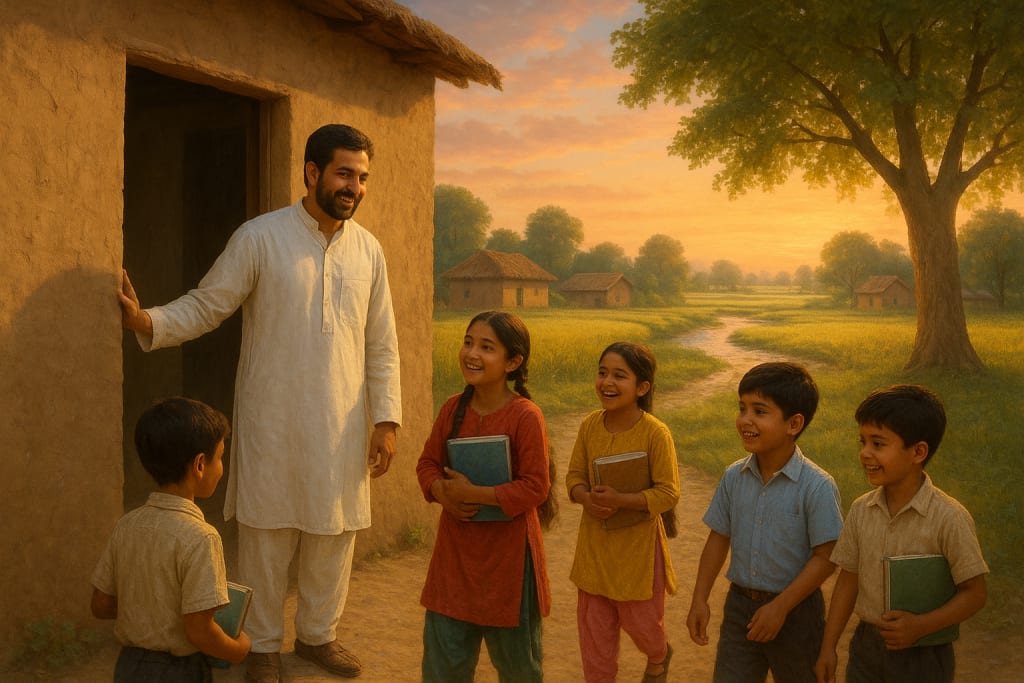
In the heart of Punjab, Pakistan, nestled among lush green fields and winding rivers, lay the small village of Chakwal. The village was known for its simplicity, hard-working people, and strong sense of community. At the center of this close-knit community was Ahmed, a dedicated schoolteacher who had devoted his life to educating the children of Chakwal. Ahmed was a man of principle. He believed that education was not just about reading and writing, but about teaching values like honesty, integrity, and critical thinking. His small school, though lacking in resources, was a place where young minds were nurtured, and dreams were born.
Every morning, Ahmed would stand at the entrance of the school, greeting each child with a warm smile and an encouraging word. His eyes sparkled with hope and determination, reflecting his unwavering belief in the power of education to transform lives. The villagers respected him greatly and often sought his advice on various matters.
One day, during a routine meeting with the village council, Ahmed learned that the government had allocated a large sum of money to improve the school’s infrastructure. The news was met with joy and excitement, as it meant new classrooms, better facilities, and more educational materials for the children. However, as weeks turned into months, Ahmed noticed that no progress was being made. The funds seemed to have disappeared, and the promised improvements were nowhere in sight. Concerned, he decided to investigate the matter further. Ahmed's inquiries led him to a startling discovery: a powerful local politician, Malik Riaz, was embezzling the funds meant for the school. Malik Riaz was a wealthy and influential figure in the region. He had a reputation for being ruthless and was known to use his power to silence anyone who opposed him.
Despite this, Ahmed knew he had to act. The future of his students and the integrity of his village were at stake. Ahmed began gathering evidence, documenting the discrepancies and financial misappropriations. He spoke to contractors who had been promised work but never paid and collected testimonies from villagers who had seen Malik Riaz's men transporting building materials to the politician’s private properties. The more evidence Ahmed collected, the more dangerous his mission became.
He started receiving anonymous threats, warning him to stop his investigation. One night, his house was vandalized, and a note was left behind: "Stay silent or face the consequences." But Ahmed's resolve only grew stronger. He knew that truth and justice were worth fighting for, no matter the cost.
Ahmed decided to share his findings with the villagers during a community meeting. He presented the evidence, exposing Malik Riaz’s corruption. The villagers were shocked and outraged. Many of them had suspected foul play but were too afraid to speak out. Ahmed’s courage inspired them, and they rallied behind him, demanding accountability, and justice. The next step was to take the evidence to higher authorities. Ahmed, along with a few trusted villagers, traveled to the district headquarters to file a formal complaint. They met with government officials and presented their case.
The officials were impressed by the thoroughness of Ahmed's investigation and promised to investigate the matter. News of the investigation spread, attracting the attention of local media. Journalists arrived in Chakwal, eager to report on the story of the brave schoolteacher who stood up against corruption. The increased publicity made it harder for Malik Riaz to silence the growing movement against him. Under mounting pressure, the government launched a full-scale investigation into Malik Riaz’s activities. The evidence Ahmed had gathered was undeniable, and Malik Riaz was eventually arrested and charged with embezzlement and corruption. The stolen funds were recovered and redirected to their intended purpose. With the funds restored, construction on the school began immediately. New classrooms were built, equipped with modern facilities and educational materials.
The village celebrated the transformation of their school, grateful for Ahmed’s bravery and dedication. Ahmed’s actions had a profound impact on Chakwal. The villagers realized the importance of standing up for what was right, even in the face of adversity. Ahmed’s students, inspired by his example, grew up with a deep sense of integrity and social responsibility. They learned that one person's courage could indeed make a difference and that the truth was a powerful force for change. In the years that followed, Chakwal flourished. The school became a beacon of hope and progress, attracting students from neighboring villages. Ahmed continued to teach; his heart full of pride for the community he had helped transform. He often reminded his students,
"Education is not just about acquiring knowledge. It's about building character, standing up for what is right, and making a difference in the world."
One particularly significant moment in Ahmed’s journey occurred when he received an invitation to speak at a regional educational conference. Teachers, principals, and education officials from across the province gathered to hear him. Ahmed shared his story, emphasizing the importance of integrity and the transformative power of education. His speech moved many in the audience, and several schools adopted his approach to instill values in their students.
Through experiences like this, Ahmed realized that his work was not just about educating children but also about inspiring other educators to uphold and teach values of truth and justice. He saw the ripple effect of his actions, as other villages began to hold their leaders accountable and demand transparency. Years passed, and Ahmed’s health began to decline, but his spirit remained strong. One day, as he was resting in his modest home, he received a letter from the government. It was an official recognition of his contributions to education and integrity in the community.
The letter announced that a new school was to be built in his honor, named “The Ahmed School of Integrity.” Tears filled Ahmed’s eyes as he read the letter. It was a testament to the impact of his lifelong dedication. He knew that the values he had fought for would continue to guide and inspire future generations. His legacy would live on, not just in Chakwal, but across the province.
The moral of the story is simple yet profound: standing up for truth and justice, even when it is difficult and dangerous, is essential for the betterment of society. One person’s courage can inspire others and lead to significant positive change. Ahmed’s unwavering commitment to his principles transformed his community and proved that integrity and determination can overcome corruption and wrongdoing.
In the end, Chakwal flourished not just because of its improved school, but because of the unbreakable spirit of its people. The legacy of Ahmed lived on, a timeless reminder of the power of truth, the importance of integrity, and the impact one person can have on the world.
About the Creator
Khan Ali
I craft fictional stories woven with the emotions and truths of real life, bringing relatable characters and moments to every page.
Time to change your life.
Is it even possible for you to change your life? A lot of people, more than there should be, are unhappy with their lives. But what are they doing about it? Usually nothing. People talk about how shitty their lives are and want change, but are they not taking the actions to change?
By Jen Phillips3 days ago in Humans
When a Winter Storm Weather Forecast Changes Everything
Before the first snowflake falls, something shifts inside people. The world feels quieter, heavier, more watchful. Phones light up with alerts, and conversations circle back to the same question. What does the winter storm weather forecast really mean for us this time? These forecasts are not just numbers and maps. They shape plans, emotions, and sometimes fear. They decide whether children stay home, whether roads empty early, and whether families brace for long nights without power. A winter storm forecast carries memory and possibility at once. This article looks closely at how winter storm forecasts work, why they matter so deeply, and how to read them with clarity instead of panic. Understanding the forecast helps people prepare with care, not worry.
By Muqadas khan7 days ago in Humans



Comments
There are no comments for this story
Be the first to respond and start the conversation.