
Canada at Crossroads: A Future with the EU or the U.S.?
Exploring International Big 'What If?'

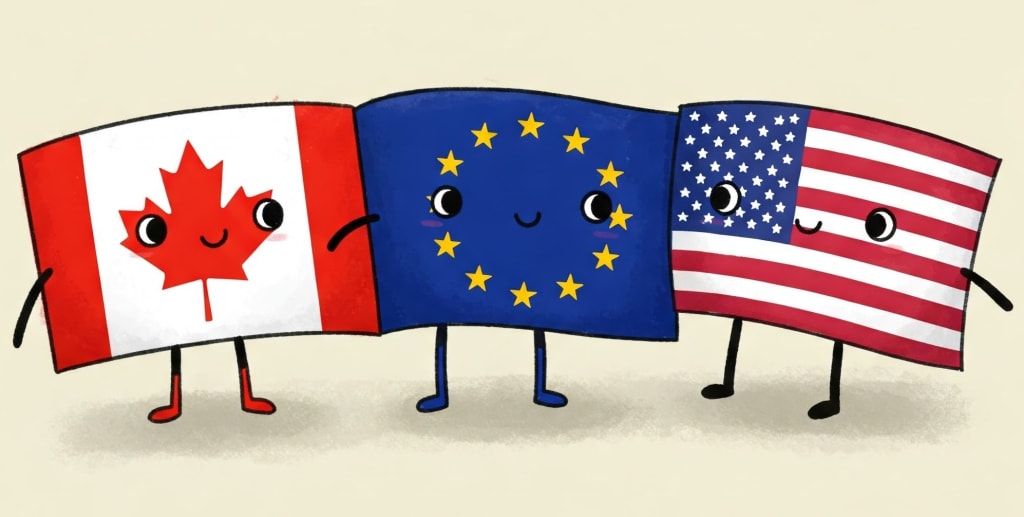
It's a thought experiment that tickles the imagination and stirs debate: What if Canada, a nation celebrated for its vast landscapes, multicultural identity, and (mostly) friendly relations, decided to formally join forces with a larger entity?
The two most frequently, if hypothetically, discussed partners are the European Union and its southern neighbor, the United States.
This isn't just a whimsical ponder. As global dynamics shift, discussions around strategic alliances and national interests evolve. An opinion piece in The Economist even ran a headline: "Why Canada Should Join the EU," suggesting that "Europe needs space and resources, Canada needs people. Let's deal." On the other hand, the long-standing close ties and intertwined economies with the U.S. perennially fuel the "Canada as the 51st state" rhetoric, especially during times of trade tensions.
Let's dive into these intriguing, albeit complex, hypothetical scenarios.
The Transatlantic Tango: Canada and the European Union
The idea of Canada, a North American nation, joining a bloc across the Atlantic might seem geographically unconventional, but the arguments in its favour often highlight shared values and economic opportunities.
Potential Upsides:
Economic Diversification: Membership in the EU would grant Canada unparalleled access to the vast EU single market, reducing its heavy economic reliance on the United States. As the EU is already Canada's second-largest trading partner, this could significantly bolster Canada's economic security.
Resource and People Exchange: As The Economist pointed out, Europe could benefit from Canada's abundant natural resources and open spaces, while Canada, facing its own demographic and labour market considerations, could welcome skilled individuals from Europe. Canada boasts the highest share of university-educated adults among EU countries (if it were a member) and would rank 4th by GDP.
Geopolitical Alignment: Proponents argue that Canada and many EU nations share deep commitments to democracy, multiculturalism, environmental protection, and social welfare systems. A formal alliance could strengthen their collective voice on the global stage.
Enhanced Global Standing: Deeper integration with the EU could position Canada as a key global player, especially in areas like critical minerals, offering a stable alternative to other global powers.
Challenges and Considerations:
The Tyranny of Distance: The sheer geographical separation would pose logistical and practical challenges for full integration, from travel to a sense of shared daily experience.
Regulatory Harmonization: Aligning Canadian laws and regulations with the EU's extensive framework would be a monumental task, potentially impacting various sectors.
Sovereignty and Identity: Concerns would inevitably arise about the dilution of Canadian sovereignty and its unique cultural identity within a large, established political and economic union.
Public Opinion: While some Canadians might welcome closer ties with Europe, there would undoubtedly be significant debate and varying opinions across the country.
The Southern Path: Canada as the 51st State?
The relationship between Canada and the United States is one of the closest and most extensive in the world. The idea of taking this a step further into political union has been a recurring, if often contentious, topic.
Potential Upsides:
Economic Integration on Steroids: Becoming a U.S. state would dissolve the border for trade and movement, creating a vastly expanded consumer marketplace. This could lead to increased competition, innovation, and potentially lower prices for Canadian consumers, converging Canada's cost of living with the generally lower costs in the U.S.
Simplified Systems (for some): For businesses operating on both sides, a single set of federal laws, currency, and market regulations could simplify operations.
Challenges and Considerations:
Loss of Canadian Identity and Sovereignty: This is arguably the most significant hurdle. Canada has a distinct cultural identity, political system, and set of social values (e.g., universal healthcare, stricter gun control) that many Canadians cherish and would fear losing.
Healthcare Overhaul: Canada's publicly funded healthcare system is a cornerstone of its identity. Joining the U.S., where no state has such a system, would inevitably mean a radical shift, likely towards a private insurance-based model with potentially higher out-of-pocket costs for individuals.
Political Transformation: Adding Canada would drastically alter the U.S. political landscape. With its population of around 40 million, Canada would become the most populous state, wielding significant electoral power. Canadian political leanings, generally considered more aligned with the Democratic Party, could shift the balance of power in the U.S.
Cultural Assimilation: While there are many cultural similarities, differences in societal norms, legal systems, and even day-to-day life could lead to significant friction and a feeling of cultural erosion for Canadians.
Economic Impacts (The Other Side of the Coin): While some see economic benefits, others would worry about the impact on Canadian industries, the value of the Canadian dollar (which would disappear), and potential job displacement.
A Spectrum of Opinions
Were either of these scenarios to be seriously considered, the debate would be passionate and multifaceted:
Canadian Nationalists: Would likely strongly oppose either move, emphasizing the importance of Canadian sovereignty, independence, and unique cultural heritage.
Businesses: Might be divided. Some could see advantages in larger markets and reduced trade barriers, while others might fear increased competition or the loss of uniquely Canadian economic advantages.
Everyday Citizens: Concerns would likely revolve around healthcare, social programs, taxation, cultural identity, and the overall impact on their way of life.
Indigenous Peoples: Would have unique and critical perspectives on sovereignty, treaties, and cultural preservation in the face of such monumental changes.
International Perspectives: The EU and U.S. would have their own complex internal debates. Would they welcome Canada? What would be the strategic and economic implications for them?
My Thoughts: The Value of a Distinct Canada
Exploring these "what if" scenarios is a fascinating exercise, highlighting what makes Canada unique and the complex web of its international relationships.
While the economic arguments for closer ties, whether east or south, have their merits, the potential cost to Canadian sovereignty, culture, and distinct societal values seems overwhelmingly significant. Canada's strength often lies in its ability to navigate its own path, drawing on its unique history and multicultural fabric.
Joining the EU, despite shared values, presents immense logistical and integration challenges due to distance and differing institutional frameworks. The idea of becoming the 51st U.S. state, while offering economic streamlining, would likely mean the absorption of Canadian identity into a much larger and culturally dominant entity—a prospect many Canadians would find unpalatable.
Canada currently enjoys strong trade agreements with both the EU (CETA) and the U.S. (USMCA). Perhaps the optimal path lies in strengthening these existing partnerships and forging new ones, allowing Canada to engage robustly with the world while fiercely protecting and nurturing the distinct character that defines it.
The "Canadian Dream," as hinted at by the image referencing The Economist, might not need to move to Europe or be subsumed by its southern neighbor. Instead, it can continue to evolve and thrive on its own terms, a nation that stands as a compelling example of diversity, diplomacy, and a unique way of life on the world stage.
Ultimately, these are thought experiments that underscore a fundamental truth: Canada's current position, while not without its challenges, offers a unique blend of independence and interconnectedness that many nations aspire to. The path forward likely involves navigating these relationships with care, rather than seeking full political or economic union with a larger power.
About the Creator
KURIOUSK
I share real-life experiences and the latest developments. Curious to know how technology shapes our lives? Follow, like, comment, share, and use stories for free. Get in touch: [email protected]. Support my work: KURIOUSK.
Time to change your life.
Is it even possible for you to change your life? A lot of people, more than there should be, are unhappy with their lives. But what are they doing about it? Usually nothing. People talk about how shitty their lives are and want change, but are they not taking the actions to change?
By Jen Phillips3 days ago in Humans
When “Find Your Passion” Goes Wrong
“Find your passion” is everywhere — in graduation speeches, self‑help books, career workshops, and inspirational Instagram posts. It’s presented as the key to a meaningful life: once you discover the thing you were meant to do, everything else will fall into place.
By Tracy Stine7 days ago in Humans
After the Storm
After the storm of winter snow there sat a small bear by the name Ted, of course. He loves the snow and likes to roll around in it making all sorts of trails and whatever he has a mind to do. He wondered where all the people are, but in a way, he is hoping that they are all snug in the homes maybe drinking hot chocolate-one of his favorite drinks with mini-marshmallows and eating something homemade for he likes this winter wonderland all to himself to romp and play and maybe even catch some fish down by the river.
By Mark Graham5 days ago in Fiction



Comments
There are no comments for this story
Be the first to respond and start the conversation.