
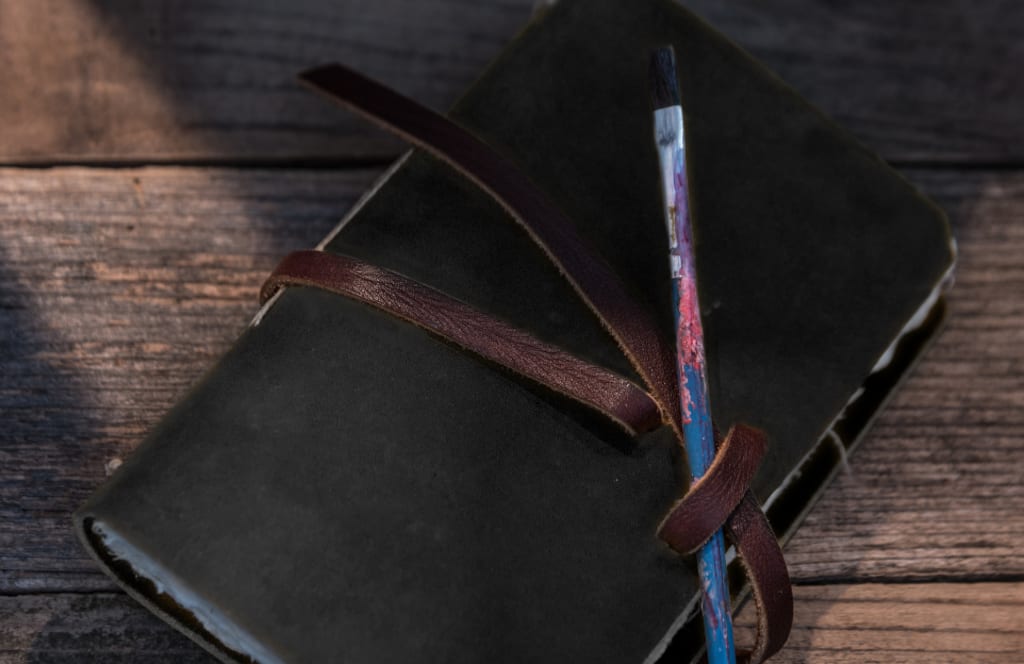
It was my Grandma's. Contained in that little black book, the intricate illustrations and musings that could only belong to an artist.
And she was an artist in every way possible. Unsubtle. Like her laugh, intelligent and lightly mocking, as she explained terms to me, abstract, postmodern. Her metal-grey hair was always flecked with paint. Sometimes she would disappear for a day or two, only to emerge with a new canvas. Conquests - she called them. Everything was about winning or losing.
I'd arrived at her apartment to pick up the remnants of her art career, and I couldn't help but feel annoyed - and that's putting it lightly.
In her will, she had enclosed a large sum of money to my brother, and my sister inherited the apartment. But for me? "To Mary, my Marigold, I leave my art legacy, including my paintings and my sketchbook". Yes, my sister got a house, and I got art supplies.
I shouldn't be surprised. My earliest memory of my Grandma, Joyce, is when I was 5. I was painting, or at least attempting to paint daffodils. My Grandma was a savant, and like most young children, I was not. I sat there merrily, with fat splooges of cheap acrylic paint drying on my paper. Quite content until she came over to judge. 'Darling, why don't you start with the watercolours? This is only good for one thing!' she declared, before feeding it to the lounge room fire, 'kindling'.
She would shudder to see her apartment now, clearly unlived in. A faint musty smell hangs in the air, complemented by dusty skirting boards and grubby walls. I feel a prickling sensation on the back of my neck as I take in the cobwebs and furniture covered in semi-opaque sheets. All physical signs that it has taken me far too long to come to terms with it. I remove a sheet from a likely looking armchair and, with a deep sigh, sink into a squishy embrace.
I ignore the pile of dusty canvases in the corner of the room and fiddle with the book's leather opening. I wonder why she had explicitly left it to me in her will. It may have been the most precious thing in the world to her, but not to me. The artwork made sense; they were valuable, probably more now, since…
Anyway. Her art was grotesquely beautiful. Like Frankenstein, she was a scientist, concocting chaos from colour theory. And successful. She was once commissioned to paint for a late English princess, and you best believe she wouldn't let you forget it. Yes, they would fetch some money. Not a house-load of money, but something. The notebook, on the other hand, was, well… junk. Why did she leave it to me?
Growing up, I was often dropped off at my Grandparents house after school until my parents finished work. My siblings would raid the house for snacks, but I was quite content to watch Joyce. She would explain things to me as I sat there - god forbid I touch the paints myself. Her love of impasto and why she used specific brushes. Why the sky didn't need to be blue, and why you need a rainbow of colours to paint something white, like an egg. When she was in a good mood, she would paint little flowers and swirls on my arms. I would refuse to bathe so I could show them off to my primary school friends. When she was in a bad mood, she would lock herself away. This is when she would produce her best work and emerge the conqueror, a pallid stallion.
I get to the last page of her sketchbook, and it is the first page that holds words, no sketches. I feel my breath catch in the back of my throat.
Safe
1. My Marigold,
2. My first,
3. and my last,
4. My greatest conquest, Unsurpassed
It stood out to me immediately. This was no preparation for an artwork; it was something else. Was it a message? A riddle? A warning?
What did it mean?
I had no idea.
I thumb the notebook as if clues will suddenly appear. The poem was so different from everything else in the book. The thought does strike me that this is probably another one of her games. But I can't help thinking, what if it isn't.
Somehow, inexplicably, I knew that she had left the poem for me. She had a penchant for making people earn things, including her trust. What if this was her final test for me? Or a final message, probably the last message she had for me?
I knew two things for sure. First, the poem was about me, her Marigold. And second, I had to get to the bottom of it.
Standing from the squishy armchair, I decide to inspect the artworks. I start by peeling off their brown paper covers and studying each one. There must've been about fifty in total, of different subject matter, but all in the same abstract style. The only unusual thing is her signature, which adorns each artwork's bottom-right hand corner in thin gold paint instead of traditional black. But this doesn't help me solve the riddle.
It takes me a while to consider looking at the back of the canvases, and I'm not surprised to find that they are meticulously organized by date. As I sift through them, I soon get lost in the pieces' strange beauty until I get to the end – or perhaps the start of the artworks – depending on how you look at it. I find nothing of interest to help me solve the poem. With a deep sigh, I begin the melancholy task of piling them in my small hatchback and making the dreary drive home.
Over the next few days, I mull over the lines in the poem. I also ponder what I will do with the dozens of artworks currently taking over my lounge room. I don't even know where to begin to sell paintings - I doubt the people of eBay would recognize their value. A much more engaging decision was the choice of which artworks I should display in my home.
There is one painting in particular that Joyce pained for me. I vaguely remember a stormy sky juxtaposed with bright marigolds. 'There is beauty in darkness,' she told me when she showed me my painting. At the time, I had no idea what she meant. Later I realized it was some sort of metaphor.
I sift through the artworks until I find it, thinking that it will suit our dining room. I make a mental note to buy some of those sticky hanging strips. I go to lean the artwork on the wall, but something catches my eye. Next to the date, written in black pen, ‘My Marigold', followed by a number, '8'.
I stride across the room to the black notebook, sitting idly on our coffee table. I flip to the last page, and my suspicions are confirmed. It's precisely the same as the line in the poem, 'My Marigold'.
It can't be a coincidence.
I thought the first line had been referring to me, and I was wrong. It was referring to the artworks. What if the other lines were the same? I look at the next two lines, 'My first and my last,' and something clicks. I scramble to the piles of artworks, frustrated that I was not more organized with them, and begin picking up each one, looking at it for a second and throwing it to the side like a madman. How could I have been so dim? Finally, I find what I am looking for, a date, 1978, the oldest in the collection. Sure enough, her familiar scrawl reveals the next line of the poem, 'My First', followed by a number, '6'.
It doesn't take me much longer to find the most recent artwork, dated only a year ago. It did not disappoint, with more of my grandmother's writing, 'My Last – 7'.
I had cracked the poem's first three lines and found three numbers, 8, 6 and 7. I feel dizzy and start to take deep breaths to slow my breathing. Concentrate. I only had one more to go. The last line, 'My greatest conquest, unsurpassed,' must be referring to an artwork as well, but this is trickier. She never talked about having a favourite piece. Or did she? She never stopped talking about the painting she did for that princess. I don’t' know if it was her favourite, but it was her most prolific. But If I'm right, it's not much help to me know, sitting in a castle thousands of kilometres away.
Miserable at having no way to reach the artwork, I hold back tears. I don't know why I'm so invested anyway. Knowing my Grandma, it would always have been an impossible task. I'm so frustrated I have to hold myself back from stomping on the book. That is, until another thought strikes me.
I flip through the book until I find what I'm looking for – the sketches for that painting. A vast landscape with exceptional detail spread across a double page. It is difficult to notice, but in a corner, there is a tiny number 5.
My emotions shift and I start to feel giddy again. I know exactly what the code is for, written in the title of the poem itself. I make a beeline for my car and make my way back to my Grandmothers apartment.
When I get there, it's as if I never left, but it feels different. Like the air is holding electricity. Trembling, book in hand, I make my way to the safe. I plug in the four numbers 8 – 6 – 7 – 5, and turn the dial. With a metallic click, the door punches open. I'm not sure what I was expecting, but I am surprised to see only one small item sitting in the safe. A plain envelope. I tear it open to see two pieces of paper: a typed note and a cheque. I decide to read the note first, 'To Joyce, I enclose the deposit for your painting, made out to your granddaughter as requested, for 20,000 dollars. When the time is ready, I shall send the remaining $480,000 for your last painting.'
I feel euphoria, but it's tinged with a slice of shame. While the book had led me to financial security, it had also ignited a childlike wonder and connected me to my Grandma. Looking at the envelope in my hand, I smile wryly. While she may have been a little crazy, she's also the most incredible person I'll ever know.
About the Creator
Keep reading
More stories from writers in Humans and other communities.
At My Wits’ End
Life is about taking out the trash and calling it trash because you have every reason to. It wasn't meant to be linear, they say. But the times you tried to make it straight led to problems, and you didn’t have the tools to put any of it to use. You don't put your right shoes on the right feet; you put the left shoes on the left feet. The grey hardened slab will trip you up anyway.
By Caitlin Charlton4 days ago in Humans
Craft Over Catharsis Challenge Winners
Craft Over Catharsis? What the hell does that even mean? The phrase came out of a curation meeting as a genuine question. We had been noticing that many challenge entries, across prompts, naturally gravitate toward trauma, grief, and personal reckoning. That makes sense. Writing is often cathartic. It's one of the ways we process what we've lived through.
By Vocal Curation Team4 days ago in Resources
'Till Death We Do Art
There would be nothing divine in this world without art. Nature may surpass the divine to all intents and purposes, but like everything it absorbs and is absorbed by, it remains here, stuck on the surface of this world, ever-present, physically bound to the universe.
By Avocado Nunzella BSc (Psych) -- M.A.P 6 days ago in Art


Comments
There are no comments for this story
Be the first to respond and start the conversation.