
Does Hinduism Really Have 33 Crore Gods? Unpacking the Myth and Meaning
Stories from India and Hinduism


In Hinduism, the concept of "33 crore (330 million) gods" is often referenced in scriptures and popular belief. However, this does not literally mean there are 330 million distinct deities. Instead, it symbolizes the infinite forms and manifestations of the divine across time, space, and creation. The idea reflects the Hindu understanding that God can be worshipped in countless ways to suit different devotees' needs and perspectives.
That said, the number 33 holds special significance in Hindu scriptures. It refers to a specific classification of divine beings or deities, which are collectively referred to as the "Trayastriṃśa" or "33 gods." These 33 categories are derived from the Vedas and other ancient texts.
The Concept of 33 Gods
The idea of 33 gods originates from the Vedas, particularly the Rigveda and other ancient scriptures. These texts describe the cosmos as being governed by a pantheon of divine beings, each responsible for specific aspects of creation, preservation, and dissolution. The number 33 is symbolic rather than literal—it represents the diversity of divine manifestations across three primary realms of existence:
Heaven (Dyuloka) : Celestial deities like the Ādityas and Rudras.
Earth (Bhuloka) : Elemental forces represented by the Vasus.
Intermediate Realm (Antariksha) : Forces governing the atmosphere, life-sustaining energies, and transitions between realms.
These 33 categories of gods are further expanded into the concept of 33 crore (330 million) gods , which reflects the infinite forms of divinity that permeate every aspect of existence. This vastness underscores the Hindu belief that God is omnipresent and can be worshipped in countless ways to suit individual needs and spiritual aspirations.
Detailed Breakdown of the 33 Types of Gods
1. The 12 Ādityas
The Ādityas are solar deities associated with celestial forces and cosmic order. They are considered sons of Aditi , the mother of all gods, and are embodiments of divine virtues. Each Āditya governs a specific aspect of life or nature:
- Vishnu :
Preserver and sustainer of the universe.
Embodies compassion, protection, and balance.
Often depicted reclining on the serpent Shesha, floating in the cosmic ocean.
- Aryaman :
God of patronage, friendship, and alliances.
Represents hospitality, harmony, and social bonds.
Indra :
King of the gods and ruler of heaven (Svarga).
Associated with storms, rain, thunder, and warfare.
Wields the thunderbolt (Vajra) and is celebrated in the Rigveda as a warrior deity.
Bhaga :
God of wealth, prosperity, and fortune.
Symbolizes fairness and equitable distribution of resources.
Dhatri :
God of health, nourishment, and creation.
Responsible for forming and sustaining living beings.
Tvashta (Tvashtr) :
Divine craftsman and architect of the universe.
Creator of weapons, tools, and celestial objects.
Also known for fashioning the physical bodies of humans.
Varuna :
God of water, oceans, and cosmic law (Ṛta).
Overseer of truth, morality, and justice.
Often paired with Mitra as guardians of oaths and contracts.
Mitra :
God of friendship, contracts, and harmony.
Represents trust, loyalty, and cooperation.
Shakra (another name for Indra) :
A duplicate entry emphasizing Indra’s importance among the Ādityas.
Savitṛ :
Solar deity associated with the morning sun and inspiration.
Invoked in the Gayatri Mantra, seeking illumination and enlightenment.
Pushan :
Protector of travelers, roads, and cattle.
Guides lost souls and ensures safe journeys.
Amsha :
God of compassion, sharing, and fairness.
Ensures equitable distribution of blessings and resources.
2. The 11 Rudras
The Rudras are fierce forms of Lord Shiva, representing destruction, transformation, and healing. They embody raw, primal energy and are often invoked during times of crisis or transition. The Rudras are both creators and destroyers, symbolizing the cyclical nature of existence. Here are the 11 Rudras:
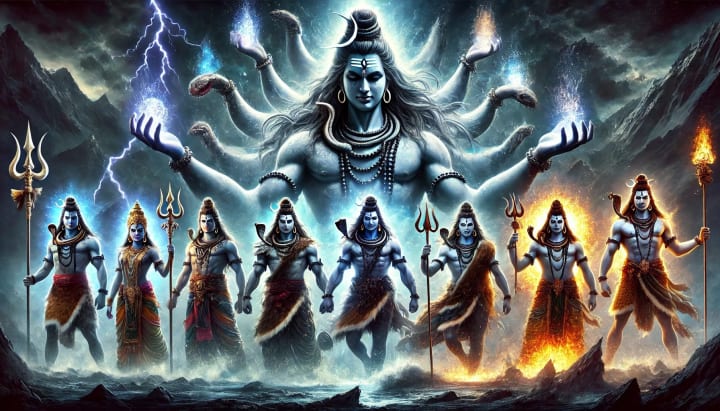
Mahākala :
The great destroyer and embodiment of time.
Represents the inevitability of change and death.
Kapardi :
Wearer of matted hair.
Symbolizes asceticism and detachment from worldly pleasures.
Pingalāksha :
One with reddish-brown eyes.
Represents intensity and focus.
Bhīma :
The terrible or fearsome one.
Embodies strength, power, and invincibility.
Vijaya :
The victorious one.
Grants success and triumph over obstacles.
Bhava :
The originator or creator.
Represents fertility, growth, and renewal.
Shambhu :
Source of joy and peace.
Brings happiness and contentment to devotees.
Isvara :
Supreme lord and controller.
Governs the entire universe with wisdom and authority.
Jayanta :
Conqueror of all.
Symbolizes victory over ignorance and ego.
Pinakin :
Holder of the bow Pināka.
Represents precision, skill, and mastery over challenges.
Aparajita :
The unconquered one.
Embodies invincibility and eternal strength.
3. The 8 Vasus
The Vasus are elemental deities who govern natural phenomena and material creation. They represent the foundational forces of the physical world and sustain life on Earth. The 8 Vasus are:
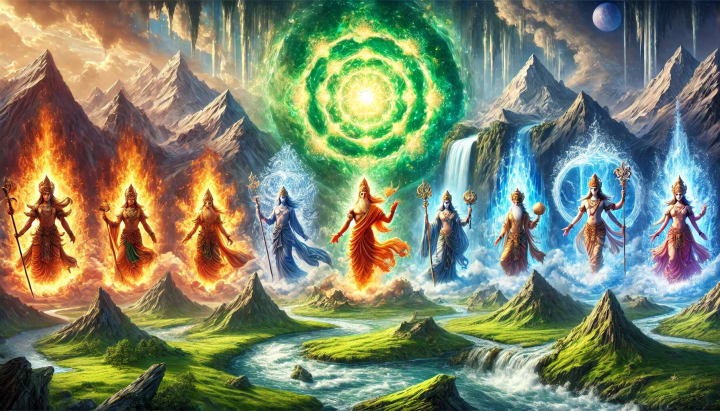
Dhara :
Earth or the solid element.
Provides stability, support, and nourishment.
Dhruva :
Pole star or steadfastness.
Represents constancy, reliability, and unwavering faith.
Soma :
Moon or nectar.
Governs emotions, intuition, and cooling, soothing energies.
Anila :
Wind or air.
Controls breath, movement, and vitality.
Anala (Agni) :
Fire.
Represents energy, purification, and transformation.
Pratyusha :
Dawn or light.
Symbolizes new beginnings, hope, and awakening.
Prabhasa :
Radiance or brilliance.
Reflects inner light, knowledge, and spiritual illumination.
Apah (Āpaḥ) :
Water.
Governs fluidity, adaptability, and life-giving properties.
4. The 2 Ashvins
The Ashvins are twin deities associated with healing, medicine, and protection. They are depicted as divine horsemen or physicians who travel swiftly to aid those in need. The two Ashvins are:
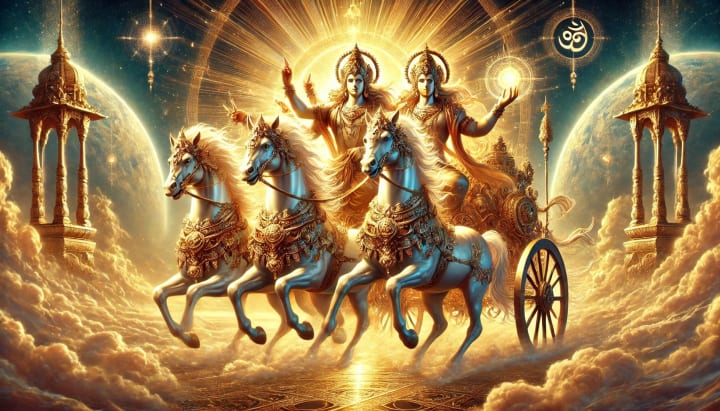
Nasatya :
Associated with curing illnesses and restoring health.
Embodies rejuvenation and vitality.
Dasra :
Associated with miraculous powers and interventions.
Represents divine assistance and unexpected blessings.
Philosophical Significance of the 33 Gods
While the 33 gods represent distinct aspects of creation, they are ultimately seen as manifestations of the one supreme reality , known as Brahman . This unity amidst diversity reflects key philosophical principles in Hinduism:
Unity in Diversity :
Despite the multiplicity of deities, all paths lead to the same ultimate truth. Each god serves as a lens through which devotees can connect with the divine.
Cosmic Order :
The 33 gods collectively maintain the harmony and balance of the universe. Their interplay reflects the interconnectedness of all things.
Symbolism of Nature and Existence :
The classification of gods mirrors the structure of the cosmos—celestial, atmospheric, and terrestrial realms—and highlights humanity's relationship with the environment.
Personalized Worship :
By categorizing divinity into 33 forms, Hinduism allows individuals to choose a deity that resonates most deeply with their personal needs, temperament, and aspirations.
Final word
The 33 types of gods in Hinduism are not merely a list of names; they encapsulate profound truths about the nature of existence, the workings of the universe, and humanity's place within it. From the radiant Ādityas to the fierce Rudras, the nurturing Vasus, and the compassionate Ashvins, each category of deity fulfills a vital role in maintaining cosmic order and guiding human life.
Ultimately, these 33 gods point toward the infinite expressions of divinity found in every corner of creation. As the Upanishads proclaim:
"Ekam Sat Vipra Bahudha Vadanti" ("Truth is one; sages call it by many names").
This inclusive and holistic worldview is what makes Hinduism's approach to divinity so rich and enduring.
About the Creator
Sujeet M Sonar
An artist, teacher, and lifelong learner influenced by philosophers like J Krishnamurti & Socrates, and writers like Premchand and Kahlil Gibran. Inspired by Swami Vivekananda’s, I believe inner growth leads to outward expansion and Wisdom.
Keep reading
More stories from Sujeet M Sonar and writers in Humans and other communities.
The Story of Sudarshan Chakra - Lord Vishnu's Invincible weapon
Long ago, in a time when gods walked among mortals and demons roamed freely, there was chaos in the universe. Powerful demons called Daityas had grown stronger than ever before. They were cruel and merciless, wreaking havoc on Earth and heaven alike. They disrupted sacred rituals, harmed innocent people, and even attacked the gods. The gods, who were meant to protect creation, found themselves powerless against these evil forces.
By Sujeet M Sonar12 months ago in Humans
I Don't Need My Phone... Wait, Is That Actually True?
My parents gave me my first cell phone when I was twelve years old. It wasn't a fancy iPhone or anything, not even close. Just a simple black flip phone for when I needed to call or text them after school.
By Madison "Maddy" Newton4 days ago in Humans
AI Dating Platforms That Help Singles Avoid Fake Or Dishonest Partners
A major issue in internet dating is the ability to differentiate real and unreal or deceitful individuals through online dating. The AI dating sites have adopted modern authentication methods to verify the users. Profiles in social media are analyzed by algorithms to verify their authenticity in terms of profile photos, connections, and account behavior. These platforms minimize the chances of contacting fraudsters or suspicious users by notifying and warning users about the presence of inconsistencies or suspicious behavior so that singles feel more confident before starting a conversation.
By Tiana Alexandra4 days ago in Humans



Comments
There are no comments for this story
Be the first to respond and start the conversation.