
Introduction To The Enneagram
This powerful tool can help you improve yourself and your relationships


The first thing people always want to know about the Enneagram is how to pronounce it, so let's get that out of the way! The term, which comes from Greek roots meaning "nine" and "written," is pronounced any-uh-gram.
Now that you know how to say it, what exactly is the Enneagram? I could tell you that the Enneagram is a personality typing system that helps you identify your core needs, threats, and patterns, but that's only just scratching the surface.
We'll get to a deeper description of the Enneagram later, but to get started, here is a quick overview of six things that the Enneagram is, and six things that it is not:
What The Enneagram Is
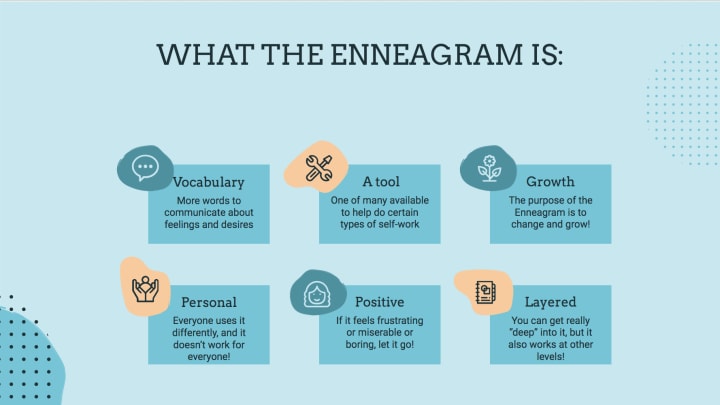
Vocabulary: At its core, the Enneagram is just a new list of terms you can use to define and describe things that you feel, desire, and experience. It's easier to understand and communicate about things if we have a wide range of words that can capture the nuance of what we're trying to say. Imagine trying to paint a sunset with only three colors! The Enneagram adds a bunch more colors to our palette when it comes to painting a picture of who we are and what's going on inside our minds, which helps a lot considering most humans are much more complicated than a sunset.
A tool: The Enneagram is a specific tool that many people find helpful for doing self work and improving their communication skills. Like any tool, it has its applications and its limits. You'd have a hard time building a house with just a hammer, but having one in your tool box would certainly make things easier. And like any tool, it's meant to be used by you for your purposes - not to dictate your actions or control you.
Growth: Unlike many other "personality typing systems," the Enneagram's goal is not simply to slot you into one type. In fact, identifying your type is only the beginning of Enneagram work, not the whole point of it. The purpose of the Enneagram is to help you grow, shed patterns that are not serving you, transcend limitations that have held you back, and develop more areas of strength and joy.
Personal: The Enneagram is not universally applicable to every person, and every person uses the Enneagram in a different way. Your perspective on the Enneagram, and how you use it, might look very different from someone else's. That doesn't mean either one of you is doing it wrong! The Enneagram isn't dogmatic, but personal and individual.
Positive: Some people report that diving into Enneagram work makes them feel confused, frustrated, or annoyed. That probably means the Enneagram isn't for them! While self work often requires us to face down uncomfortable feelings and painful beliefs, it should ultimately be an experience of growth and positivity. This isn't like a prescribed medicine that you need to take in order to heal from a specific condition. If the Enneagram doesn't seem like something that will help you achieve your goals, let it go!
Layered: One great thing about the Enneagram is that you can use it effectively with a "101" level understanding, just by knowing your type and some of your basic patterns. But if you want to go deeper, there's so much more to engage with, from "wings" to "centers." The Enneagram is a tool anyone can use, from the huge Ennea-nerds like me to people with a passing interest.
What The Enneagram Is Not
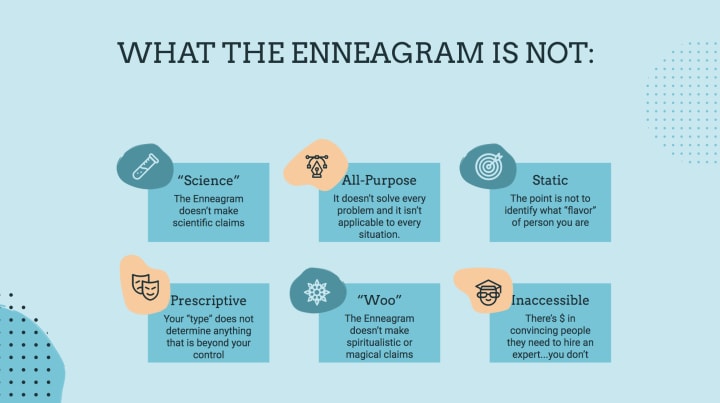
With that out of the way, let's move on to six things that the Enneagram is absolutely not. There's a lot of misinformation out there about this tool, so let's clear some things up. The Enneagram is not:
Science: The Enneagram does not make empirical or scientific claims. No one is saying that if you were to put people into a lab or scan their brains, we would be able to find their "type" through some replicable process. Because it doesn't make scientific claims or pretend to be medical or empirical truth, it also can't be a "pseudoscience." It's just a method for talking about feelings, relationships, and desires.
All-Purpose: They say that "if all you have is a hammer, everything looks like a nail." Don't let the Enneagram become that hammer! It won't solve every problem, explain every interpersonal phenomenon, or apply to every situation. Like any tool, it has its limitations and applications.
Static: The Enneagram is not meant to stick you permanently in one place or represent something completely fixed. While it's true that someone's core type tends not to change, people are contextual beings, and you may have very different patterns and desires in different areas of your life or at different times.
Prescriptive: There's no room in Enneagram work to throw up your hands and say "well that's just my type, I can't help it." Nothing beyond your control determines your choices and patterns, and the Enneagram is meant to help you take more intentional control over your life, not surrender your sense of self to some external force.
Woo: The Enneagram is not a religion, nor does it make spiritual, supernatural, or metaphysical claims. Many people find that Enneagram work is especially helpful when combined with a spiritual practice or faith context, but that connection is for each individual to make. People of any faith background, including atheists, can access the Enneagram.
Inaccessible: When you start looking into the Enneagram, you may come across expensive courses taught by certified coaches and other experts. You may find tests that sit behind paywalls. You may even get overwhelmed by everything there is to read and learn about the Enneagram, including some confusing looking diagrams. But there is nothing esoteric about the Enneagram, and you can learn all about it without hiring outside help. If you want to go deeper with your Enneagram work after learning about it on your own, a coach or a workshop is a great option, but it's not at all required.
The Core Question Of The Enneagram
When learning about any personality typing system, it's important to identify the central question that system is asking. Anything that stops at "what type of person are you?" is not going to be a useful or effective tool. Instead, it should ask a more specific question, like "how do you receive and process information?" or "what makes you feel loved?"
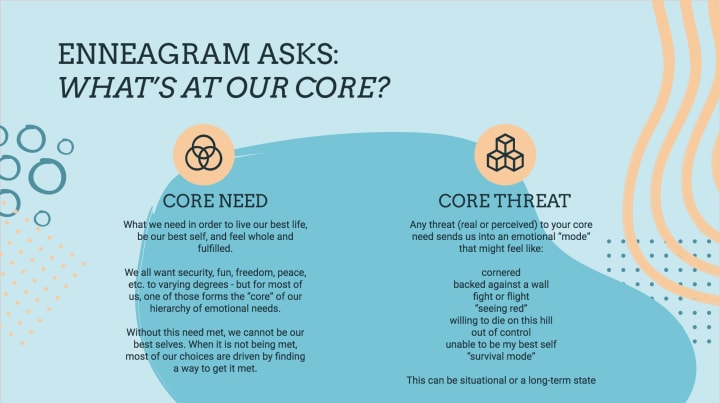
In the case of the Enneagram, the core question is: What is your most basic need?
Or, put differently: What is the one thing which, when threatened, puts you into survival mode and which, when you have it, allows you to be your best self?
The Enneagram defines nine core needs which correspond to each of the nine types. Your type simply defines what your core need is. This core need is something you pursue above all else, the one thing you would never sacrifice in pursuit of something else. When you have it, you are on solid ground and able to grow, engage in healthy relationships, and reach your full potential. When you don't have it, you are primarily focused on how to get it.
When our core need is threatened, we find ourselves in "threat mode." People have different terms for this - on the ropes, out of control, cornered, with no other choice, etc. Think back to a time when you said or did something that you weren't proud of, something that may have been self-destructive or harmful to someone else, and something you definitely wouldn't have advised yourself to do if you'd had the time and distance to think about it. Chances are, you behaved that way in response to a perceived threat to your core need.
Want to learn more? I'll soon have more articles up about understanding core needs and threats, identifying your type, and more! You can find links to my entire Enneagram series on my Vocal Media Profile or collected at my website.
About the Creator
Keep reading
More stories from Lily Dodge and writers in Humans and other communities.
Enneagram 101: Core Threats
When I try to explain the concept of the "core threat" in an Enneagram context, I like to use this narrative example: Imagine the world's friendliest, most well trained, sweetest dog. Now, imagine if someone offered you a billion dollars if you could get that dog to snarl and snap at you.
By Lily Dodge5 years ago in Humans
Time to change your life.
Is it even possible for you to change your life? A lot of people, more than there should be, are unhappy with their lives. But what are they doing about it? Usually nothing. People talk about how shitty their lives are and want change, but are they not taking the actions to change?
By Jen Phillips7 days ago in Humans



Comments
There are no comments for this story
Be the first to respond and start the conversation.