
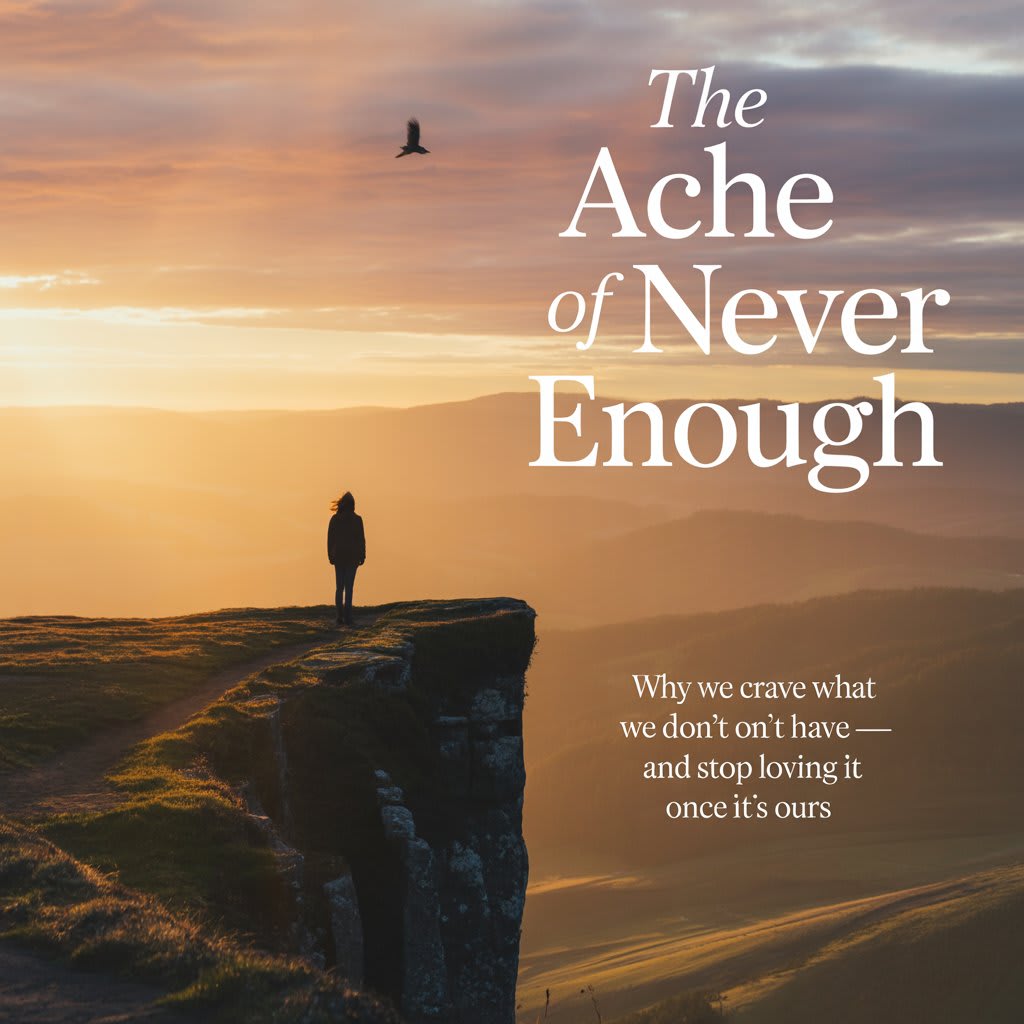
The Ache of Never Enough
Why we crave what we don’t have — and stop loving it once it’s ours.

There is a strange ache that lives inside every human heart — a quiet, restless longing that never fully sleeps. It wakes in moments of silence, when the noise of the world fades and we are left alone with ourselves. It whispers that something is missing — that no matter how much we have, no matter how far we’ve come, it’s still not enough.
This is the ache of never enough. It is not a wound of the body, but of the soul. It’s the feeling that keeps people chasing, even after they have arrived. It’s what makes a millionaire feel poor, a married woman feel trapped, a successful man feel small. It’s the reason we look at other people’s lives and imagine that they hold the secret we somehow missed.
We are creatures of desire. From childhood, we are taught to reach, to dream, to want. The world tells us that wanting is the beginning of becoming — and that once we get what we want, we will finally be happy. But the truth is far more complicated. Because the moment we touch what we once longed for, its magic fades. The wanting ends, but the emptiness remains.
The Mirage of More
In every culture, desire wears different clothes — but its nature never changes.
In the West, it often hides behind the promise of “more”: more success, more comfort, more beauty, more control. People are told that happiness is just one achievement away.
So we run faster. We work harder. We buy, collect, and compare. We scroll through perfect pictures of other people’s lives — people who seem to have what we don’t. We feed the ache with distractions, thinking maybe this next thing will finally quiet it. But it never does.
The hunger doesn’t go away — it only grows more sophisticated.
Because what we truly crave is not the thing itself, but the feeling we think it will bring.
We don’t really want the house, the job, the love story — we want the peace, the validation, the meaning that we believe comes with it. And when reality doesn’t deliver that feeling for long, we turn away and begin to want again.
The cycle continues: we desire, we pursue, we gain, we lose interest, and then we desire anew. It’s an invisible treadmill that never stops — and the faster we run, the more tired our souls become.
The Illusion of Arrival
Every person has a secret “arrival point” in their mind — a belief that once they reach it, the ache will disappear.
“When I get married.”
“When I have children.”
“When I buy my own house.”
“When I make this much money.”
“When I find love.”
But arrival is an illusion. Because life doesn’t give us permanent satisfaction in exchange for achievements — it only gives us brief moments of calm before the next storm of wanting.
Think of the bride who spent years dreaming of marriage. She imagined that having a husband would complete her. And for a while, she glows — her heart full, her dreams unfolding. But as months pass, reality shows its rough edges. Love becomes routine, and daily life brings new frustrations. She begins to think, “Was this really what I wanted?”
On the other side, the unmarried woman watches her, believing marriage is the key to happiness. Both are caught in the same trap — the ache of never enough.
It’s not that they are ungrateful. It’s that human desire moves faster than fulfillment. The moment one dream is realized, another begins to whisper in its place.
The Psychology of Discontent
Psychologists call it hedonic adaptation — the way humans quickly get used to what once made them happy.
The new car, the new house, the promotion, the relationship — each brings a rush of joy, but only for a short time. Our emotional baseline soon resets, and what once felt extraordinary becomes ordinary.
This isn’t a flaw; it’s part of how our minds work. Desire kept our ancestors alive — it pushed them to seek food, safety, shelter, and love. But in the modern world, where survival is no longer the main struggle, this same instinct has turned inward. Now we hunger not for food, but for feeling. For validation. For meaning.
And because we don’t understand that the source of peace is internal, we keep searching for it in external things. It’s like trying to quench thirst with salt water — the more we drink, the thirstier we become.
The Spiritual Void
Beneath this psychological pattern lies a deeper spiritual truth: the human soul was never meant to be satisfied by temporary things. We try to fill infinite longings with finite pleasures — and when they fail us, we feel betrayed.
It’s not that success, love, or comfort are wrong — they are gifts. But when they become the center of our existence, they lose their power to bring peace.
We start to worship them in subtle ways — letting our happiness depend on them — and in doing so, we disconnect from something sacred inside us.
We forget gratitude. We forget stillness.
We forget that contentment is not found in having everything, but in being present with what we have.
In moments of stillness — when we pause the noise, the scrolling, the constant reaching — something amazing happens. The ache softens. The heart breathes. We remember that peace isn’t something we have to chase; it’s something we can return to.
But stillness scares us. Because in silence, we face ourselves — and that can feel unbearable at first. We see our fears, our envy, our insecurity. Yet this is where healing begins. When we stop running, we start understanding.
The War Between Gratitude and Desire
Inside every heart, there is a quiet war — between gratitude and desire.
Desire says, “You need more.”
Gratitude whispers, “You already have enough.”
Most of us live our lives listening to the louder voice. The world encourages it. Advertisements are built to make us feel like we’re lacking something — that peace can be purchased, or love can be followed, or meaning can be delivered to our doorstep.
But gratitude is a rebellion against that noise. It is not the denial of ambition — it is the grounding of it. Gratitude does not mean we stop dreaming; it means we stop believing that our worth depends on the dream.
When we learn to look at what we already have — our breath, our loved ones, the small joys that surround us — the ache starts to ease. We realize that perhaps we were never truly missing anything, except the ability to see.
The Mirror of Pain
Often, our moments of pain are mirrors. They reflect what we’ve been worshipping without realizing it.
When a relationship ends and it destroys us, it shows we were leaning on it too heavily for our sense of identity.
When a career loss feels like death, it shows we tied our worth too tightly to success.
When someone else’s happiness triggers our jealousy, it shows we’ve been measuring our lives against theirs.
Pain isn’t the enemy — it’s a teacher. It reveals where we’ve placed our trust, and invites us to bring it back to something deeper.
Finding Enough
So how do we live in a world that keeps telling us we’re not enough — unless we buy, earn, achieve, or change?
We begin with awareness.
We start by noticing our patterns: how we crave, how we complain, how quickly we move from gratitude to dissatisfaction. Then, we slow down. We learn to enjoy small things again — a morning light, a cup of coffee, the sound of rain.
We remind ourselves that contentment is not laziness. It is strength — the strength to resist the pressure of endless wanting.
We reconnect with silence, with prayer or reflection, with moments of presence that remind us life is happening now, not later.
Because the truth is: there will always be something we don’t have. There will always be people ahead of us, and others behind us. But peace doesn’t live at the finish line. It lives in the moment we stop running and start breathing.
The Ache That Teaches
The ache of never enough is not something to hate. It’s something to understand.
It’s the part of us that keeps searching for something real — something that cannot fade or be taken away.
Maybe that’s the secret — that the ache itself is a compass, pointing us back to what truly matters.
It reminds us that the things of this world, no matter how beautiful, are only temporary reflections of something greater.
That love, beauty, success, and joy are glimpses — not destinations.
That the heart will never rest until it learns to find home within itself.
And So, We Learn
We learn to desire, but gently.
To dream, but without forgetting the blessings we already hold.
To love, but without losing ourselves in the process.
To strive, but also to rest.
We learn that happiness is not found in the next thing — it’s found in the depth of our gratitude for this moment.
And maybe one day, when the ache rises again — as it always will — we won’t try to silence it or chase it away.
We’ll simply smile and say,
“I see you. You remind me I’m human. You remind me to return to peace.”
Because perhaps the real secret is this:
It’s not about having everything we want —
It’s about wanting, deeply and sincerely, what we already have.
About the Creator
Life Hopes
I share poetry, real-life stories, and reflections that inspire growth, resilience, and purpose. My vision is to guide others toward living with hope, kindness, and meaning through words that heal and uplift.
Keep reading
More stories from Life Hopes and writers in Humans and other communities.
The Last Coffee Together
The café was almost empty that afternoon. A soft drizzle tapped against the windows, painting the glass with silver streaks. The air carried the scent of roasted beans and quiet endings. At the corner table, Anna sat with her hands wrapped around a porcelain cup, her fingers tracing the rim as though holding onto time itself.
By Life Hopes5 months ago in Humans
Time to change your life.
Is it even possible for you to change your life? A lot of people, more than there should be, are unhappy with their lives. But what are they doing about it? Usually nothing. People talk about how shitty their lives are and want change, but are they not taking the actions to change?
By Jen Phillips6 days ago in Humans
7 Common Myths and Facts About Methadone Treatment
When people first hear the word methadone, fear and misinformation often rush in before facts have a chance to speak. I have seen how these myths can stop someone from getting help they truly need. If you are exploring treatment options for yourself or someone you care about, understanding what is true and what is not can make that decision feel far less overwhelming.
By Jordyn Mastrodomenico4 days ago in Humans




Comments (2)
So much wisdom in this piece. It resonates deeply. Thank you for the gentle reality check. I have been working on building inner peace and not stressing about circumstances. Reminding myself of all I have and how lucky I am. "peace doesn’t live at the finish line. It lives in the moment we stop running and start breathing." Love this! How true it is.
so relatable-can be greed or just filling a void of emptiness