
The Boy and the Ape
A touching tale of courage, kindness, and an unlikely friendship born in the wild heart of nature.

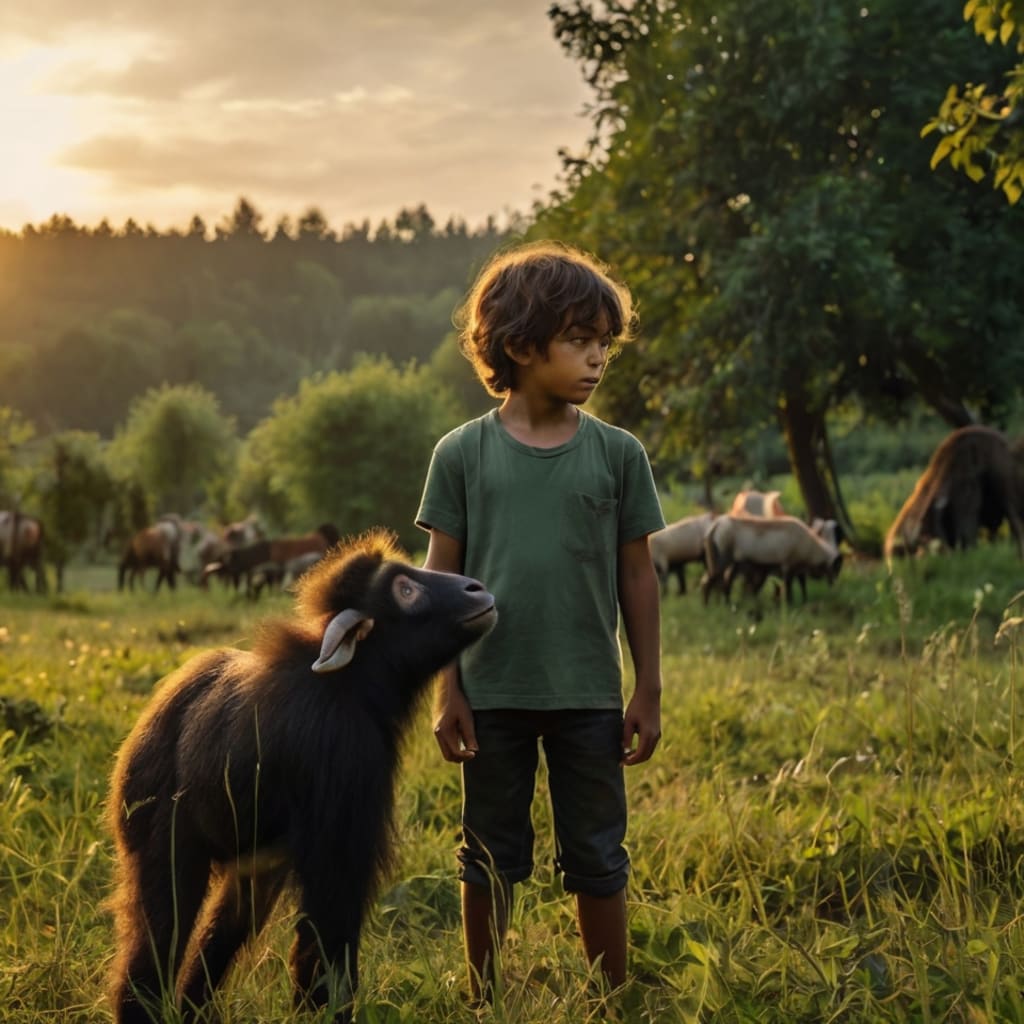
The Boy and the Ape
By Mukhtar Ahmed (Translated and Adapted)
In the quiet little village of Wazirabad lived a fifteen-year-old boy named Saeed — healthy, handsome, and full of quiet determination. Life, however, had not been kind to him. When Saeed was only ten, his mother died of meningitis. A year and a half later, tragedy struck again — his father fell into a well and lost his life.
Now, Saeed was completely alone in the world.
About twenty-eight miles away was a small town called Shehzad Nagar, where Saeed’s aunt lived. He could have gone to live with her, but Saeed was too proud to become a burden on anyone. Instead, he decided to earn his living through his own hard work.
In the village, there lived a man named Raheem who owned hundreds of chickens. He sold their eggs in the nearby markets and spent his days lazily smoking his hookah, while the birds clucked behind their bamboo coops. Raheem’s business was doing well, but as his income grew, so did his laziness. Soon, he began looking for a helper.
Around the same time, Saeed’s father passed away. Seeing the orphaned boy’s situation, Raheem offered him a job.
“Look, Saeed,” Raheem said. “You have no one to rely on now. Work for me, and I’ll pay you fairly. Hard work is the only way to survive.”
Saeed agreed at once. From that day, he began working at Raheem’s poultry farm.
The boy worked tirelessly — feeding the chickens, cleaning the coops, and collecting eggs. Every evening, he would carry a basket full of eggs through the village streets, calling out to sell them. The villagers admired his honesty and courage. Even Raheem was pleased; his chickens were healthier than ever, and his profits were rising.
But fate had its own plans.
One night, a heavy storm swept over Wazirabad. The villagers rejoiced, for rain meant rich crops — but Raheem was terrified. He knew that after such rain, a deadly poultry disease often followed. In panic, he dug out an old black chest and pulled from it a tattered herbal book. He scribbled down a few medicinal names and sent Saeed running through the rain to the local apothecary to fetch them.
All night, Raheem brewed herbal mixtures to protect his birds. Saeed stayed to help. But the rain turned into a violent storm — thunder roared, winds howled, and by morning, disaster had struck.
When they reached the poultry farm, the scene froze their hearts — the coops were silent. All the chickens lay dead. Rainwater had flooded the enclosures, and the poor creatures had frozen to death.
Raheem sat down in despair, his hands clutching his head.
Saeed, too, lost his job that day. He searched for new work everywhere but found none. Finally, he decided to become a shepherd. The villagers trusted him, especially after their last shepherd — a deceitful man — was caught stealing milk from their goats and punished publicly.
Saeed promised honesty and care. Each morning, he would collect the goats and sheep from every home, carry his simple meal, and lead them toward the green fields near the forest. For every animal, he earned two rupees a month — enough to dream of saving money and buying a small piece of land one day.
One bright afternoon, Saeed sat on a rock, watching his animals graze peacefully. Two goats began to butt heads angrily. Saeed quickly ran to separate them. One obeyed, stepping aside quietly. But the other — a proud, stubborn buck — stepped back and charged at Saeed, hitting him hard in the back.
Anger flared in Saeed’s eyes. He caught the goat by the ear and slapped it lightly. The goat bleated in protest, and Saeed let it go, still frowning.
Then suddenly — a strange sound echoed through the forest. A low crash, followed by desperate cries. Saeed froze, listening. Someone—or something—was in pain.
He ran toward the forest. There, in a small clearing, he saw a giant ape pinned beneath the trunk of an uprooted tree. The animal’s chest rose and fell heavily, and its cries filled the air. Its eyes met Saeed’s — pleading, desperate.
Saeed hesitated. The ape was huge, powerful enough to tear him apart if freed. But pity overcame fear.
Just as he was about to move closer, the same angry goat came charging from behind and struck Saeed again — this time so hard that he tumbled forward and landed right on the ape’s chest! His elbow slipped straight into the creature’s mouth. For a brief second, time stopped.
But the ape did not bite. It simply groaned in pain. Saeed rolled off, panting.
Realizing the animal meant no harm, Saeed decided to help. He crouched beside the fallen tree, dug his hands beneath the roots, and pushed with all his strength. The trunk rolled aside. The ape gasped and sat up weakly.
Its chest was bruised, but it looked at Saeed with gratitude — deep, human-like gratitude. Slowly, the great creature raised its long arm and placed its hand on Saeed’s shoulder, as if to say, Thank you.
Saeed smiled gently. “You’re free now, my friend,” he whispered, and walked away.
The next morning, when Saeed returned with his herd, he stopped in surprise. The ape was there again — sitting calmly on a rock, watching him. For a moment, fear gripped Saeed’s heart. The creature rose, swinging its long arms, and began walking toward him.
Saeed could not move. He stood frozen, expecting the worst.
But when the ape reached him, it stretched out its hand. In it lay a red and white apple.
Saeed blinked in disbelief, then took it. The ape grinned — its teeth flashing like sunlight through the trees.
From that day on, they became friends.
Every morning, as Saeed tended his sheep and goats, the ape would appear from the forest to meet him. Together they wandered beneath the tall trees, two unlikely companions bound by kindness — a boy who had lost everything, and a beast who had found a friend.



Comments
There are no comments for this story
Be the first to respond and start the conversation.