
The Cairn Beside the Lake
Why People Keep Stacking Rocks and Why It Matters

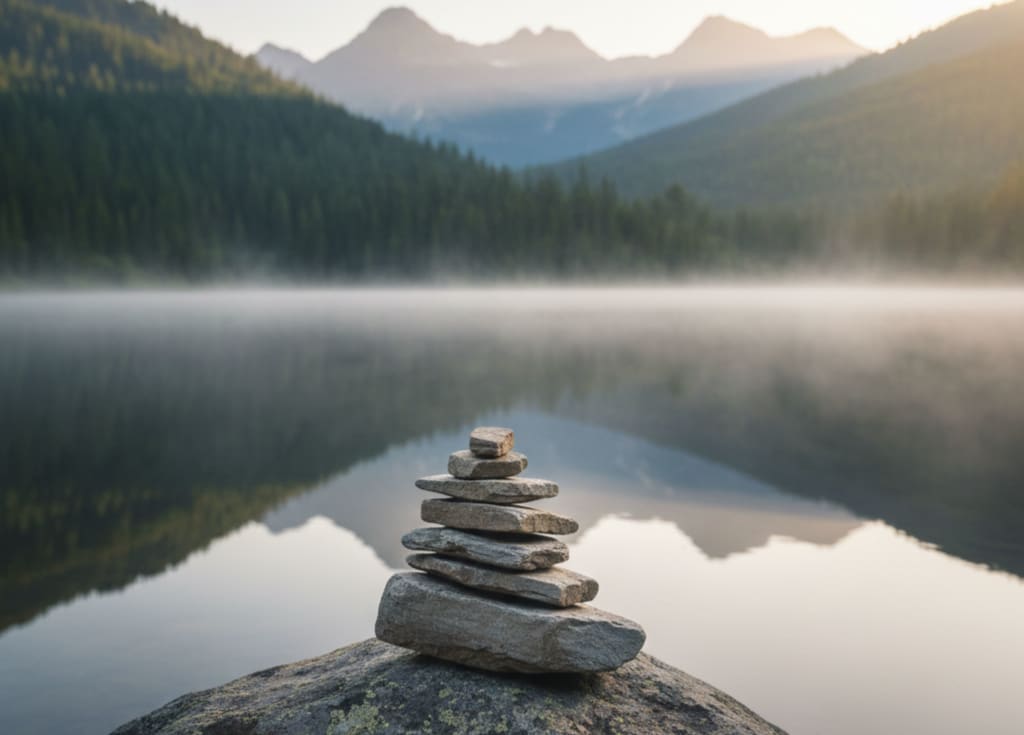
The quiet urge to leave a mark on a place that was already perfect
The first time I noticed the cairn beside the lake, it was already taller than my knee and leaning just enough to make me nervous.
Five flat river stones, each one a slightly different gray, were stacked on a boulder at the shoreline like a small, patient monument. No plaque. No initials. Just an arrangement that whispered, someone was here.
I remember standing there with wet shoes and cold toes, looking from the cairn to the mountains mirrored on the water, and feeling oddly…interrupted.
The lake itself was enough. The morning mist, the loon calling, the chill in the air—nothing about this place needed improving. And yet there was this little human exclamation point on the edge of it.
I couldn’t decide if it was beautiful or obnoxious.
And once I noticed that one, I started seeing them everywhere.
The strange satisfaction of stacking rocks
If you’ve ever picked up one smooth, flat stone and set it gently on another, you already know the feeling.
There’s a tiny thrill when it doesn’t slip. A small “click” of satisfaction when you find the exact spot where weight and balance agree. It’s like solving a physical puzzle with your fingertips.
When I was a kid, I used to do this with my dad on riverbanks.
We didn’t call them cairns. We just called it “making towers.”
He’d hand me stones and say, “Try that one,” and I’d concentrate so hard that everything else—the bugs, the heat, the arguments we’d had earlier—went quiet. It was the closest thing I had to meditation before I knew what meditation was.
I didn’t think about the river’s ecosystem or erosion or what would happen if everyone did this.
I just knew that it gave me a sense of control in a world where I had very little.
That feeling doesn’t go away when you grow up. It just dresses differently.
You get older and the world feels less and less like something you can hold. Jobs, news, climate, politics—everything is abstract and huge. But here’s a thing you can manage: six stones, your two hands, gravity.
Tiny world. Clear rules. Immediate feedback.
You stack rocks beside a lake, and for ten minutes, you are the quiet center of something.
No wonder people keep doing it.
The part we don’t like to talk about
Here’s where things get messy: that small, private moment of balance doesn’t stay private.
Because once the cairn stands, you walk away. And the rocks stay.
You leave, and now your little act of “I was here” becomes everyone else’s “you are here, whether you like it or not.”
On that same lake where I found the leaning cairn, I visited again a few years later.
The shoreline had changed.
The single cairn had multiplied.
What used to be a clean stretch of smooth stones and driftwood had turned into a sort of open-air gallery of rock sculptures. Some were short and squat. Some were ambitious and elaborate. One was shaped like an arch that looked like it would crush your foot if you breathed too hard.
At first glance, it was charming—evidence of play, of people interacting with the landscape.
But the more I looked, the more it felt like graffiti.
Not the political kind or the artful kind. The “Kevin was here 2021” kind that gets carved into picnic tables and tree trunks.
The place no longer felt wild. It felt curated.
And here’s the uncomfortable part: the people who built those cairns probably thought they were honoring the landscape.
That’s the twist no one likes. We’re often harming the places we love in the exact moments we think we’re appreciating them.
The ecological cost of a pretty stack
If you’ve never heard a ranger rant about rock stacking, you might think the complaints are overblown.
They’re not.
Those stones you lift from the lakebed or riverbed?
They’re not just “loose debris.” They’re shelter.
Under one rock there might be hundreds of insect larvae, tiny fish hiding from predators, salamanders, or the microscopic life that feeds everything above it. Those flat stones help hold soil. They stabilize stream banks. They shape how water flows.
Pulling a stone from the shallows isn’t like moving a book on a shelf. It’s closer to taking one brick out of a small animal’s house.
One brick might not collapse it. But what about a hundred people taking one brick each?
I remember kneeling beside a creek once, lifting a rock to look for crayfish—something I used to do without thinking as a kid.
Underneath, there was a wriggling cloud of life I couldn’t even name. It was like peeling back a tile and discovering a bustling neighborhood.
I lowered the rock back down so gently it barely rippled the water.
Now scale that up to a lake popular on Instagram.
One cute cairn becomes ten. Ten becomes fifty. Every visitor wants their own small monument, their own photo, their own proof.
And suddenly, this place that looks “natural” in your photo has been quietly rearranged by hundreds of hands.
If you’ve ever walked through a river where every stone under your feet felt loose and unstable, there’s a good chance you were walking through a place that’s been constantly disturbed.
The damage isn’t always dramatic. Most of the time the harm is quiet, cumulative, and invisible—until it isn’t.
But that doesn’t mean it’s not happening.
The other job cairns used to have
There’s another layer to this that gets lost in the tourist version of rock stacking.
Cairns aren’t new.
They’re ancient.
People have been stacking stones for thousands of years, but not to make cute photo backdrops. They were path markers across dangerous terrain. Memorials for the dead. Territorial boundaries. Sacred markers.
In some cultures, cairns are graves. In others, they’re spiritual offerings.
When you hike in certain places—especially in alpine or desert environments where trails are hard to see—those official cairns might be the difference between getting safely back to your car or wandering into real trouble.
Rangers and trail crews build those on purpose. They place each stone in a way that’s visible but durable. They reinforce them over time.
So when random hikers start building decorative cairns all over the place, you get two problems at once:
Real trail markers become harder to distinguish.
And sacred or culturally important cairns get visually diluted by a bunch of weekend art projects.
Imagine visiting a cemetery and scattering your own homemade headstones around because it “looked nice.”
Some cairns are not ours to imitate.
Why it’s so hard to leave things alone
Here’s the piece that keeps catching in my throat: I understand the urge.
I really do.
There’s something absolutely human about wanting to participate in a landscape instead of just observing it.
We touch tree bark as we pass.
We run our fingers over plants.
We skip stones and write our names in the sand.
We’re not wired to be neutral, passive camera holders. We’re wired to interact, to make, to fiddle with the world in front of us.
And yet, some of the most meaningful experiences I’ve ever had outside came from resisting that impulse.
Standing at the edge of that lake, looking at my reflection behind the reflection of the cairn, I felt this tug-of-war:
One part of me wanted to add a stone.
Another wanted to knock every cairn down and scatter the rocks back to where they might have been.
In the end, I did neither.
I just walked along the shore, hands in my pockets, and let that tension sit.
Because that’s the real work, isn’t it?
Not the stacking. Not the toppling. The choosing.
Choosing when to act and when to leave a place exactly as we found it—even if that means we walk away without our little signature on it.
What leaving no trace actually asks of us
“Leave no trace” gets thrown around like a slogan, but living it feels like grief sometimes.
It asks you to accept that your presence doesn’t need proof.
It asks you to give up the pleasure of rearranging a place just because the materials are conveniently loose and your hands are bored.
It asks you to trust that you existed in that moment, at that lake, even if no one ever knows you were there.
I think that’s harder than we admit.
We’re used to documenting everything. Photos. Posts. Check-ins. The idea of walking into beauty, letting it hit you full in the chest, and then walking out with nothing but memory feels…insufficient.
But what if it’s not?
What if the point of being at the lake isn’t to leave something behind, but to let the place leave something in you instead?
A thought.
A feeling.
A shift in how you move through the rest of your life.
None of that needs a cairn.
How to honor a place without rearranging it
So what do you do with your hands, if not stack rocks?
You can sit on them.
You can lean your back against a boulder and listen.
You can pick up a stone, feel its weight and texture, and then put it back where you found it.
You can pick up trash instead. There’s usually more of that than anyone wants to admit.
You can take photos that don’t require you to move anything first.
You can learn the names of the plants and animals around you.
You can read about the people whose ancestral land you’re standing on and think about what this lake means in a story bigger than your afternoon there.
You can simply stay long enough that the wild around you stops reacting to your arrival and gets back to whatever it was doing before you interrupted.
If you truly need to build something, find a place where the rocks are part of a landscape that’s already been engineered for humans—gardens, playgrounds, some beaches. Or create temporary art with something that was already loose and ephemeral: fallen leaves. Shadows. Water patterns.
Let the wind or the tide undo your work.
Give your art an expiration date.
The cairn you never see
There’s a cairn beside that lake I never touched.
But there’s another cairn that place built in me.
Whenever I catch myself wanting to meddle with something that’s already whole—someone else’s story, a quiet moment, a place that doesn’t need improvement—I feel that little stack of stones in my chest.
Stone 1: You are here.
Stone 2: Being here doesn’t entitle you to rearrange everything.
Stone 3: Your impact outlives your attention span.
Stone 4: Beauty isn’t enhanced by your signature.
Stone 5: Some of the most faithful love looks like restraint.
I still feel the temptation, every time I see a perfect flat rock, to see how it would balance on another.
But now the question that follows is sharper:
Do I need this cairn more than this place needs these stones left alone?
Most of the time, if I’m honest, the answer is no.
So I skip the stack.
I skip the photo of the stack.
I take a breath, feel the wind off the water, and let the lake stay busy being a lake, not a gallery for my momentary need to leave a mark.
And then I walk away, trusting that my presence mattered even if the landscape doesn’t show it.
Maybe that’s the new cairn we need to practice building.
Not stone on stone, but choice on choice—small, quiet acts of restraint that slowly pile up into a different kind of monument:
One that says, I was here, and I let you stay yourself.
About the Creator
abualyaanart
I write thoughtful, experience-driven stories about technology, digital life, and how modern tools quietly shape the way we think, work, and live.
I believe good technology should support life
Abualyaanart
Keep reading
More stories from abualyaanart and writers in Humans and other communities.
At My Wits’ End
Life is about taking out the trash and calling it trash because you have every reason to. It wasn't meant to be linear, they say. But the times you tried to make it straight led to problems, and you didn’t have the tools to put any of it to use. You don't put your right shoes on the right feet; you put the left shoes on the left feet. The grey hardened slab will trip you up anyway.
By Caitlin Charlton3 days ago in Humans
How to Tell if You Have a Past Life Connection with Someone.
Some relationships feel different from the start. You meet someone and feel as if you already know them. Conversation flows easily. Silence feels comfortable. The connection forms quickly, often without clear explanation.
By Wilson Igbasi4 days ago in Humans



Comments
There are no comments for this story
Be the first to respond and start the conversation.