
The Inner Compass: Distinguishing Intuition, Fear, and Wishful Thinking.
Unlocking the Language of Your Soul.


We all possess an inner voice, a quiet murmur that guides us through life's complex decisions. But is that voice intuition, a trusted advisor pointing towards our true path? Or is it fear, masquerading as caution, holding us back from growth? Perhaps it's wishful thinking, painting a rosy picture that obscures reality. Learning to discern between these three can be a transformative skill, enabling us to make choices aligned with our authentic selves and pave the way for a more fulfilling life.
The challenge lies in the subtle similarities and significant differences between intuition, fear, and wishful thinking. All three can manifest as strong feelings or urges, making it difficult to differentiate their origins and intentions. This article aims to provide a framework for understanding each, offering practical tools and insights to help you become fluent in the language of your inner compass.
Understanding the Nature of Intuition
Intuition, at its core, is a form of knowing that bypasses conscious reasoning. It's often described as a "gut feeling," an inexplicable sense of certainty, or a sudden flash of insight. Neuroscience suggests that intuition arises from the complex interplay of the brain's various systems, including the emotional centers (like the amygdala) and areas responsible for pattern recognition. In essence, intuition draws upon past experiences, observations, and subconscious processing to present us with a conclusion that might not be immediately apparent through logical analysis.
Key characteristics of genuine intuition include:
Calm Certainty: Intuition often arrives with a sense of peace and clarity, even when the message is challenging. It's not accompanied by anxiety or frantic energy. Think of it as a quiet knowing, rather than a loud demand.
Rooted in Reality: While intuition can be forward-thinking, it's grounded in a realistic assessment of the situation. It considers available information and doesn't ignore practical constraints.
Focus on Growth: Intuition often guides us towards experiences that foster personal growth and alignment with our values, even if they initially seem daunting. It pushes us outside our comfort zone in a supportive, rather than threatening, way.
Subtle and Persistent: Intuition rarely screams for attention. It's a gentle nudge that often resurfaces over time, reinforcing the message until we acknowledge it.
The Shackles of Fear: Recognizing Its Disguises
Fear is a powerful emotion designed to protect us from harm. However, fear can also be paralyzing, preventing us from pursuing opportunities and living authentically. Distinguishing fear from intuition is crucial for navigating life with courage and resilience.
Fear manifests in several ways, often disguised as logical reasoning or self-preservation. Common characteristics include:
Anxiety and Dread: Unlike the calm certainty of intuition, fear is typically accompanied by feelings of anxiety, dread, and unease. The body may respond with physical symptoms like a racing heart, sweating, or shortness of breath.
Focus on Negative Outcomes: Fear tends to dwell on worst-case scenarios, exaggerating potential risks and minimizing potential rewards. It creates a narrative of potential failure and pain.
Avoidance Behavior: Fear often leads to avoidance of situations or people that trigger anxiety. This can manifest as procrastination, social isolation, or a refusal to take risks.
Self-Limiting Beliefs: Fear can reinforce negative beliefs about ourselves and our capabilities, hindering personal growth and self-confidence.
It's important to acknowledge that fear is not always a negative force. Prudence and caution are valuable qualities. However, when fear consistently dictates our choices and prevents us from pursuing our dreams, it's time to re-evaluate its influence.
The Illusions of Wishful Thinking: Separating Fantasy from Fact
Wishful thinking is the tendency to believe that something is true simply because we want it to be true. It's a natural human inclination, especially when facing difficult circumstances. However, relying on wishful thinking can lead to disappointment and poor decision-making.
Key characteristics of wishful thinking include:
Ignoring Evidence: Wishful thinking often involves selectively ignoring or downplaying information that contradicts our desired outcome. It creates a distorted perception of reality.
Unrealistic Expectations: It sets unrealistic expectations and overlooks potential obstacles. It fosters a belief that success will come easily, without the need for effort or planning.
Emotional Reasoning: Wishful thinking relies heavily on emotional reasoning, assuming that if we feel something strongly, it must be true. It disregards logic and objective analysis.
Passive Approach: It often leads to a passive approach to life, expecting things to happen without taking proactive steps to achieve our goals.
Practical Tools for Discernment
Differentiating between intuition, fear, and wishful thinking requires self-awareness, honest reflection, and practice. Here are some practical tools to help you develop your discernment:
1. Journaling: Regularly writing down your thoughts, feelings, and urges can help you identify patterns and triggers. Ask yourself: What am I feeling physically? What thoughts are running through my mind? What is the underlying motivation behind this feeling?
2. Meditation and Mindfulness: Cultivating a regular practice of meditation and mindfulness can help you become more aware of your inner landscape. By quieting the mental chatter, you can create space to listen to the subtle whispers of intuition.
3. Seeking External Perspectives: Talking to trusted friends, family members, or mentors can provide valuable perspectives. They can offer objective feedback and help you identify blind spots.
4. Testing the Waters: Before making a major decision, consider taking small, calculated risks to test your intuition or confront your fears. This can provide valuable insights and build your confidence.
5. Time and Distance: Allow yourself time and distance from the situation before making a decision. This can help you gain clarity and perspective, separating emotions from rational thought.
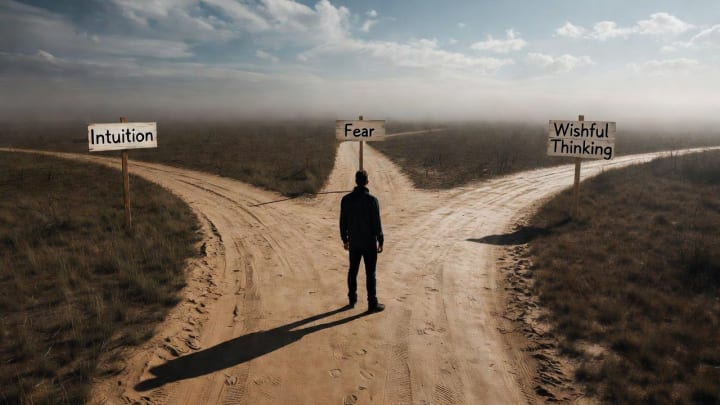
Ultimately, learning to distinguish between intuition, fear, and wishful thinking is a journey of self-discovery. It requires patience, compassion, and a willingness to embrace uncertainty. By honing your ability to listen to your inner voice with clarity and discernment, you can navigate life with greater confidence, purpose, and joy. You'll be able to identify the opportunities that are right for you, overcome challenges with resilience, and create a life aligned with your true potential. Trust in your inner guidance system, and you'll find yourself on a path that is authentically yours.
About the Creator
Wilson Igbasi
Hi, I'm Wilson Igbasi — a passionate writer, researcher, and tech enthusiast. I love exploring topics at the intersection of technology, personal growth, and spirituality.
Keep reading
More stories from Wilson Igbasi and writers in Humans and other communities.
Beyond the Familiar: Decoding the Deeper Meanings of Repeating Angel Number Sequences.
Angel numbers. The mystical, repetitive sequences that pop up on clocks, license plates, receipts, and seemingly everywhere else. For many, these numerical synchronicities are more than just coincidences; they are gentle nudges, coded messages from the angelic realm, the universe, or our higher selves. While the sequences 111 and 444 have become ubiquitous in popular consciousness, they represent only the tip of the iceberg. A vast and complex system of numerical guidance awaits those willing to look deeper.
By Wilson Igbasiabout 3 hours ago in Humans
Ignorance and Arrogance- Alive and Well
I thought by now, we would have grown up. But no, we are still ignorant children in a playground full of child bullies. Maybe it’s the human condition to want or need to hate something. Maybe it’s natural or the age old good versus evil, biblically speaking, good being God, love and peace, or the Devil’s, brand of hate and chaos. I don’t know which, and more than likely it is a combination of both. But enough is enough. The ignorance and the bullying is wearing thin, and frankly, it is a disgusting habit, like smoking.
By Alexandra Grant4 days ago in Humans



Comments
There are no comments for this story
Be the first to respond and start the conversation.