
The letter I got after my mother died changed everything.
Some truths stay buried for a reason.

My mother died on a Tuesday.
Not dramatically. No final speech. No final revelation. Just a phone call in the middle of the afternoon, the kind that rearranges your entire life in one sentence.
After the funeral, after the casseroles stopped coming, after people had returned to their normal lives, I was left with the quiet task of going through her things.
Her house still smelled of her. Laundry detergent. Old books. The faint trace of perfume she wore every day but insisted she no longer needed. I moved slowly, as if if I hurried I might erase it.
Most of it was ordinary. Clothes. Photos. Receipts from grocery stores that no longer existed. Evidence of a life lived quietly, predictably.
Until I found the letter.
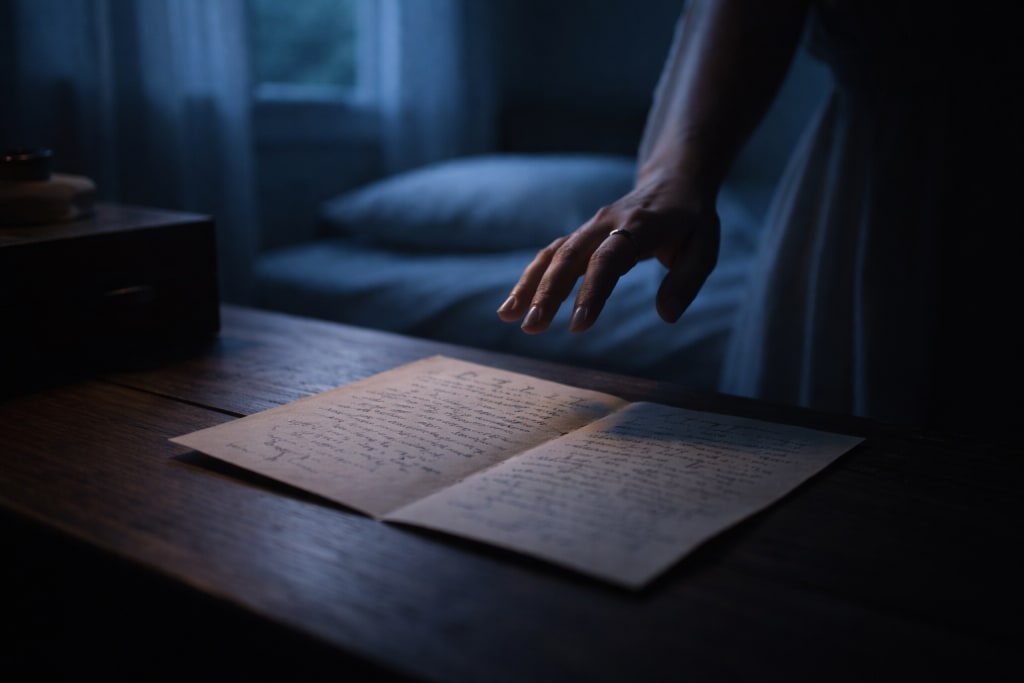
It was tucked inside a book on her nightstand. An old hardcover she had owned for as long as I could remember. No envelope. Just folded paper, yellowed at the edges, my name scrawled across the top in her handwriting.
I almost returned it.
Something about it felt wrong—like it wasn’t meant to be found, at least not accidentally. Like opening it would cross a line I couldn’t cross.
But curiosity and sadness make a dangerous combination.
So I sat on the edge of her bed and opened the paper.
The first line took my breath away.
If you’re reading this, it means I’m gone—and there are things you deserve to know.
I remember staring at those words for a long time. My heart pounding, my hands shaking, already searching for something I didn’t yet understand.
He wrote about loving me. About watching me grow up. About the choices he made that he thought would protect me, even when they hurt him.
Then the truth came out.
The man I called my father was not my biological father.
He explained it carefully, gently, as if he was afraid that even his words might break me. He wrote about the relationship he had before meeting the man who raised me. A relationship that ended badly. Very badly.
He never used words like abuse or violence. He didn’t have to. There were enough spaces between his sentences.
When he found out he was pregnant, that man disappeared. No goodbyes. No questions. Just gone.
Then he met the man who became my father. A good man. A stable man. Someone who chose to love a child who wasn’t biologically hers without ever feeling conditioned.
She said she was afraid that if the truth came out, everything good in our lives would fall apart.
So she buried him.
And she told the man who raised me to bury him with her.
I read the letter three times before I drowned.
My entire sense of self shifted to that silent bedroom.
Suddenly, the memories felt different. The conversation replayed itself with new meaning. I wondered who else knew. I wondered how many times my parents had looked at me and silently carried this secret between them.
The part that hurt the most wasn’t the lie.
It was the loneliness.
She raised him alone for decades. No one to talk to. No place to process it. It’s just that fear and love were so tightly intertwined that she couldn’t tell where one ended and the other began.
At the end of the letter, she wrote something that I still think about almost every day.
Some truths don’t set you free. Some truths only cause more pain. I hope you’ll forgive me for being silent.
I folded the letter and held it to my chest.
I didn’t know what to do with this new version of my life.
Should I tell my father—the man who raised me, who still calls me every Sunday, who cried more than anyone at his funeral?
Should I track down a stranger who shares my DNA but nothing else?
Or do I do what she did—shut down the truth and pretend it doesn’t exist?
Grief is strange. It just makes you miss someone. It introduces you to parts of her you never knew, sometimes parts you wish you hadn’t.
That’s when I realized my mother wasn’t just my mother. She was a woman who made impossible choices with no perfect answers. A woman who believed in keeping her child safe meant sacrificing her own truth.
I didn’t tell my father.
Maybe one day I will. Maybe I won’t.
What I do know is this: The letter didn’t destroy my mother’s image.
It made her human.
I now understand that families aren’t built on perfect honesty. They’re built on survival. On love. On decisions made in fear and hope and despair.
Some truths really do get buried for a reason.
But finding them doesn’t mean everything was a lie.
Sometimes it means everything was a lot more complicated than we knew.
About the Creator
Echoes of Life
I’m a storyteller and lifelong learner who writes about history, human experiences, animals, and motivational lessons that spark change. Through true stories, thoughtful advice, and reflections on life.
Keep reading
More stories from Echoes of Life and writers in Humans and other communities.
The Angry Man in Your House
"If you grow up with an angry man in your house, there will always be an angry man in your house" This statement has caused plenty of controversy online, people say its a statement that blames victims while also undermining those who break traumatic cycles to form health relationships... but if I'm honest now that I'm in my 30s it makes more sense to me than ever, and I'd argue that its not just about fathers and uncles.
By S. A. Crawford5 days ago in Humans
Top 10 Free Overseas Online Dating Sites and Apps to Try in 2026
Finding the perfect partner in the modern age often requires looking beyond your immediate surroundings and exploring the vast world of Free Overseas Online Dating Sites and Apps. In 2026, the digital romantic landscape has shifted toward a truly globalized experience where geographical borders are no longer a hindrance to finding a soulmate. These platforms have evolved to offer high-speed translation, immersive video interfaces, and deep cultural compatibility matching, all without requiring the steep monthly fees that once characterized the industry. By choosing to engage with these innovative tools, singles can connect with diverse cultures and perspectives, broadening their romantic horizons and increasing the probability of finding a match that perfectly aligns with their life goals and values.
By Robert Smith6 days ago in Humans


Comments
There are no comments for this story
Be the first to respond and start the conversation.