
The limits of human vision and the perception of the invisible
Total darkness experiments and the expanded reality

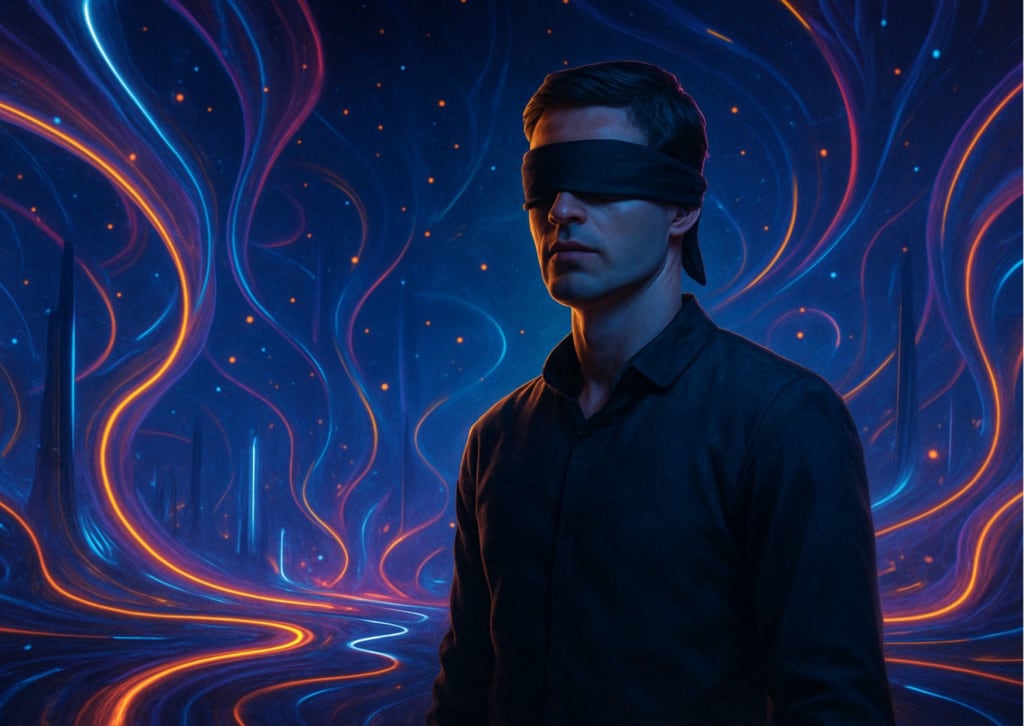
The perception we have of the world is mediated by our senses, and in particular by vision, one of the most powerful but also limited senses. Although we see with surprising clarity the world around us, our visual perception is just a tiny fraction of a much larger universe. The human eye is designed to perceive only a limited range of electromagnetic frequencies, what we call visible light, but the reality surrounding us is much more complex and escapes our everyday senses. What we cannot see, however, does not mean it doesn't exist. And the way our senses, particularly vision, interact with reality is much more complex than we think. One of the most intriguing experiments exploring the limits of visual perception is that of total darkness, which helps us understand not only how limited our senses are, but also how our perception of reality can be an illusion.
Total darkness experiments: visions or perceptions of another reality?
In recent decades, several experiments have been conducted in environments of sensory deprivation, particularly in total darkness, to observe how the human mind reacts to the absence of external stimuli. A famous experiment is that of total sensory deprivation, which involves immersing an individual in a dark and silent room for extended periods. Scientists and researchers who organized these experiments, including those conducted in the 1950s by John C. Lilly and others in the context of psychology and neuroscience, observed that in the absence of external stimuli, participants began to "see" images and "hear" sounds, phenomena that were often labeled as "hallucinations."
The scientists who conducted these experiments suggested that these visual and auditory experiences were the result of a brain "getting bored", meaning that, deprived of stimuli, the brain began to produce images and sounds to compensate for the absence of sensory information. However, this interpretation is not the only possible one. The alternative reality that emerges in these experiments does not necessarily have to be considered a "hallucination" in the strict sense of the term, but rather as a perception of another layer of reality that we normally do not see or hear.
In fact, I believe that what happens in these circumstances is not a "distortion" of the mind, but rather an access to a broader and "expanded" reality, one that is ignored by the brain under normal conditions of sensory overload. In everyday life, we are constantly bombarded with visual, auditory, and tactile stimuli that the brain filters and classifies as "non-essential", focusing only on what it considers relevant to our survival or functionality. But in total darkness, deprived of any external stimulus, the brain has no other priorities and begins to "capture" vibrations and perceptions that would otherwise remain outside our attention. This does not mean that these are hallucinations in the pathological sense, but that the brain, without distractions, begins to "observe" what is normally invisible or unheard.
The human eye: a limited perception of reality
Vision is undoubtedly one of the most important senses, but it has its limits. Humans are capable of seeing only a tiny fraction of the electromagnetic spectrum. What we perceive as "light" is limited to a narrow range, from 380 to 750 nanometers. Outside of this range, there are other wavelengths, such as ultraviolet or infrared, that are invisible to our eyes. These electromagnetic waves are an integral part of our environment, but they escape our ability to perceive them. For example, insects can see ultraviolet light, snakes can perceive infrared, but we are confined to a reality that is, in fact, partial.
Our eyes are designed to perceive light reflected from objects, but the reality we see is only a small portion of what exists in the universe. The matter surrounding us, including human bodies, is made up of particles and energy waves that vibrate at different frequencies, but these energies are not perceivable by our ordinary senses. When we talk about "reality", we often refer to what we see, but in reality, matter itself is energy, and light is just one form of energy that we are able to perceive.
Darkness as a space for perception
When our eyes do not receive visual stimuli, as happens in total darkness, the sensors of the other senses—touch, hearing, taste, smell—become sharper. This does not just mean that the brain processes sensory information faster, but that it begins to "capture" subtle energy frequencies that are normally ignored or unnoticed. The brain, without the distraction of sight, tunes in to vibrations that are part of the energetic reality but are not immediately apparent.
There are also studies that show that, in the absence of light, our body itself becomes more difficult to perceive. It has been shown that if one remains in total darkness for an extended period of time, some participants stop perceiving their own body as something separate from the rest of the environment. This phenomenon can be interpreted as an expanded perception that goes beyond the physical boundaries of the body, as if the body itself ceased to be perceived as a separation from the universe. These studies suggest that the perception of the body is not static, but fluid, and that light is what helps our brain delineate the physical boundaries between self and the external world.
Darkness, light, and reality as an illusion
The reality we see, the one we perceive every day through our senses, is an illusion. It is not that reality does not exist, but what we see is only a projection of reality itself, filtered through our brain. Vision offers us a partial representation, an interpretation of the continuous dance between light and darkness that governs the universe. Light, which appears to us as the source of all visibility, is actually just a part of the cosmic dance that unfolds through our limited perception. Darkness, on the other hand, is equally essential: it is not the absence of light, but a space of possibility, where the mind can perceive invisible and unexplored dimensions.
As in the metaphor of cats in the dark, who are all gray because without light we cannot see the colors, so too, when deprived of sight, we may perceive a world that goes beyond the physical form and colors we are accustomed to seeing. When the mind frees itself from sight, it begins to perceive what we normally ignore: the invisible energies that permeate everything. Thus, the universe itself becomes a dance of energies that passes through us and connects us, a reality far more complex than what we see with our eyes.
The expanded reality and the infinite connection
The world we see every day is not the only version of reality. The limits of human vision prevent us from perceiving the totality of existence, but our mind and spirit are capable of tuning into subtler frequencies. The total darkness experiments teach us that when traditional senses are lacking, our perception can expand and embrace an invisible world that exists parallel to what we see. Light and darkness are the fundamental forces that shape our reality, but what we perceive through them is only a small fraction of a universe that goes beyond the limits of our senses. Reality is an illusion, not in the sense that it does not exist, but in the sense that what we see is only a partial and filtered representation of the infinite world around us.
If we learn to look beyond the limits of sight, we can discover an expanded reality, where energy and the connection between all things are visible not with the eyes, but with the heart and mind. Our existence is part of an eternal dance, a dance between light and darkness, that never ceases to reveal itself.
#LimitsOfVision #HumanPerception #InvisibleReality #DarknessExperiments #QuantumPhysics #SensoryDeprivation #LightAndDarkness #MysteriesOfPerception #InvisibleEnergy #DeepKnowledge #HumanBrain #IllusionOfReality #ScienceAndPhilosophy #EnergeticPerception #UnknownUniverse #Psychology #DeepReflections #ExpandedReality
About the Creator
Halina Piekarska (UltraBeauty Blog)
Blogger, writer, and illustrator, I share stories, reflections, and practical tips on psychology, well-being, and natural beauty. I believe that learning never stops, and I strive to enrich readers’ lives with knowledge and inspiration.
Keep reading
More stories from Halina Piekarska (UltraBeauty Blog) and writers in Humans and other communities.
The Algorithms of the Heart
Marco walked down the street, head down, as always. The traffic moved slowly, the background hum of engines, the movement of people. Every step a distraction. Every step, a line of code that solved itself in his mind. The world was an algorithm. If you didn’t understand it, it swallowed you.
By Halina Piekarska (UltraBeauty Blog)10 months ago in Humans
I Don't Need My Phone... Wait, Is That Actually True?
My parents gave me my first cell phone when I was twelve years old. It wasn't a fancy iPhone or anything, not even close. Just a simple black flip phone for when I needed to call or text them after school.
By Madison "Maddy" Newton2 days ago in Humans
Real-World Challenges That Keep Local Singles From Finding True Love
Time management is one of the greatest challenges that facing the local singles. Dating is usually not possible because of work commitments and family burdens as well as personal obligations. Hectic schedules and working long hours may limit the time to participate in social activities, attend dating, or make the time to develop meaningful relationships.
By Olivia Smithabout 22 hours ago in Humans
Part 2 Interview With Joe Patterson, Author Of Melanin Memoirs
This is my second interview with Joe Patterson. His 4th anniversary writing on Vocal will be in March 2026. He has one achievement on Vocal, The Other Foot. He has over 17,000 reads on Vocal since he started on Vocal in 2022. Joe Patterson is very creative poet and rapper. Joe is deep thinker and I feel it is reflected in his latest published book, Melanin Memoirs.
By Mariann Carroll2 days ago in Interview




Comments
There are no comments for this story
Be the first to respond and start the conversation.