
What Floats When No One Carries You
When pain is invisible, survival becomes a quiet act of courage.
Some pain doesn’t ask for attention.
It doesn’t scream or leave marks behind. It stays quiet, tucked inside you, moving slowly—like something drifting under water. You don’t always notice it until you’re too tired to pretend it isn’t there.
I learned that kind of pain early.
The morning always started the same way. Silence in the house. A half-finished cup of tea on the table. My mother’s door closed. My father already gone. The day waiting for me whether I was ready or not.
That morning, my foot still hurt.
The doctor had called it “nothing serious.” People say that easily when the pain doesn’t belong to them. Walking, however, reminded me with every step that “nothing serious” could still be exhausting.
“Take the bus,” someone had suggested.
Buses require money. And money has a habit of disappearing when you need it most.
So I walked.
The air was cold enough to sting. I tried not to limp, not because it didn’t hurt, but because people stare when they notice weakness. Cars passed. People passed. Conversations floated by without touching me.
No one asked how I was.
And that’s the strange rule of the world—you’re invisible as long as you keep moving.
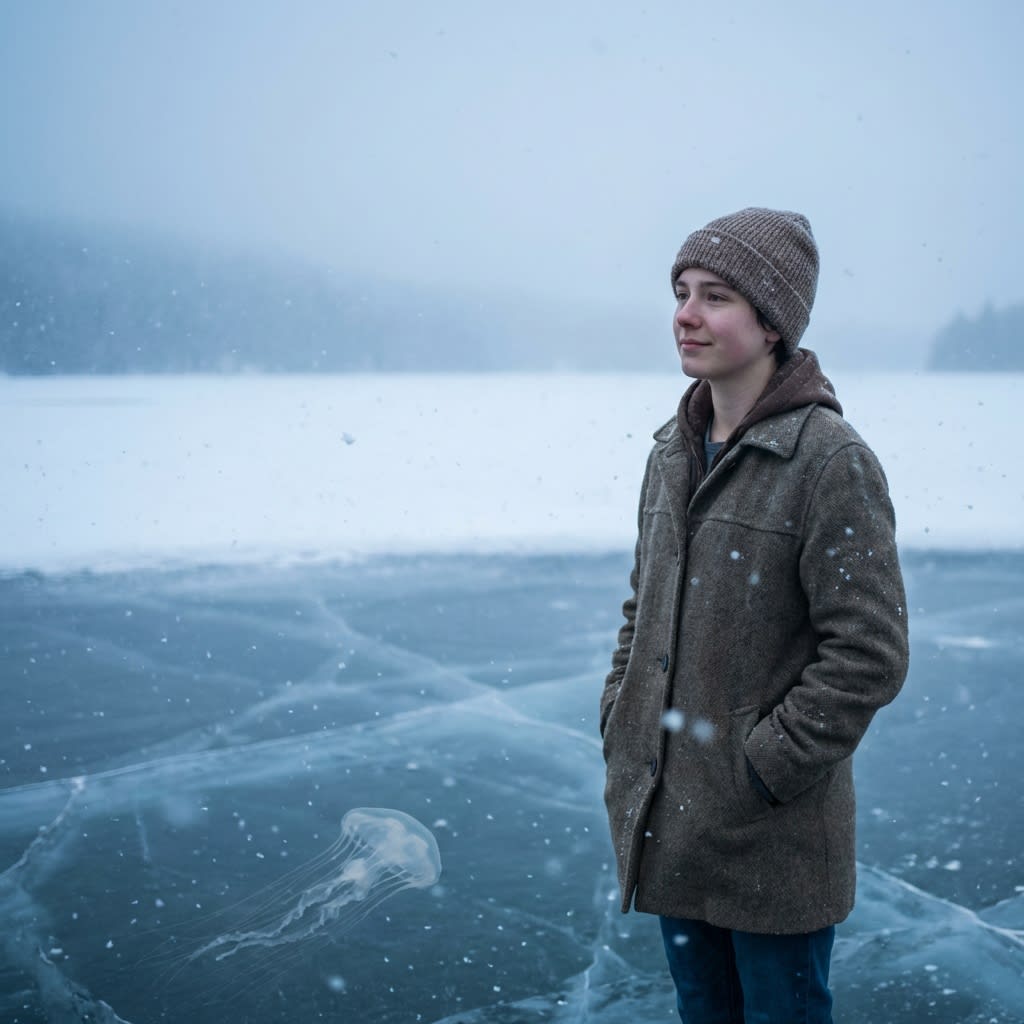
Halfway to my destination, I stopped by a small pond. Winter had frozen most of it, leaving only a thin layer of clear ice. Beneath the surface, something drifted slowly.
A jellyfish.
Its movement was gentle, effortless, almost careless. It wasn’t swimming forward or sinking down. It was just floating, letting the water decide where it should go.
I stood there longer than I should have.
Something about it felt familiar.
I thought about how often I felt the same way—moving without direction, surviving without support. Not strong enough to fight everything, not weak enough to give up.
Just… floating.
School was loud, but I felt distant from it. Sitting hurt. Standing hurt. Thinking hurt. My body carried pain while my mind carried questions I didn’t know how to ask.
The teacher spoke. I listened. I understood. But I didn’t raise my hand.
Silence had become safer than speaking. When you’ve learned that no one really listens, words start to feel unnecessary.
At lunch, everyone gathered in circles. I sat by the window, staring at the sky. I remembered being younger—when my mother used to walk me to school, holding my hand tightly like she was afraid the world might take me away.
Back then, the road felt shorter.
Back then, pain didn’t follow me everywhere.
Back then, I didn’t feel like I had to earn the right to exist.
Time changed things.
Responsibility arrived without permission. Expectations grew heavier. And somewhere along the way, I learned how to smile even when I was tired of pretending.
On the walk home, snow began to fall. Soft at first, then heavier. My foot had gone numb, but I kept going. Stopping felt dangerous. Like if I paused too long, I might never move again.
When I reached home, the silence greeted me once more.
I dropped my bag and sat on the floor. That’s when the tears came—not dramatic, not loud. Just quiet tears, like they had been waiting all day.
I didn’t fight them.
People think strength looks impressive. Loud. Confident. Unbreakable.
But sometimes strength is just endurance.
Showing up when no one notices.
Walking when every step hurts.
Floating when sinking would be easier.
The next morning, my foot still hurt.
But something inside me felt different.
I realized I wasn’t weak because things were hard. I wasn’t broken because I felt tired. I had been surviving without support, without comfort, without anyone asking the simplest question: Are you okay?
And yet, I was still here.
Later that day, someone finally noticed.
“You look exhausted,” they said.
Not judgmental. Just honest.
For once, I didn’t smile automatically.
“I am,” I replied.
The world didn’t fall apart. They didn’t walk away. They just nodded and listened.
It didn’t fix everything. It didn’t erase the pain. But it reminded me that being seen doesn’t require being loud—it requires being real.
I still have days when I feel like that jellyfish beneath the ice. Drifting. Quiet. Unnoticed.
But I’ve learned something important.
Floating isn’t failure.
Sometimes, floating is how you survive until you’re strong enough to swim again.
And maybe—for now—that’s enough.
About the Creator
Keep reading
More stories from Inayat khan and writers in Humans and other communities.
The Day ‘Stop’ Meant Nothing”
A quiet sign, a loud tragedy, and the cost of a world that won’t pause The stop sign had been there longer than anyone could remember. Its red paint had faded into a tired maroon, edges nicked and scarred by time, winters, and neglect. It stood at the corner like a patient elder, asking—politely, repeatedly—for the world to slow down. Most days, people barely noticed it. Cars rolled through the intersection without fully stopping, drivers glancing left and right just long enough to convince themselves it was safe to keep moving. Cyclists treated it like a suggestion. Walkers passed beneath it, trusting that someone else would obey. The sign did not shout. It did not move. It simply waited, believing in the rules it was made to represent. On the day everything changed, the sky was overcast—one of those gray mornings that feels unfinished, as if the sun forgot to show up. The air carried a cold stillness, the kind that makes sounds sharper and silences heavier. Snow threatened but didn’t fall. Life continued in its ordinary, careless rhythm. And then, somewhere beyond that quiet corner, violence arrived without asking for permission. There are moments in life when you realize how fragile the idea of “normal” really is. How quickly it dissolves. How easily it abandons us. That day, the word stop lost its power—not just on that sign, but everywhere. Gun violence does not announce itself. It doesn’t send warnings ahead of time. It doesn’t respect neighborhoods, routines, or innocence. It crashes into lives like an unwanted storm, leaving behind questions that never find answers. Afterward, people gathered near that intersection. Some stood silently. Others cried. A few argued—about causes, about laws, about what should have been done. The stop sign watched it all, unchanged, unmoved, still doing its job. Still asking the same thing it always had. Stop. But stopping is not something we are good at anymore. We rush through days like they owe us something. We scroll past suffering. We debate tragedies instead of mourning them. We turn real pain into statistics because numbers feel safer than names. Slower than grief is reflection, and reflection requires us to pause—something our world resists with impressive determination. The stop sign is a simple object, but it carries a complex promise: that if we all agree to pause, we can protect one another. That shared responsibility can reduce harm. That rules exist not to control us, but to keep us alive. Gun violence exposes how often we break that promise. After every incident, we hear the same phrases. Thoughts and prayers. This is complicated. Now is not the time. Each sentence is a way of rolling through the intersection without fully stopping. A way of acknowledging the sign without obeying it. Somewhere beneath the surface of all this noise, there are people trying to survive quietly. They don’t always protest. They don’t always speak. They float through the aftermath—traumatized, exhausted, invisible. Like something drifting beneath frozen water, their pain is easy to miss if you aren’t looking for it. Silent survival doesn’t make headlines. The survivors carry it with them to grocery stores, classrooms, and bedrooms where sleep comes reluctantly. They flinch at loud sounds. They measure exits when entering rooms. They learn to live with a background fear that never fully fades. And still, the world asks them to move on. The stop sign remains, doing what it has always done. It does not blame. It does not choose sides. It simply insists that some things require our full attention. That speed is not always strength. That hesitation can be an act of care. But caring takes effort. It requires us to sit with discomfort instead of rushing to conclusions. To listen without planning our rebuttals. To acknowledge that prevention is harder than reaction, and patience harder than outrage. In a culture addicted to momentum, stopping feels unnatural. We mistake motion for progress. We confuse volume with action. We demand quick fixes for slow-burning problems. Gun violence does not thrive in silence alone. It thrives in avoidance. Avoiding hard conversations. Avoiding responsibility. Avoiding the pause that might force us to change. The day “stop” meant nothing was not a single day. It was a culmination. A buildup of moments when we chose convenience over caution, speed over safety, certainty over compassion. That’s what makes the sign so haunting. It reminds us that the tools for prevention are often already in place—but they only work if we agree to honor them. You can repaint a stop sign. You can replace it. You can install brighter lights, louder warnings. But none of it matters if we don’t believe in the message behind it. Stop is not weakness. Stop is not surrender. Stop is not delay for the sake of delay. Stop is a decision. A decision to value life over haste. A decision to notice the people we usually overlook. A decision to treat prevention as seriously as punishment. Long after the crowd dispersed, the intersection returned to its routine. Cars passed. People walked. The sign stood quietly, holding its ground. It did not know about politics or policy. It did not understand arguments. It only understood its purpose. To protect. Maybe that’s what we’ve forgotten—not just how to stop, but why stopping matters. If we paused more often, we might see what’s drifting beneath the surface of our communities: grief waiting to be acknowledged, fear waiting to be eased, resilience waiting to be supported. If we stopped, even briefly, we might hear the quiet voices drowned out by louder ones. We might notice the warning signs before they become memorials. The stop sign will keep standing there, faithful and ignored, until we decide its message is worth following. The question isn’t whether the sign is clear enough. The question is whether we are willing to listen.
By Inayat khan10 days ago in Humans
The Angry Man in Your House
"If you grow up with an angry man in your house, there will always be an angry man in your house" This statement has caused plenty of controversy online, people say its a statement that blames victims while also undermining those who break traumatic cycles to form health relationships... but if I'm honest now that I'm in my 30s it makes more sense to me than ever, and I'd argue that its not just about fathers and uncles.
By S. A. Crawford4 days ago in Humans
Power of Silence
The room was loud, but what scared me most was the silence I was about to create. My phone buzzed again on the table, lighting up with a name I hadn’t saved but knew by heart. I watched it vibrate itself tired, then stop. I didn’t pick it up. For the first time in a long time, I let the silence win.
By John Smith2 days ago in Humans



Comments
There are no comments for this story
Be the first to respond and start the conversation.