
Because of the One-Armed Hockey Player
Souvenirs Become Art
BAM! I'm laying on the ice, looking up at the silver-filmed insulating panels on the ceiling of the hockey rink. Am I OK?
"Hey lady, are you OK?" A player swishes by me. Another stops, spraying ice into my face. I hate co-ed hockey, but earlier that evening I'd thought, "How bad can it be?"
"I'm fine. Thanks. I'll go sit on the bench for a minute." I eek through the rest of the session and limp on home. The next day I make an appointment with the chiropractor who also plays hockey in our smallish town on the Vermont-New Hampshire border.
"What happened?"
"This guy with one-arm took me out. Or he just skated by me real fast, and I fell down. I'm not sure."
After the doc quits laughing he says, "Yeah, that guy is tough. Don't let the lack of an arm fool you."
After a few crunches and pops, I walk out of his office into the bright afternoon. Glancing to my right, I see a small shop displaying colorful fabrics. I enjoyed sewing crafts as a kid, but all I've been doing for the last 20 years is clothing repair. The colors beckoned me.
Tentatively stepping into the quilt shop, I immediately fall in love with the craft. I must have fabric. But I must also have a reason to buy fabric. There are books. I buy a book. Books lead to tools, books and tools lead to fabric. Books, tools, and fabric lead to my first wall hanging, which is hideous.
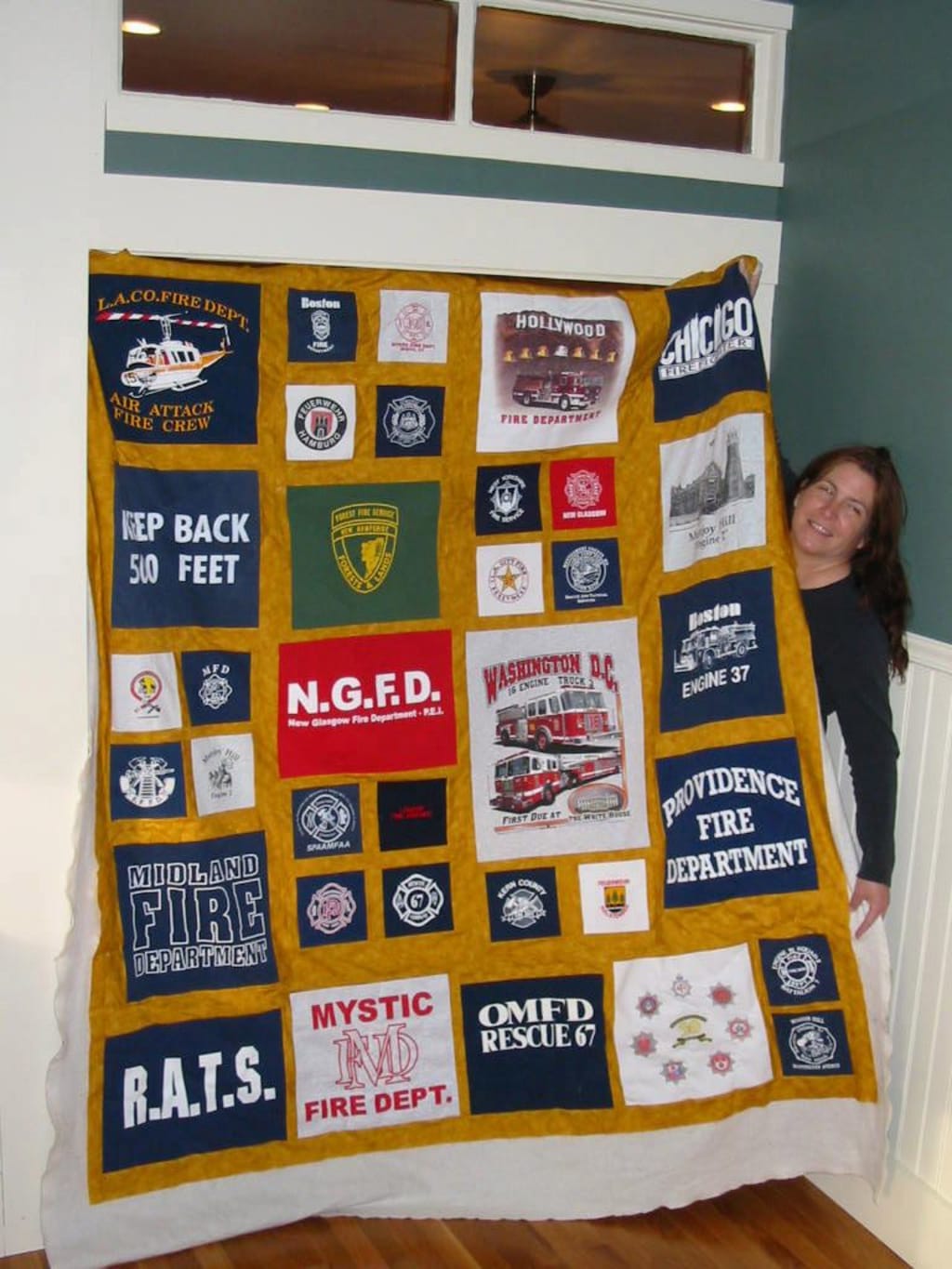
Around this time, I fall in love with a man who has sisters - five older sisters and a mother, who quilt. I'm in the fold. I go on vacation with my future in-laws on a family quilt retreat in Maine where I construct my first T-shirt quilt from cherished souvenirs that were passed on to my fiancée by the relative of a deceased firefighter.
Cutting into the T-shirts is nerve-wracking. I've never done this before. While I'm surrounded by expert quilters, none of them have created quilts from shirts before. They give me suggestions from their combined decades of experience, but they can't tell me exactly what to do.
Many T-shirt quilts I've seen have squares all cut the same size, regardless of the design. That's not the look I want. These designs should be respected, thoughtfully cut to bring out the look that was originally intended. I develop a plan and execute. Success! I was thrilled to present the stunning keepsake to Dave. A few years later, after we break up, he tries to give it back to me. No; the memories are not mine.
My success with the firefighter T-shirts quickly focuses my attention on a pile of motorcycle T-shirts that I no longer wear. And again, while the clothing is relegated to a closeted box, it's scary cutting into those treasured memories.
Having my stories bundled together and easy to see, especially those of my first solo cross-county motorcycle ride, brings me joy. I recall the conversations with other riders who were once strangers on the road and are now friends. I can feel the cold of that rainy night I was camping in my tiny tent or relive the awe felt in the spectacular views in Arches, Yellowstone, and Rocky Mountain National Parks. Even the smell of balsam fir on a back road in Maine is revisited with a look at a square on my quilt.
More quilts lead to more ideas. I start sprinkling traditional quilt blocks in with my T-shirt squares. I put my quilts on Etsy for sale, only to hear from the Harley-Davidson Motor Company itself that not only is it illegal to sell T-shirt quilts with their designs, but I cannot cut up their licensed products and do anything with them other than their original use. Oops!
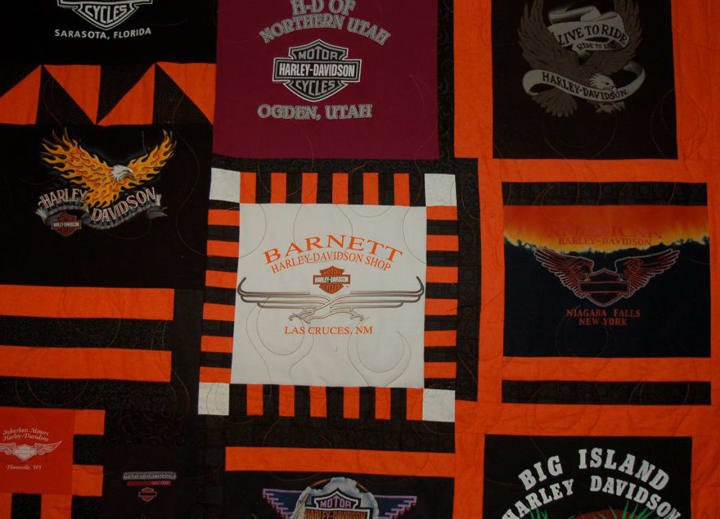
I continue to make T-shirt quilts, eventually taking the step to eliminate fabric between squares and creating a technique to put varied sizes together in what appears to be a random pattern. People want my quilts, but my prices are high. I understand that what I ask is a lot, so I create an online class to help people make their own.
A close friend's husband dies in a car accident on Christmas day and leaves behind three children. I offer to make quilts for the kids, and she delivers the shirts. For some reason, I don't move quickly. The tragedy of the situation is more than sudden death. She doesn't push for completion, and I drag my feet. Five years later I dig the bags of T-shirts out and start cutting. He played softball, loved tattoos, and attended motorcycle events. I recall some of the events as I snip and sew. By this time, her son is in the Army, and her oldest daughter has been accepted into the Air Force Academy. Jacey wants to be an astronaut. I'm so proud of how this family has pulled through their darkest time and is stronger than anyone could have dreamed. COVID had eliminated most social gatherings, but I manage to deliver the quilts with air hugs. I'm honored that these young adults, who have risen above their trauma and are now serving our nation, are cherishing the quilts that I created for them.
I swear off T-shirt quilts. I have countless unfinished quilting projects and am ready to use my quilting creativity in other ways. Then a fellow riding friend is plowed into by a truck that crossed the center line during a long distance motorcycle event. Rob is critically injured and close to death. I contact others in the group who participate in this event and ask for T-shirt donations. Shirts come in, and once again I'm in my element chopping up perfectly good shirts into little pieces so they can come together in a piece of art.
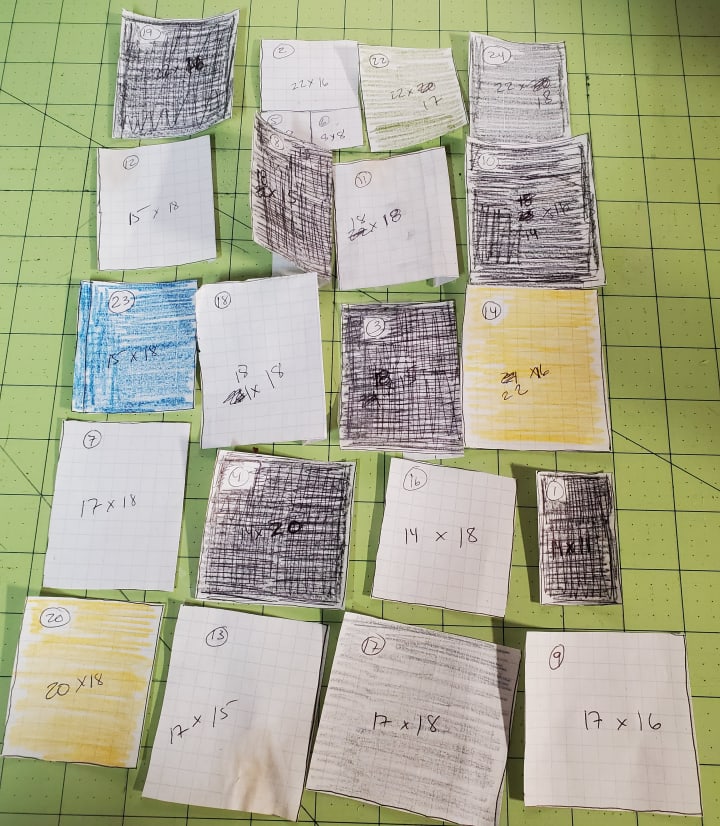
I develop a new technique for planning the quilts to eliminate waste of both time and materials. I do the initial cut as large as the T-shirt will allow. I take maximum and minimum measurements and write those down along with a short description of the shirt. I draw squares of relative sizes on graph paper and color them in to match the shirt. Then using scissors (that are not my fabric scissors!!!), I cut out the squares and assemble a mock-up of the quilt, determining precise T-shirt panel sizes. I am then able to make smaller cuts on the shirts with the rotary blade before applying the interfacing. Not only does this save on the cost of materials, but I can determine size and placement of the squares without having to throw everything on the floor.
Rob makes it through multiple surgeries, and the quilt is raffled to help pay for medical expenses. Looking at that quilt reminds me of my Hoka Hey Motorcycle Challenge brothers and sisters who came together in Rob's time of need.
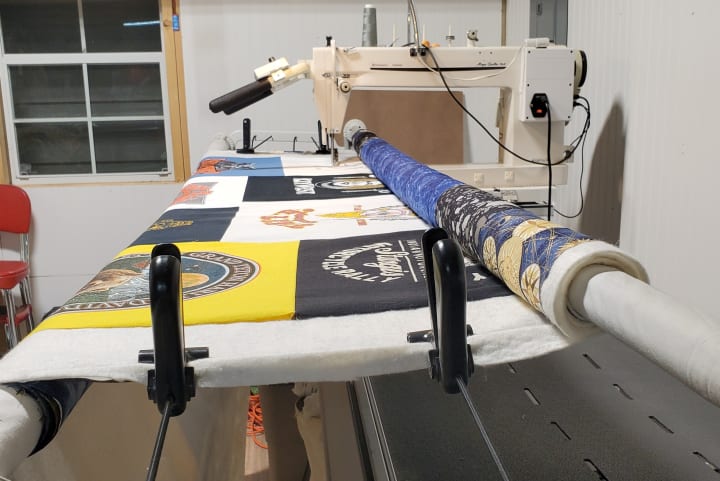
At the same time I am stitching the Hoka Hey quilt, my husband's 35th Annual Toy Run approaches. For decades he's organized bikers on the first Sunday of December to gather toys and raise money for the Salvation Army. We typically gather donated items for a silent auction, but in the middle of COVID restrictions, we get creative with an outdoor, social distancing fund raiser. I dig out T-shirts from previous toy runs along with other motorcycle-themed shirts and once again start cutting and sewing to assemble another quilt. The day is gorgeous, and more riders than ever come out for the event. Instead of the $400 or $500 we typically raise in the silent auction, the quilt raffle, along with other donations, raises $4,000!
People give me more shirts in case I need them for another quilt. Once again, I've put T-shirt quilts on hold while I catch up on some unfinished projects and work on a Quilt of Valor to be donated to a Veteran. I am not announcing my retirement from T-shirt quilts as I did the last time; decades of love and skills will be available when needed - all because of the one-armed hockey player.
About the Creator
Keep reading
More stories from writers in Journal and other communities.
How to Open a Methadone Clinic and Use Technology to Improve Patient Outcomes
Introduction to Methadone Clinics and Their Public Health Significance Methadone clinics occupy a critical locus within the continuum of addiction treatment services. They provide medication-assisted treatment (MAT) for individuals struggling with opioid use disorder (OUD), a condition marked by neurochemical dependency and behavioral dysregulation. Methadone, a long-acting opioid agonist, mitigates withdrawal symptoms and attenuates cravings without producing the euphoric volatility associated with short-acting opioids.
By Fida Hassainabout 16 hours ago in Journal




Comments
There are no comments for this story
Be the first to respond and start the conversation.