
Behaviour Driven Testing Explained: Benefits, Process & Tools
Introduction to Behaviour Driven Testing (BDT)


Getting software development right goes far beyond writing good code. It involves understanding user behaviours, aligning teams, and delivering seamless functionality. This is where Behaviour Driven Testing (BDT) becomes a crucial methodology, ensuring that everyone contributing to a software project speaks the same language and works towards meeting user needs.
But what exactly is BDT? Simply put, Behaviour Driven Testing is an extension of Test Driven Development (TDD), focusing specifically on user behaviour and experience. It fosters collaboration by using common, non-technical language to define software behaviour, ensuring clarity across developers, QA engineers, and stakeholders.
This blog will walk you through everything you need to know about BDT, including its benefits, process, commonly used tools, implementation strategies, and its comparison with Test Driven Development (TDD). By the end, you'll also have actionable steps to integrate BDT into your workflow successfully.
Core Benefits of Behaviour Driven Testing
Why should teams adopt BDT over other testing methodologies? Here are the top benefits that make it stand out:
1. Enhanced Collaboration Across Teams
BDT fosters a shared understanding of requirements between developers, QA engineers, and business stakeholders. By using plain, non-technical language, it breaks down communication barriers, enabling all parties to stay aligned and work cohesively.
2. Improved Test Coverage with User-Centric Focus
Instead of solely focusing on technical aspects, BDT prioritises real-world user behaviour. This allows teams to create scenarios that represent end-user interactions more effectively, ensuring better coverage and intuitive testing.
3. Code Clarity and Maintainability
By mapping tests directly to user stories, BDT simplifies how the code relates to associated behaviours. This makes it easier to review, maintain, or update code without confusion.
4. Eliminates Ambiguity
Concrete examples and scenarios in BDT help clarify vague requirements. Teams know precisely what needs to be built, tested, and delivered, leaving no room for misinterpretation.
5. Automates Testing for Efficiency
BDT seamlessly integrates with BDD automated testing frameworks, enabling more efficient automated test execution. Teams can save time, reduce repetitive work, and increase testing accuracy.
The BDT Process and Lifecycle
Implementing Behaviour Driven Testing involves several structured phases. Here's a typical BDT lifecycle in action:
Phase 1: Requirement Gathering
Collaborate with stakeholders to gather initial requirements and user stories. Translate these into behaviour scenarios using plain, precise language.
Phase 2: Define Scenarios in Gherkin Format
Create behaviour scenarios using Gherkin syntax (Given-When-Then). For example:
- Given: A user is logged in
- When: They click “Add to Basket”
- Then: The item should appear in their basket
Phase 3: Implement Step Definitions
Developers write code to map the Gherkin scenarios to specific application functions. This bridges scenarios to actual testing.
Phase 4: Run Automated Tests
Execute your automated tests, track outcomes, and fix failures as they occur.
Phase 5: Evaluate and Refine
Review results with the team, refine scenarios where necessary, and continuously improve your testing processes.
Tools Commonly Used in Behaviour Driven Testing
To ensure an effective BDT workflow, you’ll require reliable tools. Below are some of the most widely used ones, broken down by their functionality:
1. Cucumber
Cucumber is one of the most popular BDT frameworks. It supports Gherkin syntax for writing test scenarios and integrates seamlessly with test automation tools for smooth execution.
2. SpecFlow
Specifically designed for .NET applications, SpecFlow allows teams to write scenarios in Gherkin and run them within the Microsoft ecosystem.
3. Behave
Behave is the go-to choice for Python developers. It provides an intuitive way to implement behaviour scenarios in Python-based projects.
4. JBehave
For Java-based applications, JBehave stands out as a powerful and flexible BDT framework designed to handle complex projects.
5. Gauge
Gauge expands on BDT principles by offering features such as reusable specifications and robust reporting tools for continuous improvement.
Implementing BDT Successfully
Applying BDT effectively in your software development lifecycle requires careful planning and execution. Here’s how to get it right:
Educate Your Team
Training your team on the basics of Gherkin syntax and BDT workflows is essential. Clear understanding across developers, QA engineers, and stakeholders ensures alignment.
Start Small
Begin with smaller, simpler functionalities to test how well your team adapts to the methodology and workflows before scaling.
Pair BDT with Automation
Leverage BDD automated testing frameworks (like Cucumber or Behave) to automate repetitive tasks, ensuring long-term efficiency gains.
Continuous Feedback
BDT relies heavily on collaboration, so facilitate regular feedback sessions to refine scenarios and workflows as your project evolves.
BDT vs Test Driven Development (TDD)
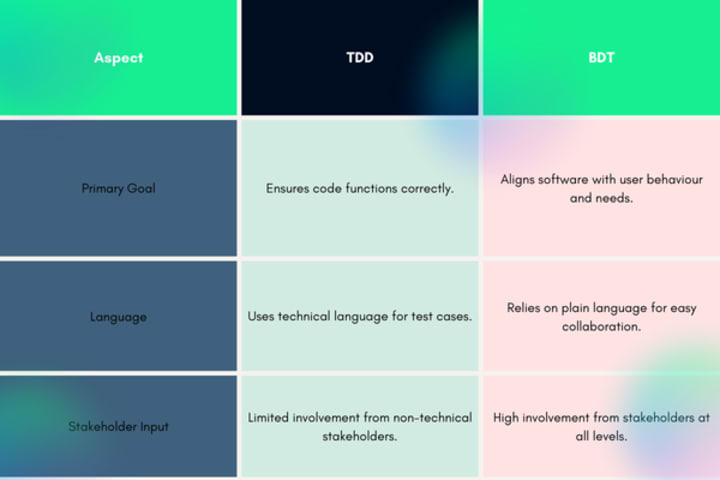
While both Behaviour Driven Testing and Test Driven Development aim to improve the quality of software, they differ in focus and application.
Common Challenges of BDT
Despite its many advantages, BDT isn’t without its challenges. These include:
Time-Consuming Setup
BDT involves significant initial investment in training and creating behaviour scenarios.
- Difficulty in Writing Scenarios
Crafting clear, concise, and non-redundant scenarios requires practice and collaboration.
- Overhead of Automating Every Scenario
Automation tools can streamline testing, but automating all behaviours reflects diminishing returns in certain cases.
- Resistance to New Process
Not all teams adapt easily to major changes like BDT. Internal resistance or lack of buy-in could hinder implementation success.
Redefine Software Quality with Behaviour Driven Testing
Behaviour Driven Testing transforms how teams approach software development. By focusing on user behaviours, creating collaboration opportunities, and leveraging BDD automated testing, it sets the stage for stronger, more user-centric applications.
Are you ready to bring clarity, collaboration, and efficiency to your testing process? Start leveraging Behaviour Driven Testing today for scalable and impactful results!
Further Reading and Resources
- [Gherkin Scenario Writing Basics]
- [Introduction to Cucumber for BDT]
- [How to Automate BDD Tests in 5 Simple Steps]
About the Creator
Leeanna marshall
Hello, I'm Leeanna Marshall, an ardent enthusiast of all things automation and a passionate blogger. visit my blog
Keep reading
More stories from Leeanna marshall and writers in Journal and other communities.
Why Businesses Should Prioritize Automated Accessibility Testing in 2025
Creating an inclusive digital experience is no longer optional—it’s a necessity. As technology advances, businesses must ensure their digital platforms are accessible to all users, including those with disabilities. Automated accessibility testing plays a crucial role in achieving this goal efficiently. With the rise of accessibility regulations and growing user expectations, companies that neglect accessibility risk legal repercussions and brand reputation damage.
By Leeanna marshall11 months ago in Journal
Iran–US Nuclear Talks in Geneva End Quickly, but Tensions Remain High
The second round of nuclear talks between Iran and the United States ended in Geneva after only four hours, showing both the urgency of the situation and the deep disagreements that still divide the two sides. Geneva hosted the indirect negotiations, which were mediated by Oman and focused on Iran’s nuclear program and the future of sanctions.
By dua fatimaabout 4 hours ago in Journal
Valentine's Dates Over the Years
Colin grinned as Brooklyn slipped into the living room. “Is it all set?” he asked. The twenty-one year old grinned. She was in her last year of college and Colin knew that Lincoln was proud of her. Although she had been away at college, she’d eagerly helped Colin plan his surprise for Lincoln. “I’m so glad you’re finally doing this,” she said.
By Reb Kreyling5 days ago in Chapters




Comments
There are no comments for this story
Be the first to respond and start the conversation.